
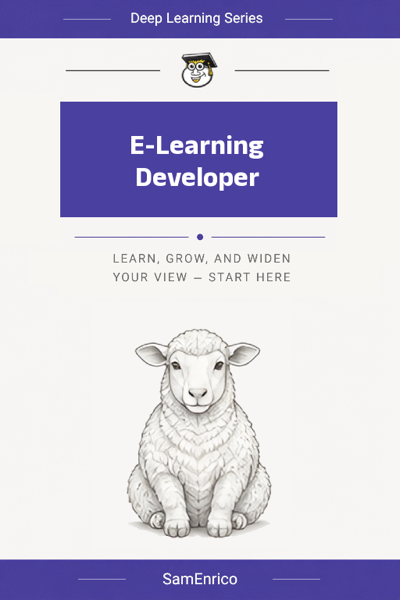
Non-FictionInformativeEducational
E-Learning Developer eBook
A Coursebook on E-Learning Developer
A Coursebook on E-Learning Developer
Formats
Free sample
Chapter 1: The Accidental Architect–- You did not plan to be here. Let that sink in for a moment, because it is the single most important truth about the e Learning development profession. You likely stumbled into this field through a side door—maybe you were a teacher who got tapped to digitize curriculum during the pandemic, a graphic designer whose clients started asking for “clickable training modules,” a tech support specialist who was the only person in the building who could figure out why the SCORM package wouldn’t upload, or an HR coordinator who inherited a decaying library of CD-ROM training materials. Whatever your origin story, you are not alone. The vast majority of working e Learning developers did not earn a degree in “e Learning development” because such degrees barely exist.
They arrived accidentally, and that accident has become the single greatest strength of the profession.This chapter is your formal onboarding to a career you may have already been living without a map. We will dismantle the confusion between overlapping roles, name the tools and standards you need to know, chart the “accidental” career path as a feature not a bug, and finally lay out the development lifecycle that will structure everything else in this book. By the end, you will know exactly where you fit in the e Learning ecosystem—and more importantly, you will stop apologizing for how you got here.The Three-Hat Problem: Why One Person Does Three Jobs Walk into any corporate learning and development department and ask three different people to define “e Learning Developer.” You will get four different answers. The confusion is not accidental; it is structural. The field emerged at the intersection of three established professions, and most organizations never bothered to build clean walls between them.The Instructional Designer (ID) focuses on learning strategy.
The ID asks: What does the learner need to be able to do after this course that they cannot do now? What is the underlying performance problem? What evidence-based methods will close the gap? The ID writes learning objectives, scripts scenarios, plans assessments, and sequences content. They care about cognitive load, motivation, and transfer of learning to the job.
The ID might never open an authoring tool.The Graphic Designer focuses on visual communication. The Graphic Designer asks: Does this layout guide the eye to what matters? Do the colors create the right emotional response without violating accessibility standards? Is the typography readable at different screen sizes? Does the visual hierarchy support the learning objectives or fight against them?
The Graphic Designer produces style guides, templates, and assets. They care about contrast, alignment, proximity, and repetition. The Graphic Designer might never write a line of instructional text.The e Learning Developer builds the functional course using authoring tools and, increasingly, code. The Developer asks: How do I make the ID’s branching scenario actually work in Storyline? How do I ensure the Graphic Designer’s perfect layout renders correctly on an i Phone and a desktop and a tablet?
How do I package this so the LMS knows when the learner has completed it? How do I troubleshoot when the score doesn’t report? The Developer lives in the messiness of triggers, layers, states, variables, SCORM, x API, and the eternal question: “Why did it work in preview but break in the LMS?”Here is the reality that most job descriptions hide: in the majority of organizations, especially small to mid-sized ones, the e Learning Developer wears all three hats. You will be expected to analyze the problem, design the solution, lay out the screens, write the text, record the audio, build the interactions, publish to the LMS, and then prove that it worked. This book trains you as a “full-stack” learning developer precisely because that is what the market demands.If you are fortunate enough to work on a large team with dedicated instructional designers and graphic designers, you may choose to skip Chapters 2 through 6 of this book, which cover strategy, analysis, writing, visual design, and interactivity planning.
But keep this warning in mind: even on large teams, the developer who understands why a learning objective is written a certain way builds better courses than the developer who simply implements someone else’s specification. The chapters you skip today may be the chapters that save your career tomorrow.The Accidental Career Path: Your Messy Origin Story Is an Asset Let us name the elephant in the room. You are reading this book because you need to learn skills you were never formally taught. That feels like a disadvantage. It is not.The e Learning development profession has no established pipeline.
University programs in instructional technology exist, but they tend to focus on theory rather than production. Bootcamps and certificates exist, but they teach tools rather than the underlying craft. The result is that the field is filled with people who arrived from:K-12 or higher education – Teachers who discovered that classroom management skills translate surprisingly well to learner engagement strategies, and who learned to build digital content because their schools went remote.Human resources or training coordination – HR professionals who inherited a library of outdated training materials and taught themselves to modernize them because the budget didn’t exist to hire an agency.Tech support or IT – Technical professionals who were the only people in the building comfortable with software, and who gradually migrated from fixing computers to building training for them.Graphic or web design – Designers who got asked to “make it interactive” and discovered that slicing PSD files was no longer enough.Corporate communications or marketing – Writers who learned to write for conversion and discovered that writing for learning requires a different—but related—skill set.Military or government training – Professionals who came up through structured, compliance-heavy training environments and learned rigor that civilian counterparts often lack.No prior career at all – Recent graduates who fell into an e Learning developer role because it was the only job that would hire them, and who are learning on the fly.Every single one of these origin stories brings a superpower. The former teacher understands how to read a room and adjust pacing. The former HR professional understands stakeholder management and compliance.
The former tech support specialist can debug anything. The former designer has an eye for layout. The former writer can craft a sentence that does not bore. The former military trainer understands the stakes of getting it wrong. The recent graduate has no bad habits to unlearn.Your messy origin story is not a gap in your resume.
It is the raw material of your expertise. The only thing you lack is a common framework. That is what this book provides.The Tool Ecosystem: What You Actually Need to Learn First Walk into any e Learning developer’s office and you will see a desktop cluttered with icons for a dozen different applications. The beginner looks at this and panics. The professional knows that only three or four tools do the heavy lifting; the rest are specialists called in for specific plays.Let us separate the essential from the nice-to-have.The Authoring Tools (The Core Four)These are the tools where you actually build courses.…
This is the end of the free sample. Get the eBook to keep going. Buy now
About this book
Details
- Author
- Colburn Collen
- Publisher
- SamEnrico
- Language
- English
- Genre
- Non-Fiction, Informative, Educational
- Released
- 2026-06-02
- Pages (approx.)
- 147
- Available as
- eBook, Audiobook

Read better in the ZLOADR app
Your eBooks on your phone or tablet. Sign in with your SamEnrico account and start reading.
More by Colburn Collen
 Parental Anger And Teen DefianceColburn Collen$11.99
 First Lady Fashion Influence GuideColburn Collen$11.99
 Remote Communication Anxiety GuideColburn Collen$11.99
 Trauma and Sex AddictionColburn Collen$11.99
 Self Hypnosis Morning Ritual GuideColburn Collen$11.99
 The Bridge That Defied the Ganges: How J.N. Gupta Built India's First Steel Cantilever BridgeColburn Collen$11.99
 Black Box Blues: The Mystery of Flight 447Colburn Collen$11.99
 How to Become a Jewel StringerColburn Collen$11.99
 Form 990EZ Filing GuideColburn Collen$12.99
 Healthcare Marketing PlanColburn Collen$12.99
 Understanding Dandy–walker Syndrome Recessive FormColburn Collen$17.99
You may also like
 Hong Kong Handover 1997Dunn Johnnie$11.99
 Zumba For Postnatal Recovery CourseNeal Christian$11.99
 Zumba for BeginnersLadner Nikia$11.99
 YouTube Comment Mining GuideHumes Pandora$12.99
 Worry Box MeditationCarlin Rudy$11.99
 Workplace Stress MeditationNguyen Lynn$11.99
 Workplace Stress and Sleep RepairHawley Ivory$11.99
 Workplace Perfectionism CureDelaney Jeffry$11.99
 Workplace Injustice Anger GuideWallen Isabelle$11.99
 Work Addiction and Burnout LinkGreenwood Ester$11.99
 Women in Yoga and WellnessBeattie Galina$11.99
 Women in Stand Up ComedyChun Evangeline$11.99