
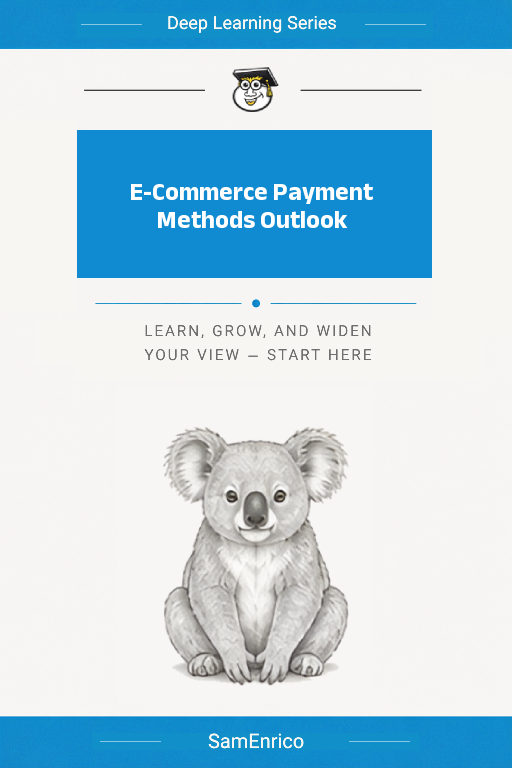
Non-FictionForecast & OutlookPayment Tech
E-Commerce Payment Methods Outlook eBook
Project BNPL adoption, digital wallet share, crypt
by Schuster Chi
Project BNPL adoption, digital wallet share, cryptocurrency payments, and buy now pay later regulation across global markets.
Formats
Free sample
Chapter 1: The Great Decoupling--It begins not with a crash, not with a regulatory edict, and not with a press release from a fintech unicorn. It begins with a 22-year-old named Maya, standing in a grocery store aisle in Manchester, England, staring at her phone. The total on the screen is £47.32. In her hand is a credit card with a £5,000 limit, untouched for eleven months. She does not use it.
Instead, she opens Klarna, taps "Pay in 3," and walks out with her shopping bags. The credit card remains in her wallet, a relic of a financial system she has inherited but refuses to operate.Maya is not an anomaly. She is not a tech early adopter, a cryptocurrency enthusiast, or a personal finance guru. She is an average consumer, employed at a marketing agency, with no particular animosity toward banks. And yet, like 47 percent of her peers in the United States and a growing plurality across the United Kingdom and Europe, she has permanently abandoned traditional revolving credit for flexible, point-of-sale financing.
She cannot articulate why, exactly, except to say that credit cards feel "slippery" and BNPL feels "transparent." She knows exactly how much she owes and exactly when she will pay it. The credit card, by contrast, feels like a trap she has been told to walk into her entire life.This chapter is about Maya and the millions of consumers like her. It is about the quiet, unannounced divorce between an entire generation and the financial product that has dominated e-commerce for half a century. And it is about what merchants, payment providers, and investors must understand about this shift before they can possibly navigate the landscape mapped out in the rest of this book.The term for this rupture is the Great Decoupling. It describes the structural separation of consumer spending from traditional banking rails, accelerated by the pandemic, the cost-of-living crisis, and the maturation of fintech alternatives that actually work better.
This chapter will dissect the psychology, the data, and the strategic implications of this decoupling. By the end, you will understand why 46 to 47 percent of digital natives in the United States have cut up their credit cards, why the rest are likely to follow, and what the first major credit card issuer will do in response before the end of 2026.The Psychological Contract Is Broken To understand why credit cards are losing, one must first understand what they once promised. For most of the post-war period, the psychological contract between consumer and credit card issuer was simple: you pay interest for the privilege of deferring payment, and in return, you receive convenience, purchase protection, and the ability to smooth consumption across income shocks. The contract had friction, yes, but it was understood. You swiped, you owed, you paid, you repeated.That contract has been broken for younger consumers, not because the terms changed but because the context did.
The 2008 financial crisis, which occurred when Gen Z was in elementary school and Millennials were graduating into a collapsed labor market, taught an entire cohort that debt is not a tool but a weapon. The 2020-2024 BNPL boom taught the same cohort that there is an alternative: interest-free credit with fixed terms, no compounding, and no surprises. And the 2021-2025 inflation shock taught consumers that traditional credit cards, with their variable interest rates now approaching 22-28 percent APR, are a terrible way to finance everyday purchases.Consider the mathematics. A consumer who puts a £100 purchase on a credit card at 24 percent APR and makes only the minimum payment will take more than two years to pay off the debt, accruing over £30 in interest. The same consumer using Klarna Pay in 3 pays £33.33 three times and owes exactly nothing after sixty days.
The difference is not marginal; it is transformative. Young consumers have done the math, and the math says credit cards are predatory.But the math is only half the story. The other half is psychological. Credit cards are designed to obscure the true cost of debt through complex billing cycles, deferred interest offers, and minimum payment structures that stretch repayment indefinitely. BNPL products, by contrast, offer what behavioral economists call "mental accounting clarity." The consumer knows exactly what they owe and exactly when it is due.
There is no ambiguity, no compounding, no shame spiral. This clarity is not an accident; it is a deliberate design choice by BNPL providers who understood that transparency is a competitive weapon against opaque incumbents.The Instrument of Convenience Here is the paradox that will define the next five years: credit cards are not going away, but their role is shrinking to a specific, narrow use case. The concept that captures this is the "instrument of convenience."An instrument of convenience is a payment method consumers use not because they prefer it but because the context requires it. Credit cards remain essential for booking hotels, renting cars, and making deposits for services where a hold on funds is necessary. These use cases persist because the infrastructure is already built—hotel booking engines are not rewriting their deposit logic for BNPL, and rental car companies are not accepting Klarna for security deposits.
But for daily e-commerce—groceries, clothing, household goods, electronics, subscription services—credit cards are becoming a last resort.The data support this narrowing. In a 2025 survey of US consumers aged 18-34, only 22 percent reported using a credit card for an online clothing purchase in the previous thirty days. For groceries, the figure was 18 percent. For electronics, 31 percent, driven largely by the purchase protection benefits credit cards offer on expensive items. Meanwhile, 64 percent of the same cohort reported using a debit card or BNPL for routine e-commerce purchases, with BNPL capturing the majority of transactions between 50and50 and 50and500.This is the decoupling: credit cards are retreating to the edges of e-commerce while BNPL and digital wallets capture the center.
Merchants who design their checkout experience around credit cards are optimizing for a shrinking demographic. Merchants who design around BNPL and wallets are optimizing for the future.The 47 Percent: A Data Portrait The most frequently cited statistic in this book appears here: 46 to 47 percent of US digital natives have abandoned traditional revolving credit for flexible point-of-sale financing. This figure comes from a synthesis of three major studies: a 2025 Federal Reserve Bank of New York consumer credit survey, a 2025 PYMNTS.com BNPL adoption report, and proprietary transaction data from a major payment orchestration platform. The range accounts for methodological differences between the studies, but the direction is unambiguous: nearly half of young Americans have effectively exited the revolving credit market.But the aggregate figure conceals important variation. Among consumers aged 18-24, the abandonment rate is 54 percent.
Among those aged 25-34, it is 42 percent. The older cohort has more established credit histories, higher credit limits, and more experience managing revolving debt, which makes them slightly more likely to retain a credit card for specific use cases. However, even among the older cohort, the trend is toward reduced usage: the median credit card transaction value for 25-34 year olds fell from 87in2021to87 in 2021 to 87in2021to52 in 2025, suggesting that cards are being used for smaller, more incidental purchases while BNPL captures larger, planned…
This is the end of the free sample. Get the eBook to keep going. Buy now
About this book
Details
- Author
- Schuster Chi
- Publisher
- SamEnrico
- Language
- English
- Genre
- Non-Fiction, Forecast & Outlook, Payment Tech
- Released
- 2026-06-01
- Pages (approx.)
- 147
- Available as
- eBook, Audiobook

Read better in the ZLOADR app
Your eBooks on your phone or tablet. Sign in with your SamEnrico account and start reading.
More by Schuster Chi
 Legacy Research GuideSchuster Chi$11.99
 Self Esteem And Conflict ResolutionSchuster Chi$11.99
 Mobile Gaming Addiction CureSchuster Chi$11.99
 MBSR for Teenagers GuideSchuster Chi$11.99
 Black Gold & Broken Promises: The Rise and Fall of the Texas Tea PartySchuster Chi$11.99
 Whispers in the Wreckage: The Last Broadcast of the MV DerbyshireSchuster Chi$11.99
 How to Become a SecondSchuster Chi$11.99
 Microsoft Exchange EngineerSchuster Chi$11.99
 Understanding HemoglobinuriaSchuster Chi$17.99
You may also like
 Hong Kong Handover 1997Dunn Johnnie$11.99
 Zumba For Postnatal Recovery CourseNeal Christian$11.99
 Zumba for BeginnersLadner Nikia$11.99
 YouTube Comment Mining GuideHumes Pandora$12.99
 Worry Box MeditationCarlin Rudy$11.99
 Workplace Stress MeditationNguyen Lynn$11.99
 Workplace Stress and Sleep RepairHawley Ivory$11.99
 Workplace Perfectionism CureDelaney Jeffry$11.99
 Workplace Injustice Anger GuideWallen Isabelle$11.99
 Work Addiction and Burnout LinkGreenwood Ester$11.99
 Women in Yoga and WellnessBeattie Galina$11.99
 Women in Stand Up ComedyChun Evangeline$11.99