
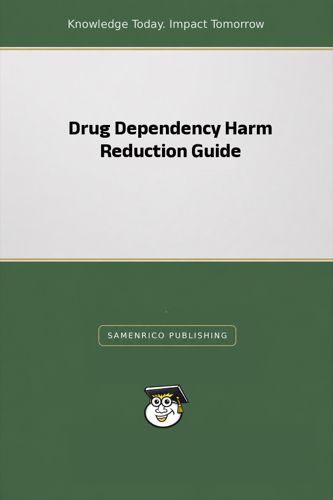
Non-FictionSelf-HelpHarm Reduction
Drug Dependency Harm Reduction Guide eBook
Use safer use strategies, fentanyl testing, and ne
by Rowell Olen
Use safer use strategies, fentanyl testing, and needle exchange while working toward abstinence.
Formats
Free sample
Chapter 1: Beyond the Lie...--–- The first time someone told you to "just stop," they probably meant well. They might have been a parent, a partner, a counselor, or a friend who had never felt their own brain scream for a chemical the way a starving person screams for food. They looked at your life—the missed appointments, the strained relationships, the money that evaporated—and saw a simple problem requiring a simple solution. Stop using. Get clean.
Choose differently. And when you couldn't, they concluded something about your character. You weren't trying hard enough. You didn't want it badly enough. You were weak where others were strong.
That conclusion, repeated often enough by enough people, becomes a story you start to believe about yourself. This book begins by telling you that story is a lie.The lie has two parts. The first part is that abstinence is the only legitimate goal. The second part is that any movement toward abstinence must begin with immediate, total cessation of all drug use. Both parts are demonstrably false, and more importantly, both parts kill people.
The data is unforgiving: over 100,000 drug overdose deaths in the United States in a single recent year. Behind each number is a person who was told, at some point, that the only acceptable path was to stop everything at once. Many of them tried. Most of them failed. Some of them died trying, not because they lacked willpower, but because they lacked the incremental safety measures that could have kept them alive long enough to eventually succeed.This is a book about staying alive.
Not about purity. Not about perfection. Not about meeting someone else's definition of recovery. About staying alive long enough to make whatever changes you want to make, on whatever timeline actually works for your brain and your body. If you want to quit someday, these pages will help you get there.
If you never want to quit, these pages will help you stay alive anyway. Both paths are valid because both paths share a single prerequisite: a beating heart.The approach outlined in this chapter and carried through the entire book is called harm reduction. Before going further, it is essential to understand what harm reduction actually is—and what it is not—because the term has been deliberately misrepresented by people who have never had to make the choices you make every day.What Harm Reduction Is Not Harm reduction is not pro-drug. No credible harm reduction organization has ever advocated for drug use as a positive good. What harm reduction advocates for is the recognition that drug use exists, has always existed, and will continue to exist, and that acting as if prohibition will erase that reality has cost millions of lives.
The War on Drugs, launched with genuine concern about addiction but implemented through policing and incarceration, has been a catastrophic failure by every measurable metric. Drug overdose deaths have risen steadily for decades. Prisons are filled with people whose primary crime was possessing a substance. And the stigma generated by this approach has driven people who use drugs underground, away from medical care, away from family, and into isolation—the single greatest predictor of fatal overdose.Harm reduction is not a surrender to addiction. It is a strategic recognition that people are more likely to make lasting changes when they are alive, housed, and connected to others than when they are dead, homeless, or alone.
A person who uses fentanyl today and survives because they used a test strip is a person who can choose to seek treatment tomorrow. A person who dies from an overdose because they were too ashamed to carry Narcan has no tomorrow. Harm reduction prioritizes the existence of tomorrow over the purity of today.Harm reduction is not a rejection of abstinence. Most harm reduction organizations explicitly support abstinence as one legitimate goal among many. What they reject is the demand that abstinence be the only legitimate goal, and that any deviation from total cessation constitutes failure.
This all-or-nothing framework has a name in clinical literature: abstinence-only mandate. And it has a known outcome: increased mortality. People who are told they must stop everything immediately and who cannot do so often feel such profound shame that they stop seeking any help at all. They disappear from clinics, from exchanges, from support groups. They use alone.
They die alone.Harm reduction is not complicated. It is a set of practical strategies that reduce the negative consequences of drug use without requiring the user to stop using. That is the entire definition. Seatbelts are harm reduction. They do not prevent car crashes, but they dramatically reduce the likelihood that a crash will kill you.
Condoms are harm reduction. They do not prevent sex, but they dramatically reduce the transmission of HIV and other infections. Needle exchanges, fentanyl test strips, and overdose reversal medications are harm reduction. They do not prevent drug use, but they dramatically reduce the likelihood that drug use will end a life.The War on Drugs Versus the Public Health Model To understand why harm reduction is necessary, it helps to understand the two competing frameworks for addressing drug use. The first is the criminal justice model, often called the War on Drugs.
The second is the public health model.The criminal justice model operates on a simple theory: if you make drugs illegal, punish people who use them harshly enough, and create sufficient fear of consequences, people will stop using. This theory has been tested for over fifty years at enormous cost—trillions of dollars, millions of arrests, entire communities destabilized by mass incarceration. The results are in. The theory failed. Portugal decriminalized all drugs in 2001, treating possession as a public health issue rather than a criminal one.
Overdose deaths plummeted. HIV transmission collapsed. Treatment enrollment rose. The United States, by contrast, continued escalating enforcement while overdose deaths climbed year after year. The evidence is not ambiguous: the War on Drugs has killed more people than it has saved.The public health model operates on a different theory.
It acknowledges that some people will continue to use drugs regardless of legal consequences. Rather than punishing them, the public health model seeks to reduce the harm they experience while using. This includes providing sterile syringes to prevent HIV and hepatitis C, distributing Narcan to reverse overdoses, offering test strips so people can check their drugs for fentanyl, and creating low-barrier treatment options that do not require immediate abstinence. The public health model does not celebrate drug use. It simply refuses to let the perfect be the enemy of the alive.The contrast between these models is stark.
Under the criminal justice model, a person found with a small amount of heroin might go to prison, where they will have no access to sterile syringes, no overdose prevention, and no treatment—only punishment. Under the public health model, that same person might be referred to a syringe services program, offered voluntary treatment options, and given a phone number for overdose prevention. One model produces more deaths. The other produces more lives. The evidence is overwhelming, yet the criminal justice model remains dominant in many…
This is the end of the free sample. Get the eBook to keep going. Buy now
About this book
Details
- Author
- Rowell Olen
- Publisher
- SamEnrico
- Language
- English
- Genre
- Non-Fiction, Self-Help, Harm Reduction
- Released
- 2026-06-10
- Pages (approx.)
- 127
- Available as
- eBook, Audiobook

Read better in the ZLOADR app
Your eBooks on your phone or tablet. Sign in with your SamEnrico account and start reading.
More by Rowell Olen
 Financial Stress And Social LifeRowell Olen$11.99
 Self Hypnosis For Pickleball DoublesRowell Olen$11.99
 Freudian vs Jungian DreamsRowell Olen$11.99
 Anapanasati for MenopauseRowell Olen$11.99
 Building Relationship With JournalistsRowell Olen$11.99
 Dementia Parent CaregivingRowell Olen$11.99
 Sunday Scaries MeditationRowell Olen$11.99
 Robin Williams GenieRowell Olen$11.99
 The Forger of Timbuktu: The Lost Masterpieces of the SahelRowell Olen$11.99
 Tangaroa’s Whisper: The Navigator’s Lost CompassRowell Olen$11.99
 Growing ClytostomaRowell Olen$11.99
 PhD Application Zero Publications GuideRowell Olen$12.99
You may also like
 Hong Kong Handover 1997Dunn Johnnie$11.99
 Zumba For Postnatal Recovery CourseNeal Christian$11.99
 Zumba for BeginnersLadner Nikia$11.99
 YouTube Comment Mining GuideHumes Pandora$12.99
 Worry Box MeditationCarlin Rudy$11.99
 Workplace Stress MeditationNguyen Lynn$11.99
 Workplace Stress and Sleep RepairHawley Ivory$11.99
 Workplace Perfectionism CureDelaney Jeffry$11.99
 Workplace Injustice Anger GuideWallen Isabelle$11.99
 Work Addiction and Burnout LinkGreenwood Ester$11.99
 Women in Yoga and WellnessBeattie Galina$11.99
 Women in Stand Up ComedyChun Evangeline$11.99