
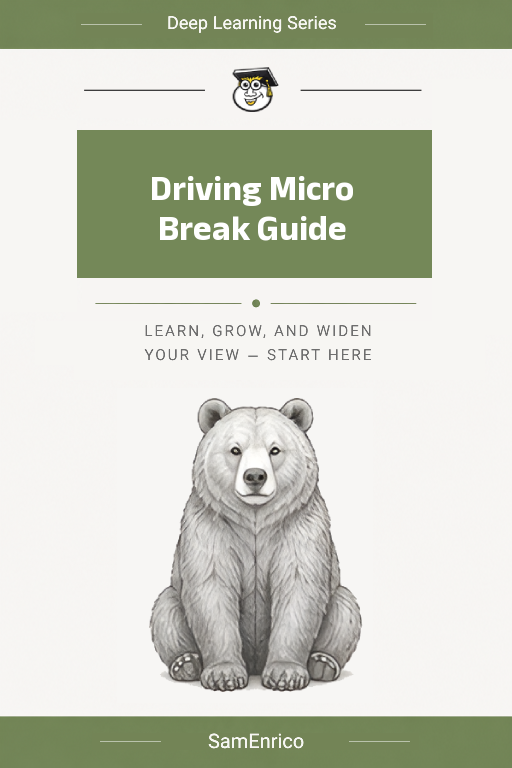
Non-FictionMental WealthDriving
Driving Micro Break Guide eBook
Uses safe micro-breaks while driving (at stops) to
Uses safe micro-breaks while driving (at stops) to regulate nervous system, reducing road rage and driving-related stress.
Formats
Free sample
Chapter 1: The One Rule...--–- The average driver will experience fifteen threat activations on a thirty-minute commute. Each one triggers the same neural pathways as a physical attack. Your heart races. Your hands grip the wheel. Your jaw clenches.
Your brain releases cortisol and adrenaline. And you haven't even left the neighborhood yet.This is not a moral failure. This is not because you are an angry person. This is biology meeting an unnatural environment. The car is a two-ton metal box moving at deadly speeds, surrounded by other two-ton metal boxes operated by strangers who cannot read your mind, do not care about your schedule, and occasionally make terrifying decisions.
Your nervous system was designed to detect threats in a savanna, not a highway. It cannot tell the difference between a lion charging and a driver cutting you off. To your amygdala, they are the same event.Every driver knows this feeling. The sudden flash of brake lights ahead. The merge without a turn signal.
The slow driver in the fast lane. The tailgater who seems to want to inspect your rear bumper. Each moment triggers a cascade: pupils dilate to take in more visual information, blood vessels constrict to redirect blood to large muscle groups, breathing becomes shallow and rapid, and the prefrontal cortex—the part of your brain responsible for rational decision-making and impulse control—gets partially bypassed. You are literally less intelligent when you are angry behind the wheel.Most books about road rage will tell you to "just relax" or "count to ten." These books are wrong. They misunderstand the problem.
You cannot talk your way out of a physiological state. You cannot think your way out of a flood of cortisol. The nervous system does not respond to reasoning. It responds to safety cues, rhythm, temperature, pressure, and breath.This book offers a different approach. It is not about suppressing anger or pretending you don't feel it.
It is about building off-ramps for your nervous system—small, safe, scientifically grounded pauses that you can take during the forced stops that already happen in every drive. Red lights. Stop signs. Traffic jams. Railroad crossings.
Drive-throughs. Parking lots. These are not interruptions to your day. They are opportunities. They are the pause buttons your nervous system desperately needs.But before we teach you a single technique, before we explain the neuroscience or the breathing patterns or the cognitive reframes, we must establish one rule.
This rule is non-negotiable. It is the foundation upon which everything else in this book is built. Break this rule, and you are not practicing the method. You are endangering yourself and everyone around you.The Non-Negotiable Rule The single rule is this: Every micro-break in this book is designed to be performed only when your vehicle is completely stopped.Not slowing down. Not coasting.
Not at a rolling stop. Completely stopped. The kind of stop where your foot is on the brake pedal and the world outside your window is stationary relative to you. Red lights. Stop signs.
Traffic jams where traffic is not moving. Railroad crossings with gates down. Drive-through lines. Parking lots before you shift into park. These are the only places where micro-breaks happen.Why is this rule so absolute?
Because the human brain has a limited attentional budget. When you are driving, even at low speeds, your brain is performing dozens of simultaneous calculations: speed, distance, peripheral movement, potential hazards, lane positioning, mirror checks, pedal pressure, steering angle. Adding a deliberate internal practice on top of that is not multitasking. Multitasking is a myth. The brain does not do two things at once.
It rapidly switches between tasks, and each switch costs time and accuracy.A micro-break that requires any internal focus—breath counting, body scanning, cognitive reframing—takes attention away from the road. For a moment as short as one second, that might not matter. But if that second coincides with a child stepping into the crosswalk, a car running a red light, or a sudden stop ahead, the consequences are catastrophic.This is why the rule exists. It is not because the author believes you are irresponsible. It is because the author respects the physics of driving and the limits of human attention.
The car does not care how regulated your nervous system is. The car cares whether you are looking at the road.Mindfulness Versus Mindlessness One of the most dangerous misconceptions in popular psychology is that meditation and mindfulness are always beneficial and always safe. They are not. Mindfulness—the practice of paying attention to the present moment without judgment—is a powerful tool. But it becomes a weapon when applied in the wrong context.There is a critical difference between mindfulness and mindlessness.
Mindfulness is eyes open, aware of surroundings, soft focus on the present. Mindlessness is eyes closed, internal trance, disconnection from the external world. Mindlessness behind the wheel is called "driving while dissociated," and it is responsible for countless near-misses and accidents every day.You have experienced mindlessness while driving. It is the state where you arrive at your destination and realize you remember nothing about the last ten minutes. Your body was on autopilot.
Your conscious mind was elsewhere—planning dinner, replaying an argument, worrying about work. This is not safety. This is the absence of presence.The micro-breaks in this book are designed to be mindful, not mindless. They keep your eyes open. They keep your awareness on your surroundings.
They use the physical car as an anchor—the texture of the steering wheel, the pressure of the seat against your back, the temperature of the air from the vent. You do not close your eyes. You do not withdraw from the external world. You simply add a layer of internal regulation on top of your normal visual scanning.Think of it this way: you are already breathing while you drive. You are already holding the steering wheel.
You are already feeling the seat against your body. The micro-break does not ask you to do anything new. It asks you to do what you are already doing, but with intention. That is the difference between mindlessness and mindfulness.The "Eyes Open, Gaze Soft" Technique The first technique in this book is also the simplest. It requires no breath counting, no body scanning, no cognitive reframing.
It is simply an adjustment in how you use your eyes.Most drivers, when they feel threatened, narrow their visual field. This is a natural survival response. When the amygdala detects danger, it instructs the eyes to focus on the threat and ignore everything else. On the savanna, this helped our ancestors track a predator. On the highway, it creates tunnel vision.
You stare at the brake lights of the car in front of you, missing the car merging from the side. You fixate on the driver who cut you off, missing the pedestrian on the curb."Eyes Open, Gaze Soft" is the opposite of tunnel vision. You keep your eyes open—obviously, because you are driving—but you soften your gaze. Instead of focusing on any single object, you let your visual field widen. You take in the whole scene.
The car in front. The car behind. The side mirrors. The crosswalk. The traffic light.…
This is the end of the free sample. Get the eBook to keep going. Buy now
About this book
Details
- Author
- Oconnell Dion
- Publisher
- SamEnrico
- Language
- English
- Genre
- Non-Fiction, Mental Wealth, Driving
- Released
- 2026-05-30
- Pages (approx.)
- 135
- Available as
- eBook, Audiobook

Read better in the ZLOADR app
Your eBooks on your phone or tablet. Sign in with your SamEnrico account and start reading.
More by Oconnell Dion
 Anger for PharmacistsOconnell Dion$11.99
 Submarine War Academic StudyOconnell Dion$11.99
 Workaholism in ITOconnell Dion$11.99
 Secondary Lactose IntoleranceOconnell Dion$11.99
 The Habit Craving Rewiring GuideOconnell Dion$11.99
 The Crimson Tide: The Rise and Fall of the British Pirate LordsOconnell Dion$11.99
 Understanding Ssadh (Succinic Semialdehyde Dehydrogenase Deficiency)Oconnell Dion$17.99
 Cooperative Liquidation GuideOconnell Dion$12.99
 10 Ways to Use Custard (Recipe Book)Oconnell Dion$11.99
 Beauty Shop ManagerOconnell Dion$11.99
You may also like
 Hong Kong Handover 1997Dunn Johnnie$11.99
 Zumba For Postnatal Recovery CourseNeal Christian$11.99
 Zumba for BeginnersLadner Nikia$11.99
 YouTube Comment Mining GuideHumes Pandora$12.99
 Worry Box MeditationCarlin Rudy$11.99
 Workplace Stress MeditationNguyen Lynn$11.99
 Workplace Stress and Sleep RepairHawley Ivory$11.99
 Workplace Perfectionism CureDelaney Jeffry$11.99
 Workplace Injustice Anger GuideWallen Isabelle$11.99
 Work Addiction and Burnout LinkGreenwood Ester$11.99
 Women in Yoga and WellnessBeattie Galina$11.99
 Women in Stand Up ComedyChun Evangeline$11.99