
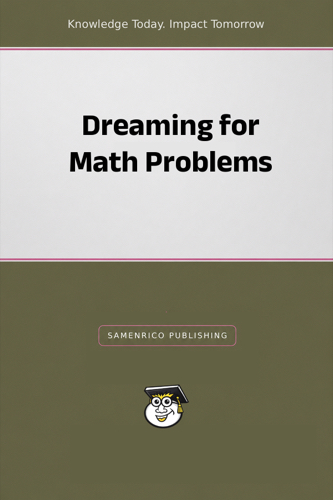
Dreaming for Math Problems Audiobook
Incubates complex equations and proofs during slee
by Ohara Louie
Incubates complex equations and proofs during sleep.
Formats
Free sample
Chapter 1: The Insomniac’s Paradox--–- Charles Dodgson—better known as Lewis Carroll—could not sleep. Night after night, the Oxford mathematician and author of Alice’s Adventures in Wonderland lay awake in his college rooms at Christ Church, his mind racing not with jabberwocks or grinning cats, but with geometry. While his fictional Alice tumbled down rabbit holes, Dodgson tumbled down rabbit holes of a different kind: proofs of Euclidean theorems, algebraic manipulations, and geometric constructions. His insomnia was so persistent that he developed a peculiar coping mechanism. He would, in the dark, invent mathematical problems and solve them entirely in his head.
He called them Pillow Problems. Between 1883 and 1884, he published a collection of seventy-two such problems, ranging from elementary algebra to fiendish geometry, all solved without pen, paper, or candlelight. The preface of that slim volume contains a confession that should strike any mathematician as both admirable and absurd: "I have found that the solving of a mathematical problem in the dark—without any means of writing or recording—is an excellent remedy for insomnia."Let us pause here. Dodgson was using mathematics to avoid sleep. He was weaponizing logic against rest.
And yet, a century and a half later, his name appears in nearly every popular account of mathematical dreaming. He is held up as a patron saint of nocturnal problem-solving, a man who wrestled equations in the dark and won. But there is a profound irony that no one seems to notice, or perhaps no one dares to name: Dodgson did not dream his solutions. He stayed awake for them. He used math as a stimulant, not a sedative.
The very thing that kept him conscious is the thing we now mistakenly cite as evidence that the sleeping mind can do mathematics.This paradox—the insomniac mathematician—is the hidden doorway into everything this book will teach you. Because the truth is far more interesting than the myth. Dodgson’s Pillow Problems are not a record of dreams. They are a record of what a highly disciplined mind can do in the twilight state between full wakefulness and the edge of sleep, a state he never fully surrendered to. He balanced on the threshold, solving equations to keep from falling over.
But what if you could step through that threshold? What if, instead of fighting sleep, you could collaborate with it? What if the dark…
This is the end of the free sample. Get the Audiobook to keep going. Buy now
About this book
Details
- Author
- Ohara Louie
- Publisher
- SamEnrico
- Language
- English
- Genre
- Non-Fiction, Self-Help, Mathematics
- Released
- 2026-06-10
- Pages (approx.)
- 151
- Available as
- eBook, Audiobook

Listen in the VoxFlicks app
Audiobooks and audio dramas wherever you go. Sign in with your SamEnrico account and press play.
More by Ohara Louie
 Trigger Identification WorkbookOhara Louie$11.99
 Progressive Overload HandbookOhara Louie$11.99
 Postpartum Asking for Help GuideOhara Louie$11.99
 Acetyl L Carnitine NeuropathyOhara Louie$11.99
 IBS Symptom Tracking WorkbookOhara Louie$11.99
 Eccentric Exercise SarcopeniaOhara Louie$11.99
 Alcohol Recovery Self CompassionOhara Louie$11.99
 Team Retrospective FormatsOhara Louie$11.99
 The Lost Kingdoms of the Congo: Mapping Africa’s Hidden HeartOhara Louie$11.99
 The Last Witness of the SphinxOhara Louie$11.99
 The Last Voyage of the SS America: A Ship’s Final JourneyOhara Louie$11.99
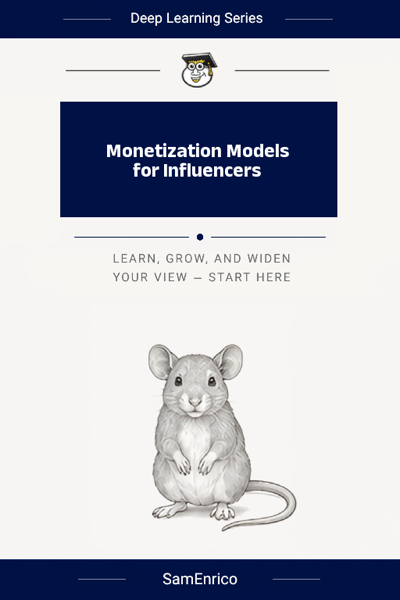 Monetization Models for InfluencersOhara Louie$11.99
You may also like
 Math Pattern RecognitionMull Lulu$11.99
 Math Formula PalaceKarr Krysta$11.99
 Benzo Taper Calculator WorkbookNickel Kirstie$11.99
 Pattern Recognition in MathLea Gwenn$11.99
 Memory Palace For MathematicsSinger Cristine$11.99
 Math SRS Card DesignMarch Digna$11.99
 Math Formula Memory GuideAcevedo Francesca$11.99
 Anki For Math FormulasCorreia Eugena$11.99