
Non-FictionSelf-HelpProgramming
Dreaming for Code Debugging eBook
Sleeps on software bugs and wakes with solutions.
Sleeps on software bugs and wakes with solutions.
Formats
Free sample
Chapter 1: The 3 AM Heresy--It is 2:47 on a Tuesday morning. Your screen glows like an accusation. The cursor blinks with infinite patience. You have been staring at a null pointer exception for six hours, and you have nothing to show for it except cold coffee, a stiff neck, and the quiet certainty that you are not as smart as you thought you were.You have tried everything. You have added log statements.
You have stepped through the code line by line. You have rewritten the method three times. You have searched Stack Overflow, Git Hub issues, and the darkest corners of mailing list archives. You have even done the thing you swore you would never do again: you changed something at random, recompiled, and prayed.The bug remains.Your teammates went home hours ago. The office is empty except for the hum of servers and the faint buzz of fluorescent lights that no one ever turns off.
You are alone with your failure. And somewhere in the back of your mind, a voice is whispering: Maybe I am not cut out for this.Here is the heresy this book asks you to consider: That voice is wrong. But not for the reasons you think.You are not failing because you lack intelligence, experience, or grit. You are failing because you are using the wrong tool for the job. You are trying to solve a puzzle that requires your subconscious mind with the conscious mind of a tired, frustrated, over-caffeinated programmer.
And that is like trying to hammer a nail with a screwdriver. It is not weakness. It is a category error.This book exists because of a simple, powerful, and for many programmers deeply uncomfortable truth: The most effective debugging tool is not a better IDE, more logging, or sheer willpower. It is the human brain’s natural ability to solve problems while you sleep.This is not mysticism. It is not self-help fluff.
It is cognitive science, backed by decades of research on creativity, problem-solving, and the neuroscience of sleep. And once you understand how it works and learn to use it deliberately, it will change not only how you debug but how you think about thinking itself.The Night Everything Changed Let me tell you about Sarah. (Name changed, story used with permission.)Sarah was a kernel developer at a mid-sized cloud infrastructure company. For three weeks, she had been chasing a race condition that would crash their storage system under high load. The bug was a ghost.
It would appear in production, never in staging. It left no consistent stack trace. It vanished when she added logging and returned when she removed it.She had done everything by the book. She had reproduced the load conditions in a test environment. She had added metrics.
She had instrumented every lock and mutex. She had even flown to a different time zone to run experiments on the production hardware directly. Nothing worked.On the twenty-second day, she went home exhausted at 8 PM, which for her was early. She did not think about the bug. She ate dinner, watched half an episode of a show she would not remember, and fell asleep.At 3:17 AM, she woke up gasping.
She had been dreaming. In the dream, she was standing inside a giant diagram of her system’s memory allocation. The diagram was three-dimensional, impossibly detailed. She could see every thread, every lock, every allocation. And she saw something she had never noticed while awake: two threads that should never have been able to access the same memory region were doing exactly that, through a pointer she had assumed was thread-local but was not.She grabbed her phone from the nightstand and typed a single sentence into her notes app: Check the gc_free pointer in the io_uring path.
It is not actually thread-local.In the morning, she wrote a unit test for that hypothesis. It failed exactly as she had dreamed. She fixed the pointer, ran the test again, and it passed. The race condition, after three weeks, was gone.Sarah is not a mystic. She does not believe in psychic powers or prophetic dreams.
She is a systems programmer who understands memory layouts and lock contention. What happened that night was not magic. It was her subconscious mind, which had been loaded with three weeks of data about the bug, finally making a connection that her conscious mind could not see because it was too busy being frustrated.This is the incubation effect. And it is real.What the Incubation Effect Is (And Is Not)The incubation effect is a well-documented psychological phenomenon in which setting a problem aside leads to better solutions than continuous effort. The term was coined by the psychologist Graham Wallas in his 1926 book The Art of Thought, which broke creative problem-solving into four stages: preparation, incubation, illumination, and verification.Wallas observed what countless programmers have experienced since: that after working on a problem intensely, the best thing you can do is stop working on it.
Walk away. Sleep on it. Let your mind wander. When you come back, the solution often arrives with embarrassing ease.For decades, researchers have studied this effect. In a typical experiment, participants are given a difficult problem (often an insight puzzle, like the nine-dot problem or the candle problem).
One group works continuously. Another group is interrupted and given a distractor task for a few minutes. The interrupted group consistently solves the problem faster and more often.But here is what the incubation effect is not. It is not a guarantee that every problem will be solved by morning. It is not a substitute for deep technical knowledge or careful debugging practice.
And it is not an excuse to give up at the first sign of difficulty.The incubation effect works only when three conditions are met. First, you must have done the preparation work: you have loaded the problem into your memory thoroughly enough that your subconscious has something to work with. Second, you must genuinely disengage. Staring at the ceiling thinking about the bug is not incubation; it is just frustration with a different posture. Third, you must have a retrieval system in place to capture the solution when it arrives, because the subconscious does not send a calendar invitation.This book will teach you all three.
But before we get to the how, we need to talk about why your conscious mind is so terrible at debugging certain kinds of bugs.The Two-Processor Brain Your brain is not one computer. It is two.The conscious mind, which neuroscientists sometimes call the executive system, is slow, linear, energy-intensive, and easily distracted. It handles syntax checking, arithmetic, following a known algorithm, and reproducing a bug according to a written test case. It is excellent for what it does. But it has a tiny working memory.
You can hold roughly four to seven chunks of information in conscious awareness at once. That is why you lose track of a stack trace after stepping through five function calls.The unconscious mind is something else entirely. It is massively parallel, pattern-matching, and always running. It never gets tired. It processes millions of bits…
This is the end of the free sample. Get the eBook to keep going. Buy now
About this book
Details
- Author
- Soriano Margorie
- Publisher
- SamEnrico
- Language
- English
- Genre
- Non-Fiction, Self-Help, Programming
- Released
- 2026-06-06
- Pages (approx.)
- 148
- Available as
- eBook, Audiobook

Read better in the ZLOADR app
Your eBooks on your phone or tablet. Sign in with your SamEnrico account and start reading.
More by Soriano Margorie
 Dust Ingestion Toxin PreventionSoriano Margorie$11.99
 Strength Training Foundations GuideSoriano Margorie$11.99
 Alcohol Recovery Mindfulness PracticeSoriano Margorie$11.99
 Alpha Lipoic Acid NerveSoriano Margorie$11.99
 ABCDE For Self CareSoriano Margorie$11.99
 Sarcopenia Inflammatory DietSoriano Margorie$11.99
 The Low FODMAP Diet GuideSoriano Margorie$11.99
 Design Sprint FacilitationSoriano Margorie$11.99
 The Last Broadcast: The Mysterious Silence of Radio S-O-SSoriano Margorie$11.99
 Orbiting Dreams: Australia’s Pioneers in Space HabitationSoriano Margorie$11.99
 Nobel Visionaries: Black Geniuses Who Shaped the SciencesSoriano Margorie$11.99
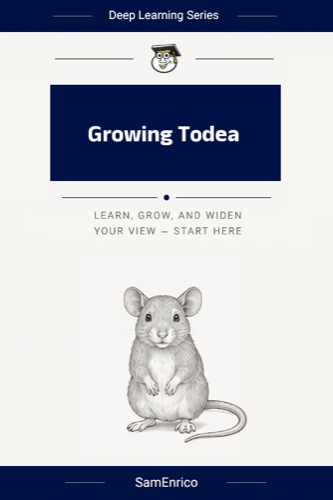 Growing TodeaSoriano Margorie$11.99
You may also like
 Hong Kong Handover 1997Dunn Johnnie$11.99
 Zumba For Postnatal Recovery CourseNeal Christian$11.99
 Zumba for BeginnersLadner Nikia$11.99
 YouTube Comment Mining GuideHumes Pandora$12.99
 Worry Box MeditationCarlin Rudy$11.99
 Workplace Stress MeditationNguyen Lynn$11.99
 Workplace Stress and Sleep RepairHawley Ivory$11.99
 Workplace Perfectionism CureDelaney Jeffry$11.99
 Workplace Injustice Anger GuideWallen Isabelle$11.99
 Work Addiction and Burnout LinkGreenwood Ester$11.99
 Women in Yoga and WellnessBeattie Galina$11.99
 Women in Stand Up ComedyChun Evangeline$11.99