
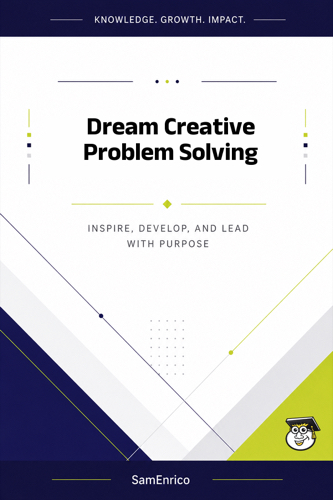
Non-FictionSelf-HelpCreativity
Dream Creative Problem Solving eBook
Journal dreams to access creative solutions for wa
Journal dreams to access creative solutions for waking problems.
Formats
Free sample
Chapter 1: The 3 AM Advantage...--–- Why does the solution to a problem that stumped you for three days suddenly appear at 3:00 AM, fully formed, as if delivered by a ghost? You wrestle with a creative block all afternoon. You stare at the spreadsheet, the blank page, the unresolved conflict. Nothing comes. You give up, go to sleep, and then—bam—at three in the morning, you sit bolt upright with the answer.
Or worse, you wake up at 7:00 AM with the memory of a brilliant solution already dissolving like a dream you cannot quite catch. You know you had the answer. You remember it felt perfect. But now it is gone.This is not magic. It is not mysticism.
It is neuroscience.Your brain is a problem-solving machine that never sleeps. While you are awake, your prefrontal cortex—the CEO of your brain—insists on logic, linear thinking, and inhibition. It says, "That idea is stupid. That connection doesn't make sense. We tried that before." This internal editor is useful during the day.
It stops you from saying embarrassing things or making obvious mistakes. But it is terrible for creativity. It kills novel ideas before they reach awareness.Then you sleep. And everything changes.The Two Brains: Your Day Self and Your Night Self To understand why dreams solve problems, you first need to understand that you have two very different cognitive systems. They use different parts of your brain, follow different rules, and produce different kinds of insights.Your waking brain (let us call it the Day Manager) relies on the prefrontal cortex.
This is the part of your brain behind your forehead that handles executive functions: planning, inhibition, working memory, and logical reasoning. The Day Manager is linear. It takes information in sequence, evaluates it against past experience, and rejects anything that does not fit. This is called focused thinking. It is narrow, critical, and efficient.
You need it to file taxes, drive a car, and follow a recipe. But it is terrible at solving novel problems because it can only work with what it already knows.Your dreaming brain (let us call it the Night Architect) operates very differently. During REM (Rapid Eye Movement) sleep, the prefrontal cortex goes mostly offline. In its place, the limbic system (emotion center) and the visual cortex (image processing) become hyperactive. The brain also activates something called the Default Mode Network (DMN) —a collection of brain regions that light up when your mind is wandering, daydreaming, or sleeping.
The DMN is the opposite of focused thinking. It is diffuse thinking. It makes loose associations, jumps between unrelated memories, and connects dots that your Day Manager would never allow.Consider the difference this way: Your waking brain thinks in prose. Your dreaming brain thinks in poetry, metaphor, and collage.This is not a metaphor. It is literally how your brain rewires itself during sleep.
Research from the University of California, Berkeley, and Harvard Medical School has shown that during REM sleep, the brain strengthens novel connections between distantly related memories. It literally creates new neural pathways that did not exist when you went to bed. That is why you wake up with solutions that your waking brain could not generate.The Critical Censor: What Happens When Your Editor Goes on Vacation Let us name the most important concept in this book: the Critical Censor.During waking hours, your Critical Censor sits in your prefrontal cortex and reviews every idea before it reaches your conscious awareness. It asks: "Is this logical? Is this safe?
Has this worked before? What will other people think?" This censor evolved for survival. If your ancient ancestor had a wild idea like "Let me pet that saber-toothed tiger," the censor said "Absolutely not" and kept him alive. But in the modern world, the censor kills creativity. It kills the weird, uncomfortable, brilliant connections that lead to breakthroughs.Here is the key insight: The Critical Censor goes offline during REM sleep.When you dream, your prefrontal cortex is in a state of reduced activity.
The censor is on vacation. And without the censor, your brain is free to make associations that would never occur during the day. A car can turn into a whale. Your dead grandmother can give you stock tips. You can fly.
You can be chased by a labyrinth of filing cabinets. These images are not random noise. They are your brain processing information without the editor.But there is a catch. And this catch explains why most people never benefit from their dreams.The Recall Filter: The Censor That Returns The Critical Censor vanishes while you dream. But it returns the moment you wake.Let us call the waking version the Recall Filter.
The Recall Filter is not identical to the Critical Censor—it has a different job. The Critical Censor prevents ideas from forming during the day. The Recall Filter erases or edits your dreams within seconds of waking. Why? Because dreams are weird.
They are illogical, emotionally charged, and often disturbing. The waking brain, which craves order and predictability, looks at a dream and says, "This is nonsense. Discard it."Within sixty seconds of waking, the average person loses 50% of their dream content. Within five minutes, 90% is gone. You wake up knowing you dreamed something important, but the Recall Filter has already scrubbed the hard drive.This book exists to teach you how to bypass the Recall Filter.The first step is simple: stop moving.
The moment you wake, the Recall Filter is activated by physical movement, speech, and light. If you turn on your phone, speak to your partner, or get out of bed, you are telling your brain, "I am now in waking mode. Delete dream data." The solution is to lie perfectly still for sixty seconds. Keep your eyes closed. Do not speak.
Do not reach for your phone. Just lie there and let the dream come back to you.We will spend an entire chapter on recall techniques later. For now, know this: the single most powerful thing you can do for dream creativity is to stop moving when you wake.The Evidence: Breakthroughs That Arrived While Sleeping Before we go any further, let us look at the evidence. The following are not myths or urban legends. They are well-documented cases of creative and scientific breakthroughs that originated in dreams.Case Study 1: August Kekulé and the Ouroboros In the 1860s, the chemist August Kekulé was trying to understand the molecular structure of benzene.
The known rules of chemistry suggested carbon atoms formed straight chains. But benzene did not behave like a chain. Kekulé struggled for years. Then, in 1865, he fell asleep in front of his fireplace. He dreamed of atoms dancing in snake-like formations.
One snake reached the end of its body and bit its own tail, forming a circle. Kekulé woke up and realized: benzene was not a chain. It was a ring. This discovery revolutionized organic chemistry and led to the entire field of aromatic compounds. Kekulé later told colleagues, "Let us learn to dream, gentlemen."Case Study 2: Paul Mc Cartney and "Yesterday"In 1964, Paul Mc Cartney woke up with a melody in his head.
He had dreamed it. He rushed to a piano and played it, convinced he must have heard it somewhere else—it…
This is the end of the free sample. Get the eBook to keep going. Buy now
About this book
Details
- Author
- Damon Florencia
- Publisher
- SamEnrico
- Language
- English
- Genre
- Non-Fiction, Self-Help, Creativity
- Released
- 2026-06-07
- Pages (approx.)
- 135
- Available as
- eBook, Audiobook

Read better in the ZLOADR app
Your eBooks on your phone or tablet. Sign in with your SamEnrico account and start reading.
More by Damon Florencia
 After Holiday Spending Hangover GuideDamon Florencia$11.99
 Values And Mission Alignment Complete GuideDamon Florencia$11.99
 Mindfulness for Impatient PeopleDamon Florencia$11.99
 Binge Eating Mindfulness Retreat GuideDamon Florencia$11.99
 Echoes of the Deep: The Lost Submarine That Changed the Cold WarDamon Florencia$11.99
 Understanding Congenital Adrenal Hyperplasia Due to 21-hydroxylase DeficiencyDamon Florencia$17.99
 BoP Customer Retention GuideDamon Florencia$12.99
 Professor Interaction StylesDamon Florencia$12.99
 IT Support AssociateDamon Florencia$11.99
 How to Start a Shop Fronts Made of Wood Business (Beginners Guide)Damon Florencia$11.99
You may also like
 Hong Kong Handover 1997Dunn Johnnie$11.99
 Zumba For Postnatal Recovery CourseNeal Christian$11.99
 Zumba for BeginnersLadner Nikia$11.99
 YouTube Comment Mining GuideHumes Pandora$12.99
 Worry Box MeditationCarlin Rudy$11.99
 Workplace Stress MeditationNguyen Lynn$11.99
 Workplace Stress and Sleep RepairHawley Ivory$11.99
 Workplace Perfectionism CureDelaney Jeffry$11.99
 Workplace Injustice Anger GuideWallen Isabelle$11.99
 Work Addiction and Burnout LinkGreenwood Ester$11.99
 Women in Yoga and WellnessBeattie Galina$11.99
 Women in Stand Up ComedyChun Evangeline$11.99