
Non-FictionInformativeEducational
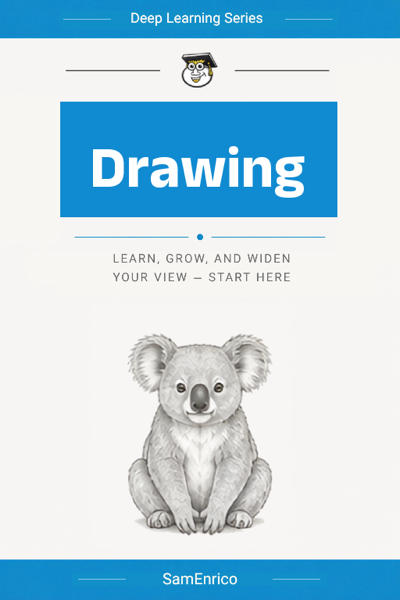
Drawing eBook
A Coursebook on Drawing
A Coursebook on Drawing
Formats
Free sample
Chapter 1: The First Mark...--–- Every master drawing you have ever admired—from Leonardo’s anatomical sketches to a contemporary graphic novelist’s battle scenes—began with exactly one thing: a single mark on a blank surface. That mark was not born from talent. It was born from a decision. The decision to start, to make a mistake, to learn, and to try again. This chapter is not about teaching you to draw a perfect sphere or a realistic eye in thirty minutes.
This chapter is about something far more important: dismantling the myth that drawing is a gift reserved for the lucky few and replacing it with the truth—that drawing is a teachable, learnable skill built from observation, patience, and a handful of simple tools.If you have ever said, “I can’t even draw a straight line,” you have already identified the wrong problem. Drawing is not about straight lines. It is about seeing relationships: how wide something is compared to how tall, how dark this shadow is compared to that highlight, how this angle relates to that horizon. The straight line will come. More importantly, the wobbly line, the awkward line, the line that goes too far and has to be corrected—those are not failures.
They are the fingerprints of a human hand learning to see.This chapter will guide you through three foundational shifts. First, you will unlearn the “symbol system” that your brain has been using since childhood—the reason you draw an eye as a football shape or a nose as a triangle. Second, you will meet your materials not as intimidating professional tools but as friendly instruments you already know how to use. Third, you will make your first real drawings: blind contours that feel like scribbles but contain surprising accuracy, and a value scale that will become your lifelong reference for light and dark. By the end of this chapter, you will have drawn something that surprises you.
That is not hype. That is how the brain rewires itself when you stop asking it to name things and start asking it to see.The Three Great Reasons Humans Draw Before you sharpen a single pencil, ask yourself a deeper question: why are you here? Not “to learn to draw” but why does drawing matter at all? Across every human culture and every historical era, people have drawn for three fundamental reasons. Understanding which one calls to you will shape your entire learning path.Drawing as Recording.
The oldest drawings—bison on cave walls, botanical illustrations, architectural blueprints—exist to capture what the eye sees. This is drawing as documentation. When you draw a coffee mug on your kitchen table, you are joining a lineage of record-keepers. The goal here is accuracy: getting the proportions right, the shadows believable, the perspective convincing. Most beginning drawing courses emphasize recording because it trains your observation like nothing else.Drawing as Thinking.
Have you ever sketched a diagram to explain an idea? Doodled during a phone call to help yourself focus? Those are drawings as thought. Designers, engineers, scientists, and writers use drawing to work out problems that words cannot solve. A quick sketch of a furniture layout, a rough map of a hiking trail, a scribbled face expressing an emotion you cannot name—these drawings are not meant for galleries.
They are meant for clarity.Drawing as Creating. This is drawing from imagination: inventing worlds, designing characters, composing scenes that have never existed. Comic book artists, concept designers, and children with crayons all draw to bring something new into being. Creating does not require perfect realism. It requires visual vocabulary—a mental library of forms, lights, and textures that you can rearrange into something original.Most of this book focuses on the first two purposes (recording and thinking) because they build the visual vocabulary you need for the third.
You cannot convincingly invent a dragon until you understand how a lizard’s legs bend. You cannot draw a fantasy city until you know how one-point perspective works. But keep your “creating” goal in your back pocket. It is the destination.Exercise 1.1: The “Why I Draw” Journal Prompt Before you pick up a pencil, write three sentences in a notebook: “One thing I am afraid of about drawing is…” and “One thing I am excited about drawing is…” and “The kind of drawing I most want to make is (recording/thinking/creating) because…” This is not busywork. Fear and excitement live in different parts of the brain.
Naming them clears the path.The Myth of Talent Let us address the elephant in the studio. You have heard someone say, “She’s so talented,” as if drawing ability arrived in the crib like a silver spoon. This belief—that drawing is a genetic lottery—is the single greatest barrier to learning. It is also scientifically false.Decades of research on skill acquisition (from chess masters to violinists to surgeons) point to the same conclusion: what we call “talent” is almost always early, enjoyable practice combined with effective feedback. A child who draws obsessively from age four has logged thousands of hours of practice by age twelve.
Their “talent” is actually a head start. The good news is that adults learn differently—more strategically, with better metacognition—and can close that gap faster than most people assume.Here is what the research actually shows about drawing ability:Visual memory (the ability to hold an image in your mind) improves with practice.Hand-eye coordination (getting your hand to do what your eye sees) improves with practice.Proportional judgment (seeing that this line is twice as long as that one) improves with practice.What does not improve automatically? The willingness to make mistakes and look foolish. That is a choice, not a skill.Every professional artist you admire has a folder (digital or physical) filled with embarrassing early work. They did not skip the awkward phase.
They just did not stop. Your job in this chapter is not to make a masterpiece. Your job is to make marks, make mistakes, and make the mental switch from “I hope this is good” to “I am curious what will happen.”Your Materials: A Friendly Tour You do not need a $200 kit to learn to draw. In fact, expensive materials often intimidate beginners into perfectionism. Here is what you actually need, why it works, and how to use it without fear.Pencils: The H-B System Pencils are labeled with a letter and number: H (hard), B (black/soft), or HB (middle).
The higher the number, the more extreme the effect.H pencils (2H, 4H, 6H): Hard leads that make light, fine lines. They stay sharp longer but do not get dark. Use them for precise construction lines, perspective grids, and light sketching that you will later cover with darker marks.B pencils (2B, 4B, 6B, 8B): Soft leads that make dark, rich marks. They dull quickly and smudge easily. Use them for shading, shadows, and any area that needs deep black.HB and F: Middle-of-the-road pencils for everyday writing.
Fine for sketching, but you will want at least one H and one B for real control.What to buy as a…
This is the end of the free sample. Get the eBook to keep going. Buy now
About this book
Details
- Author
- Burkhart Eladia
- Publisher
- SamEnrico
- Language
- English
- Genre
- Non-Fiction, Informative, Educational
- Released
- 2026-06-02
- Pages (approx.)
- 149
- Available as
- eBook, Audiobook

Read better in the ZLOADR app
Your eBooks on your phone or tablet. Sign in with your SamEnrico account and start reading.
More by Burkhart Eladia
 The Resistance Band Workout GuideBurkhart Eladia$11.99
 Small Talk Scripts for NeurodivergentsBurkhart Eladia$11.99
 Feet Direction Decoding GuideBurkhart Eladia$11.99
 Listening For De escalationBurkhart Eladia$11.99
 The Golden Compass of the North: The Sweethearts Who Charted CanadaBurkhart Eladia$11.99
 Learn to Play the Mezzo-soprano Saxophone (Alto In F)Burkhart Eladia$11.99
 Buffer AI Social Media SchedulingBurkhart Eladia$12.99
 How to Start a Carding of Trimmings Business (Beginners Guide)Burkhart Eladia$11.99
You may also like
 Hong Kong Handover 1997Dunn Johnnie$11.99
 Zumba For Postnatal Recovery CourseNeal Christian$11.99
 Zumba for BeginnersLadner Nikia$11.99
 YouTube Comment Mining GuideHumes Pandora$12.99
 Worry Box MeditationCarlin Rudy$11.99
 Workplace Stress MeditationNguyen Lynn$11.99
 Workplace Stress and Sleep RepairHawley Ivory$11.99
 Workplace Perfectionism CureDelaney Jeffry$11.99
 Workplace Injustice Anger GuideWallen Isabelle$11.99
 Work Addiction and Burnout LinkGreenwood Ester$11.99
 Women in Yoga and WellnessBeattie Galina$11.99
 Women in Stand Up ComedyChun Evangeline$11.99