
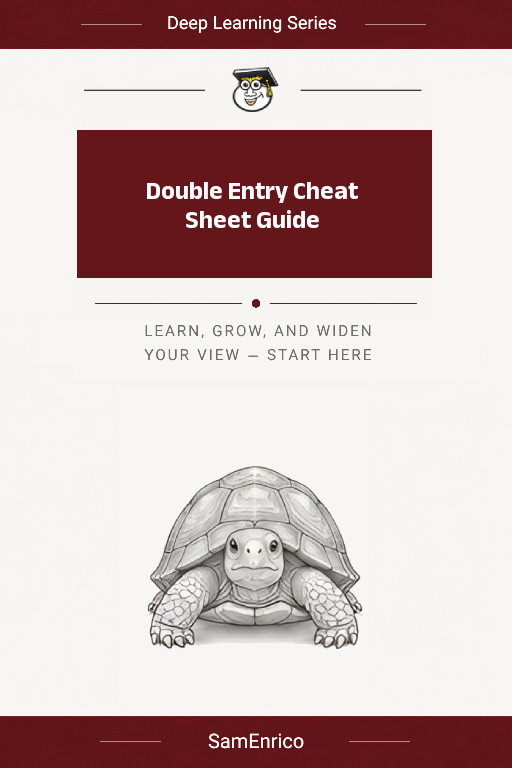
Double Entry Cheat Sheet Guide
Remember debits and credits with simple memory tri
Remember debits and credits with simple memory tricks. Apply the accounting equation to any transaction from cash sales to depreciation.
Formats
About this book
Free sample
Chapter 1: The Mirror Test--–- Close your eyes and imagine you just received 100incash.Inyourpersonallife,whatdoyoufeel?Relief.Excitement.Youhave∗more∗.Nowimagineyouareanaccountantforasmallbusiness.Thesame100 in cash. In your personal life, what do you feel? Relief. Excitement. You have *more*.
Now imagine you are an accountant for a small business. The same 100incash.Inyourpersonallife,whatdoyoufeel?Relief.Excitement.Youhave∗more∗.Nowimagineyouareanaccountantforasmallbusiness.Thesame100 lands in the cash register. The accountant does not say “plus.” The accountant says “debit Cash.” If you are new to accounting, that single word – debit – feels like a betrayal. Debit sounds like a penalty. Your bank debits your account when you lose money.
How can receiving cash possibly be a debit?This is the first wall that every accounting beginner hits. It is a solid brick wall, and most textbooks respond by throwing more bricks at you: rules, tables, exceptions, and historical anecdotes about Venetian merchants. You do not need history. You need a mirror.The Mirror World of Accounting Accounting is not personal finance. That is the single most important sentence in this book.
In personal finance, you track what you have. Your bank account goes up when you deposit cash; it goes down when you spend. You are the center of your own financial universe. Accounting does something radically different. Accounting tracks where value came from and where it went simultaneously.
Every transaction has two sides, and the accountant must record both. That is why it is called double-entry.When you receive $100 in cash, that cash came from somewhere. It did not materialize out of thin air. Maybe it came from a customer who bought a product (revenue). Maybe it came from a bank loan (liability).
Maybe it came from the owner investing personal funds (equity). The cash exists, but its origin story matters just as much as its presence. The debit to Cash says: “We have this asset now.” The credit to something else says: “Here is where it came from.”Think of it as a mirror. On one side of the mirror, you see the asset – the cash, the equipment, the inventory. On the other side of…
This is the end of the free sample. Get the eBook to keep going. Buy now
Contents
- Chapter 1
- Chapter 2
- Chapter 3
- Chapter 4
- Chapter 5
- Chapter 6
- Chapter 7
- Chapter 8
- Chapter 9
- Chapter 10
- Chapter 11
- Chapter 12
Details
- Author
- Gass Lynnette
- Publisher
- SamEnrico
- Language
- English
- Genre
- Non-Fiction, Student's Shortcut, Bookkeeping
- Released
- 2026-05-30
- Pages (approx.)
- 151
- Available as
- eBook, Audiobook

Read better in the ZLOADR app
Your eBooks on your phone or tablet. Sign in with your SamEnrico account and start reading.
More by Gass Lynnette
 The 90 Minute Work BlockGass Lynnette$11.99
 Scripting TipsGass Lynnette$11.99
 LinkedIn Optimization After LayoffGass Lynnette$11.99
 Focus Blocks for Chaotic Days GuideGass Lynnette$11.99
 UK VAT Online Account Setup WorkbookGass Lynnette$11.99
 Disney Channel Star BurnoutGass Lynnette$11.99
 The Freelance Energy ManagementGass Lynnette$11.99
 Persuasion Resistance GuideGass Lynnette$11.99
 Buffett GEICOGass Lynnette$11.99
 Mozart and the Marching Bands: Music That Shaped the War of Austrian SuccessionGass Lynnette$11.99
 The Vanishing Hiker: The Last Broadcast of the Lost 44Gass Lynnette$11.99
 Silk & Sabotage: The Unraveling of the Great Silk Road HeistGass Lynnette$11.99