
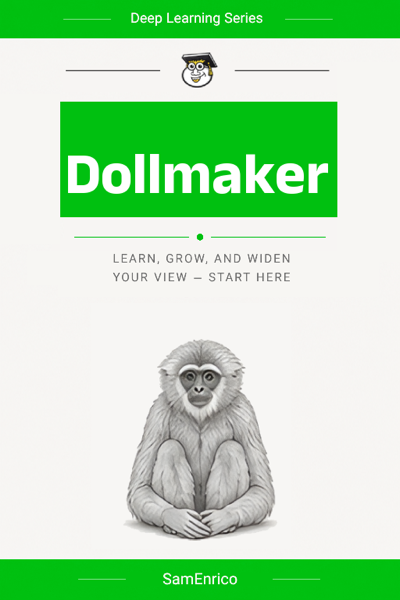
Non-FictionInformativeEducational
Dollmaker eBook
A Coursebook on Dollmaker
A Coursebook on Dollmaker
Formats
Free sample
Chapter 1: The Maker’s Two Faces...--The first time you hold a finished doll in your hands, something shifts. Not because the object is beautiful—though it might be—but because you have done something strange. You have taken dead materials: cloth, wood, wax, clay, thread, paint. You have cut them, shaped them, stitched them, breathed into them the heat of your workshop and the sweat of your palms. And now something sits before you that seems, against all reason, almost alive.This is the dollmaker’s paradox.
No other craft produces this specific vertigo. A potter throws a bowl, and the bowl is a bowl. A carpenter builds a chair, and the chair is a chair. But a dollmaker creates a figure that mimics the human form, and in that mimicry lurks a question the maker never intended to ask: What have I made? An object?
A companion? A replacement? A weapon? The answer depends entirely on the hands that made it and the heart that beats behind those hands.This chapter dismantles the simplest possible understanding of the dollmaker—the artisan, the skilled worker, the craftsperson—and rebuilds that figure as something far more interesting: a psychological and narrative archetype. We will establish the two poles between which every fictional dollmaker moves.
We will introduce the central psychological engine that drives these narratives. And we will lay the groundwork for every subsequent chapter in this coursebook, from horror to fantasy to historical fiction.The Spectrum of Creation: Life-Giver and Controller Every dollmaker in literature, from Harriette Arnow’s Gertie Nevels to Nina Allan’s Andrew to Lynn Buchanan’s Shean, occupies a position on a single spectrum. At one end stands the life-giver. At the other, the controller. No maker is purely one or the other, but the dominant orientation determines everything: why they make, what they make, what happens when the doll is finished, and whether the story ends in tragedy, horror, or reluctant hope.The life-giver creates from love, from grief, from the unbearable weight of absence.
The doll is a bridge. It connects the maker to someone they have lost, someone they cannot reach, someone they fear they are becoming. This maker does not want to control the doll. They want the doll to be other—to have its own presence, its own reality, its own strange dignity. When the life-giver looks at their finished work, they feel not triumph but relief, as if they have returned something borrowed.The controller, by contrast, creates from fear, from rage, from the need to impose order on a world that refuses to cooperate.
The doll is a substitute. It replaces a person who was insufficiently compliant: a child who died, a lover who left, a society that rejected the maker. The controller wants the doll to be same—to mirror exactly what the maker demands. When the controller looks at their finished work, they feel not relief but satisfaction, the cold pleasure of a problem solved.Between these two poles lies the entire terrain of dollmaker fiction. And the most powerful narratives are those in which a character begins at one pole and is forced—by trauma, by love, by the dolls themselves—toward the other.The Pinocchio Complex: Why We Want Things to Wake Up Before we examine specific characters, we must name the engine that drives all dollmaker narratives.
Call it the Pinocchio Complex: the deep-seated human desire to animate the inanimate. It is older than written history. It lives in every child who talks to a stuffed animal, every adult who names their car, every culture that carves gods from stone. We want things to wake up because we are lonely. Because we are frightened of death.
Because we suspect—correctly or not—that the boundary between alive and not-alive is thinner than we pretend.The Pinocchio Complex is not the same as the life-giver or controller orientation. It is the raw impulse. The orientation determines what happens next. The life-giver wants the doll to wake up so they can have a relationship with it—an unequal relationship, yes, but a relationship nonetheless. The controller wants the doll to wake up so they can own it—so they can finally have something that obeys perfectly, that never talks back, that never leaves.But here is the secret that the best dollmaker fiction understands: when things wake up, they never behave as expected.
Pinocchio wants to be a real boy, not a perfect puppet. The creature wakes and rejects its creator. The doll remembers what the maker tried to forget. The Pinocchio Complex is not a wish fulfillment. It is a curse disguised as a wish.We will return to the Pinocchio Complex in Chapter 4, when we explore the uncanny valley and why waking dolls are terrifying.
We will return to it in Chapter 7, when we design magic systems around the cost of animation. And we will return to it in Chapter 9, when we discuss symbolism and the soul in the stitches. For now, simply recognize it as the primal heat beneath every dollmaker narrative.Case Study One: Andrew from Nina Allan’s The Dollmaker (The Life-Giver)Nina Allan’s novel The Dollmaker—which we will examine across multiple chapters, including its Gothic setting in Chapter 2 and its nested narratives in Chapter 6—presents us with Andrew, a dollmaker who leans heavily toward the life-giver pole. Andrew is described as a small, quiet man, physically unremarkable, socially isolated. He lives on the edge of Bodmin Moor, in a house that was once an institution.
He repairs and creates dolls for a living, but his work is not commercial. It is devotional.What drives Andrew? Grief, primarily. The novel reveals slowly that Andrew lost someone—a sister, a friend, a self—and that his dolls are attempts to hold onto something that slipped away. He does not want to replace the lost person.
He wants to remember them, and the dolls are his memory palaces. Each doll he makes contains a detail, a gesture, a scrap of clothing that belongs to the absent figure. A stranger looking at Andrew’s dolls would see only craftsmanship. Someone who knew the story would see a trail of breadcrumbs leading back to a wound.Andrew’s orientation as a life-giver produces specific narrative consequences. First, he is empathetic.
His dolls serve as emotional bridges not just to the dead but to the living—to Bramber, the woman whose letters we read, to the strange community that forms around him. Second, he is passive. Life-givers do not impose. They invite. Andrew rarely pursues; he waits.
This makes him a difficult protagonist for fast-paced thrillers but a perfect protagonist for literary fiction, where interiority matters more than action. Third, he is vulnerable. Because his dolls contain his heart, they can be broken, and when they break, he breaks.The workshop at the end of this chapter will ask you to create a character who, like Andrew, reveals hidden trauma through the act of making. But before you write, consider the second case study.Case Study Two: Shean from Lynn Buchanan’s The Dollmakers (The Controller)Lynn Buchanan’s The Dollmakers—which we will revisit in Chapter 3 for…
This is the end of the free sample. Get the eBook to keep going. Buy now
About this book
Details
- Author
- Solomon Ranee
- Publisher
- SamEnrico
- Language
- English
- Genre
- Non-Fiction, Informative, Educational
- Released
- 2026-06-02
- Pages (approx.)
- 122
- Available as
- eBook, Audiobook

Read better in the ZLOADR app
Your eBooks on your phone or tablet. Sign in with your SamEnrico account and start reading.
More by Solomon Ranee
 Sugar Addiction and Gut Health GuideSolomon Ranee$11.99
 Social Intelligence Networking GuideSolomon Ranee$11.99
 After Caregiving RecoverySolomon Ranee$11.99
 Adrenal Breathing Exercise CourseSolomon Ranee$11.99
 Art Student Critique SurvivalSolomon Ranee$11.99
 The Boardroom Betrayal: How a 19th-Century Monopoly Scandal Reshaped Global TradeSolomon Ranee$11.99
 Frozen Symmetry: The Antarctica Math Puzzle That Redefined the UniverseSolomon Ranee$11.99
 How to Start a Fat of Marine Animals Production Business (Beginners Guide)Solomon Ranee$11.99
 Voiceover Niche SelectionSolomon Ranee$12.99
 Data Protection Officer RoleSolomon Ranee$12.99
 Understanding Ectopic PregnancySolomon Ranee$17.99
You may also like
 Hong Kong Handover 1997Dunn Johnnie$11.99
 Zumba For Postnatal Recovery CourseNeal Christian$11.99
 Zumba for BeginnersLadner Nikia$11.99
 YouTube Comment Mining GuideHumes Pandora$12.99
 Worry Box MeditationCarlin Rudy$11.99
 Workplace Stress MeditationNguyen Lynn$11.99
 Workplace Stress and Sleep RepairHawley Ivory$11.99
 Workplace Perfectionism CureDelaney Jeffry$11.99
 Workplace Injustice Anger GuideWallen Isabelle$11.99
 Work Addiction and Burnout LinkGreenwood Ester$11.99
 Women in Yoga and WellnessBeattie Galina$11.99
 Women in Stand Up ComedyChun Evangeline$11.99