
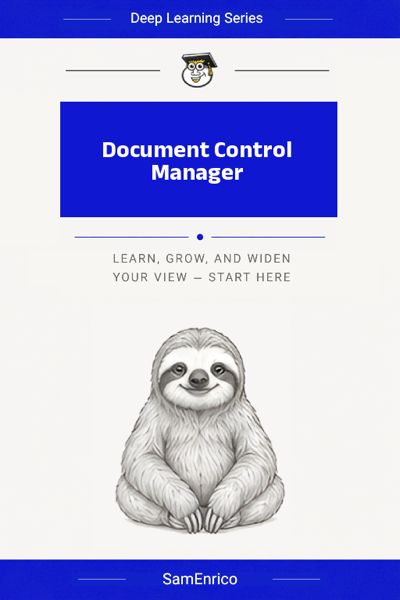
Non-FictionInformativeEducational
Document Control Manager eBook
A Coursebook on Document Control Manager
A Coursebook on Document Control Manager
Formats
Free sample
Chapter 1: Beyond the Filing Cabinet...--The year is 1985. In a fluorescent-lit basement of a Houston engineering firm, a clerk named Margaret spends her days pushing a cart loaded with three-ring binders. Each binder contains specifications for an offshore oil platform. Each specification has been revised seven times. The binders are color-coded, but the colors have faded.
The revision letters are handwritten on sticky labels that peel at the edges. When an engineer calls asking for "the current version of Specification 204-B," Margaret must walk to the binder, open it, check the revision block, and read the date. If the binder is missing—if someone has checked it out and not returned it—she must walk the corridors, knocking on doors, asking, "Do you have the blue binder?" This takes hours. Sometimes days. Sometimes the binder never reappears.
Margaret is not incompetent. She is a victim of a system that was obsolete before she was hired. She is a filing clerk in a world that had not yet invented document control.The year is 2026. The basement is gone. The binders are gone.
Margaret is retired. In her place stands a Document Control Manager named James. James sits in an open-plan office, but his desk is largely empty. His tools are not physical. They are digital: an Electronic Document Management System (EDMS), a dashboard of Key Performance Indicators (KPIs), and a smartphone that buzzes with approval requests from three continents.
When an engineer in Singapore asks for the current version of Specification 204-B, James does not walk anywhere. He types a query into his EDMS, and the document appears in milliseconds. He can see who viewed it, who approved it, and who tried to edit it without permission. He can see the entire audit trail from creation to current revision. He can even see that the engineer in Singapore has already downloaded the correct version twice today.
James is not a filing clerk. He is a strategic business partner. He is a Document Control Manager.This chapter is the story of that transformation. It is about the evolution of document control from a clerical afterthought to a strategic governance function. It is about the distinction between document control, document management, and records management—three terms that are often confused but serve very different purposes.
It is about the business case for professional document control: reduced rework, audit readiness, intellectual property protection, and litigation defense. And it is about you—the aspiring Document Control Manager—and the career that awaits you. By the end of this chapter, you will understand not just what document control is, but why it matters. And you will be ready to move beyond the filing cabinet.The Three Pillars: Document Control, Document Management, and Records Management Before we go any further, we must clarify our terms. The field of document control is plagued by ambiguous language.
Different industries use the same words to mean different things. Different regulators use different frameworks. Even within a single organization, you may hear "document control," "document management," and "records management" used interchangeably. They are not interchangeable. They are three distinct pillars of information governance, and understanding the difference is the first step toward mastery.Document control is the management of active documents throughout their review, approval, distribution, and revision cycle.
It answers the question: "Is everyone using the right version?" Document control ensures that when a specification is revised, every controlled copy is updated. It ensures that obsolete documents are removed from circulation. It ensures that approvals are captured and archived. Document control is about process—the workflows that govern how documents are created, reviewed, approved, and changed. Document control is active, dynamic, and forward-looking.
It is the engine that keeps the organization running on current, accurate information.Document management is the broader system of storing, retrieving, and organizing documents. It answers the question: "Where is the document?" Document management includes the folder structures, naming conventions, metadata schemas, and search tools that allow users to find documents quickly. It includes the EDMS itself—the software platform that houses the documents. Document management is about infrastructure—the architecture that supports document control. Without good document management, document control is impossible because you cannot control what you cannot find.
But document management alone is not enough. A well-organized repository of obsolete documents is still a repository of obsolete documents. Document management provides the container; document control provides the rules.Records management is the preservation and disposition of completed, legally significant documents. It answers the question: "How long must we keep this, and when can we destroy it?" Records management deals with documents that are no longer active—no longer being revised, no longer in daily use. These documents have become records: evidence of past transactions, decisions, and activities.
Records management determines retention schedules (how long records must be kept to satisfy legal, regulatory, and business requirements) and disposal methods (shredding, certified digital deletion, archiving). Records management is about compliance—ensuring that the organization does not destroy records too early (risking fines and legal sanctions) or keep them too long (risking unnecessary storage costs and privacy breaches).These three pillars are interdependent. You cannot have effective document control without document management (you cannot control what you cannot find) or records management (you cannot distinguish active documents from obsolete records). But they are distinct functions, and a Document Control Manager must understand all three. In practice, the Document Control Manager often oversees all three, particularly in smaller organizations.
In larger organizations, these functions may be split among different roles: Document Control (active documents), IT/Document Management (infrastructure), and Records Management (retention and disposal). Regardless of the organizational structure, the Document Control Manager sits at the intersection, ensuring that documents move seamlessly from creation (document control) to storage (document management) to retention (records management) to disposal.The Evolution: From Filing Clerk to Strategic Partner The role of the document controller has undergone a transformation that mirrors the transformation of information itself. Let us trace that evolution.The 1980s: The Filing Clerk. In the era of paper, document control was primarily about physical custody. The filing clerk—almost never called a document controller—was responsible for storing binders, checking documents in and out, and maintaining a log of who had what.
The work was manual, slow, and error-prone. The filing clerk had no strategic role. They were not consulted on process design or system selection. They were not invited to management meetings. They were support staff, and they were treated as such.
The limitations of the paper era were not seen as problems to be solved but as facts of life. Documents went missing. Revisions were lost. Projects were delayed. This was simply how business worked.The 1990s: The Early Adopter.
The arrival of networked computers and the first document management systems began to change the landscape. Organizations could now store documents electronically, though the systems were expensive, complex, and often user-unfriendly. The filing clerk became a "document controller"—a new title that reflected the shift from physical to digital. But the role remained largely clerical. The document controller was still not strategic.
They were still not consulted on process design. They were, however, becoming more technical. They learned to use the EDMS.…
This is the end of the free sample. Get the eBook to keep going. Buy now
About this book
Details
- Author
- Givens Sharen
- Publisher
- SamEnrico
- Language
- English
- Genre
- Non-Fiction, Informative, Educational
- Released
- 2026-06-02
- Pages (approx.)
- 134
- Available as
- eBook, Audiobook

Read better in the ZLOADR app
Your eBooks on your phone or tablet. Sign in with your SamEnrico account and start reading.
More by Givens Sharen
 Rosa Parks Detroit YearsGivens Sharen$11.99
 Past Relationship Trauma GuideGivens Sharen$11.99
 Parking Anger TriggersGivens Sharen$11.99
 Cape Town Design Talent GuideGivens Sharen$11.99
 The Afterpay and BNPL Trap GuideGivens Sharen$11.99
 The Golden Spear: The Rise of the Nubian Warrior QueensGivens Sharen$11.99
 How to Become a Spring Coiling Machine SetterGivens Sharen$11.99
 Constructive Discharge TrapGivens Sharen$12.99
 Log Linear Models Excel GuideGivens Sharen$12.99
 Understanding PseudohermaphroditismGivens Sharen$17.99
You may also like
 Hong Kong Handover 1997Dunn Johnnie$11.99
 Zumba For Postnatal Recovery CourseNeal Christian$11.99
 Zumba for BeginnersLadner Nikia$11.99
 YouTube Comment Mining GuideHumes Pandora$12.99
 Worry Box MeditationCarlin Rudy$11.99
 Workplace Stress MeditationNguyen Lynn$11.99
 Workplace Stress and Sleep RepairHawley Ivory$11.99
 Workplace Perfectionism CureDelaney Jeffry$11.99
 Workplace Injustice Anger GuideWallen Isabelle$11.99
 Work Addiction and Burnout LinkGreenwood Ester$11.99
 Women in Yoga and WellnessBeattie Galina$11.99
 Women in Stand Up ComedyChun Evangeline$11.99