
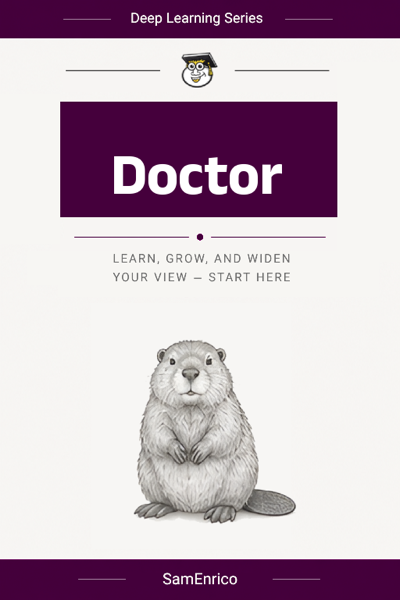
Non-FictionInformativeEducational
Doctor eBook
A Coursebook on Doctor
A Coursebook on Doctor
Formats
Free sample
Chapter 1: You Know Nothing...--– You are about to kill someone.Not today, probably. Not even this month. But sometime in the next few years, if you continue down this path, you will make a mistake that harms a patient. You will order the wrong test, miss the subtle finding, or hesitate one second too long. And when it happens, every attending who ever praised you, every exam you ever aced, every patient who ever thanked you will evaporate from your memory.
You will be left with one thought, repeating on a loop: I am a fraud. They are about to find me out. I do not belong here.Welcome to your first day as a doctor.This feeling has a name, and it is not weakness. It is called imposter syndrome, and the research from Stanford Medical School is unambiguous: residents who score highest on imposter syndrome inventories have lower rates of diagnostic misses. Not because they are better doctors—because they check everything twice.
The fear of being "found out" drives hypervigilance, and hypervigilance, in medicine, saves lives.The problem is that no one told you this. Medical school taught you the Krebs cycle, the brachial plexus, and the mechanism of action of thirty-seven antihypertensives. It did not teach you what to do at 3 AM when your patient's blood pressure is dropping and your senior resident is in another code and you are the only doctor in the room. It did not teach you how to cry in the supply closet without anyone hearing. It did not teach you that asking for help is not a sign of incompetence but the defining characteristic of a doctor who will survive.This book is the curriculum they forgot to write.The Myth of the Omniscient Physician There is a portrait that hangs in every medical school, usually in the dean's office or the main lecture hall.
It depicts a physician from a century ago: white coat, stethoscope draped precisely, expression calm and knowing. This doctor never doubted. This doctor never made an error. This doctor, if the portrait could speak, would offer the correct diagnosis after a fifteen-second glance at the patient.This doctor never existed.The reality of medical training is not a smooth arc from novice to expert. It is a series of terrifying leaps.
One day you are a medical student, following a resident around, writing down the patient's history but not making any decisions. The next day you are an intern, and suddenly every decision is yours, or at least it feels that way. The patient is bleeding. The nurse is looking at you. The attending is asleep at home.
You open your mouth, and a voice comes out that does not sound like yours. "Start two large-bore IVs. Call blood bank. Page the surgery resident."And then, miraculously, the patient stabilizes.You will spend the first six months of residency waiting for someone to tap you on the shoulder and say, "We made a mistake. You're not actually a doctor.
Please return your badge and your pager." That tap will never come. Not because you stop feeling like an imposter, but because you learn to do the work despite the feeling.The hidden curriculum is what medical schools do not teach because it cannot be taught in a lecture hall. It is the unspoken rules of hierarchy: the attending is always right, unless they are dangerously wrong, in which case you must find a way to correct them without humiliating them. It is the emotional suppression: you will see children die, and you will be expected to walk into the next room and smile at the next patient. It is the endurance: seventy-hour weeks, overnight calls, missed birthdays, and the slow erosion of every relationship you had before residency.The hidden curriculum is not malicious.
It is inherited. Every attending you meet went through the same gauntlet, and most of them believe, quietly, that if they survived, you should too. The problem is that survival is not the same as thriving. And medicine has spent a century optimizing for survival while ignoring the cost.The Three Lies They Told You in Medical School Before we go any further, we need to name the lies. Not malicious lies—lies of omission, lies of convenience, lies that medical schools tell themselves because the truth is too uncomfortable to admit.Lie Number One: "You will have all the information you need to make every decision."In medical school, every patient case is a tidy package.
The history is complete. The labs are back. The imaging is available. You have ten minutes to review everything and then present to an attending who already knows the diagnosis.In residency, you will make decisions with half the information. The patient is actively seizing.
The lab results will not be ready for forty-five minutes. The CT scanner is broken. The family is crying. You have to decide now whether to intubate. Not in five minutes.
Now.The skill they did not teach you is decision-making under uncertainty. You will learn it the hard way, by making mistakes and surviving them. But you can learn it faster by understanding the framework: separate what you know from what you assume, identify the one piece of missing information that would change your decision, and act on the best available evidence while preparing to change course when better information arrives.Lie Number Two: "Emotional detachment is a sign of professionalism."The doctors who taught you in medical school seemed calm, collected, and slightly robotic. You assumed they had no emotions. You were wrong.
They had emotions—they had just learned to hide them, and the hiding was destroying them slowly.Emotional detachment is not professionalism. It is a risk factor for burnout, depression, and medical error. The doctors who survive long careers are not the ones who feel nothing. They are the ones who feel everything and have built systems to process it: a therapist, a peer support group, a running habit, a weekly dinner with friends who are not in medicine.The skill they did not teach you is emotional resilience—not the absence of emotion, but the ability to feel it without being destroyed by it. You will learn this by losing your first patient, crying in the call room, and then walking out to see your next patient anyway.
That is not weakness. That is the job.Lie Number Three: "You are the most important person in the room."Medical school trains you to be the hero. The patient is sick. You diagnose them. You treat them.
They get better. You move to the next room.In reality, you are one person on a team of dozens. The nurse who noticed the patient's blood pressure dropping—she saved that life. The respiratory therapist who bagged the patient while you fumbled with the intubation equipment—he saved that life. The pharmacist who caught your medication dosing error before you administered it—she saved that life and saved your license.The skill they did not teach you is team-based humility.
You will learn it the first time a nurse corrects you in front of a patient and you feel your…
This is the end of the free sample. Get the eBook to keep going. Buy now
About this book
Details
- Author
- Crowder Beryl
- Publisher
- SamEnrico
- Language
- English
- Genre
- Non-Fiction, Informative, Educational
- Released
- 2026-06-02
- Pages (approx.)
- 159
- Available as
- eBook, Audiobook

Read better in the ZLOADR app
Your eBooks on your phone or tablet. Sign in with your SamEnrico account and start reading.
More by Crowder Beryl
 Chechen Mafia Power RiseCrowder Beryl$11.99
 Pinterest VA Pinterest Shop SetupCrowder Beryl$11.99
 Mindfulness for Chronic Hip BursitisCrowder Beryl$11.99
 Breast Skin Changes GuideCrowder Beryl$11.99
 Food Addiction Neurobiology BasicsCrowder Beryl$11.99
 The Duke Who Dared: Regency’s Most Scandalous Proxy RuleCrowder Beryl$11.99
 The Last Letter: Sylvia Plath’s Secret CorrespondenceCrowder Beryl$11.99
 Crowdfunding Pre Seed GuideCrowder Beryl$12.99
 Blocking Recovery TechniquesCrowder Beryl$12.99
 Understanding Colobomatous MicrophthalmiaCrowder Beryl$17.99
 How to Start a Bran Cleaners Business (Beginners Guide)Crowder Beryl$11.99
You may also like
 Hong Kong Handover 1997Dunn Johnnie$11.99
 Zumba For Postnatal Recovery CourseNeal Christian$11.99
 Zumba for BeginnersLadner Nikia$11.99
 YouTube Comment Mining GuideHumes Pandora$12.99
 Worry Box MeditationCarlin Rudy$11.99
 Workplace Stress MeditationNguyen Lynn$11.99
 Workplace Stress and Sleep RepairHawley Ivory$11.99
 Workplace Perfectionism CureDelaney Jeffry$11.99
 Workplace Injustice Anger GuideWallen Isabelle$11.99
 Work Addiction and Burnout LinkGreenwood Ester$11.99
 Women in Yoga and WellnessBeattie Galina$11.99
 Women in Stand Up ComedyChun Evangeline$11.99