
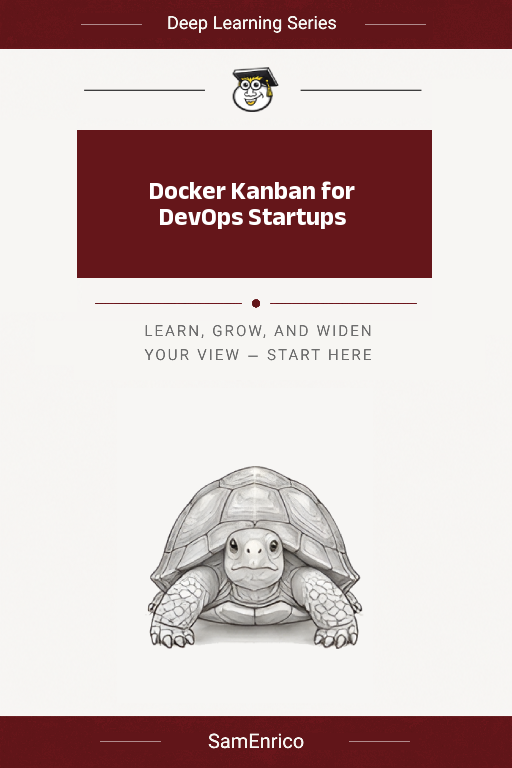
Docker Kanban for DevOps Startups eBook
Containerize your kanban workflow using Docker's i
Containerize your kanban workflow using Docker's infrastructure-as-code approach, treating process improvements as pull requests in startup environments.
Formats
Free sample
Chapter 1: The Friday Night Epiphany–- The deployment finished at 4:32 PM on a Friday. Maria Chen, CTO of a sixteen-person fintech startup called Pay Flow, watched the green checkmark appear in her CI/CD pipeline and allowed herself exactly three seconds of relief. Then her phone buzzed. Then her co-founder's face appeared on the Slack call. Then the numbers started arriving: payment success rates had dropped from 99.2% to 91.7% in the last hour. Forty-three customers had already submitted support tickets. The payment processor was threatening to flag their account for "unusual failure patterns.""What just shipped?" her co-founder asked.Maria scrolled through the deployment. A single pull request. Thirty-seven lines changed. A "minor refactor" to the retry logic that was supposed to make the payment gateway more resilient. It had passed all tests. It had been reviewed by her most senior engineer. It had been approved by product management. And it was now, unmistakably, catastrophically wrong.The rollback took eleven minutes. During those eleven minutes, Maria's team did what any competent Dev Ops startup would do: they opened the war room channel, started debugging the logs, and began the post-mortem before the fire was even out. But as Maria watched the conversation unfold, she noticed something strange. The engineer who had written the code was explaining his decisions. The reviewer was explaining why she had approved it. The product manager was explaining why the requirement had been ambiguous. Everyone was explaining. No one was blaming. And yet, the explanations didn't add up."I moved the card to 'Done' last week," the engineer said. "I thought it was finished.""I saw it in 'Review' for three days," the reviewer said. "I assumed someone else was handling it.""I marked it as 'Blocked' for legal review," the product manager said. "But legal stopped responding to tickets six weeks ago."Maria stared at their Kanban board. Eighty-three cards. Twenty-seven marked "In Progress." Twelve untouched for over two weeks. Three marked "Blocked" with no updates since the last sprint. A board that was supposed to bring clarity had become a graveyard of forgotten work, invisible handoffs, and unspoken assumptions.That was the moment Maria realized her startup was dying. Not from lack of customers. Not from technical debt. Not from a bad product-market fit. But from something she had never been taught to see, measure, or fix.Process debt.The Diagnosis No One Makes Technical debt has a vocabulary. We say "refactoring," "unit test coverage," "legacy code," "bit rot." We have tools to measure it—Sonar Qube, Code Climate, static analysis. We have methodologies to manage it—test-driven development, continuous integration, regular sprints dedicated to cleanup. Technical debt is visible, measurable, and actionable. When a developer says "we need to pay down technical debt," every other developer nods in understanding.Process debt has none of this.Process debt is the accumulation of inconsistent rules, invisible handoffs, tribal knowledge, and unenforced policies that slowly strangle a startup's ability to ship. It manifests as:A "definition of done" that changes depending on which project manager is asking A code review that takes three days because the only senior engineer who understands the payment system is overwhelmed with meetings A blocked card that sits in a column for two weeks while everyone assumes someone else is handling it A WIP limit that everyone ignores because no one remembers why it was set or who has the authority to change it A status column called "In Review" that actually means "waiting for CI" or "needs product signoff" or "I forgot to move it"Maria's team had all of these symptoms. The payment gateway disaster was not the cause of their problems. It was a symptom of a deeper disease.Why Saa S Tools Make Everything Worse Pay Flow used Jira. Before Jira, they used Trello. Before Trello, they used a whiteboard. Each migration was supposed to fix the process. Each migration made it worse.Here is the fundamental problem with every Saa S-based project management tool: they are stateful, cloud-locked, and impossible to replicate locally. Your process lives in someone else's database, configured through a point-and-click interface that cannot be version-controlled, code-reviewed, or rolled back. Every change to your workflow is an irreversible, un-auditable act of faith.Ask yourself these questions:When was the last time you changed a WIP limit? Can you find the discussion that led to that decision? Can you see who approved it and why? Or is it lost in Slack history?If your project management tool went offline right now, could you spin up an identical board with all the same rules in under fifteen minutes? Or would your team be paralyzed?Do you have a single, authoritative definition of what "In Progress" means, enforced automatically rather than left to interpretation? Or does it mean different things to different people?Can you trace a single card from its creation in the backlog, through every transition, to its deployment in production, with all associated code changes, review comments, and test results linked together? Or does that require a five-tab browser session and tribal knowledge?For ninety-nine percent of startups, the answer to every question is no. This is not a failure of discipline. It is a failure of tooling. The tools we use to manage process are fundamentally incompatible with the way we manage code.And until that changes, process debt will continue to accumulate.The Insight That Changes Everything What if your process could be treated exactly like your code?What if your Kanban board was defined in a Dockerfile and a docker-compose.yml file, stored in Git, versioned with Sem Ver tags, and deployed via the same CI/CD pipeline that ships your application?What if changing a WIP limit required a pull request, a code review, and automated tests that verified the new limit wouldn't break your team's throughput?What if a blocked card triggered the same kind of alert as a failed unit test—stopping the line until the problem was resolved?What if you could roll back your entire process to last week's configuration with a single docker compose up command?This is not speculation. This is not a thought experiment. This is the core thesis of this book: your process should be containerized, version-controlled, and auditable, just like your code.Maria had this insight at 2:17 AM on Saturday, alone in her home office, a cold cup of coffee beside her and the memory of forty-three support tickets burning in her mind. She opened her terminal and typed:bash Copy Downloadmkdir payflow-process
cd payflow-process git init She didn't know what she was building yet. But she knew the direction.The Four Container Types: A Taxonomy for the Rest of This Book Before we go further, we need to establish a shared vocabulary. Throughout this book, we will refer to four distinct types of containers. Understanding the difference between them is essential to everything that follows.Type A: The Process Container This is the Kanban board itself—the running application that displays your columns, enforces your WIP limits, validates your transitions, and stores your card data. The Type A container is stateless in terms of configuration (which lives in Git) but stateful in terms…
This is the end of the free sample. Get the eBook to keep going. Buy now
About this book
Details
- Author
- Ryan Guadalupe
- Publisher
- SamEnrico
- Language
- English
- Genre
- Non-Fiction, Startup Guide
- Released
- 2026-06-01
- Pages (approx.)
- 149
- Available as
- eBook, Audiobook

Read better in the ZLOADR app
Your eBooks on your phone or tablet. Sign in with your SamEnrico account and start reading.
More by Ryan Guadalupe
 Workaholic People PleasingRyan Guadalupe$11.99
 The B Vitamin Complex GuideRyan Guadalupe$11.99
 Mnemonic Journal PracticeRyan Guadalupe$11.99
 Intention Setting MorningRyan Guadalupe$11.99
 Physical Activity Burnout RecoveryRyan Guadalupe$11.99
 Jumia Warehouse Storage GuideRyan Guadalupe$12.99
 Veterinarian Imposter GuideRyan Guadalupe$11.99
 Influence For Human ResourcesRyan Guadalupe$11.99
 Burn Community ResourcesRyan Guadalupe$11.99
 Quantum Horizons: The Explorers Who Redrew the WorldRyan Guadalupe$11.99
 The Lion Engineers of Aksum: Building Bridges to the WorldRyan Guadalupe$11.99
 English Setter: Gentle & BirdyRyan Guadalupe$11.99
You may also like
 MongoDB Kanban for Database StartupsZamora Loyd$12.99
 Zoom Kanban for Video StartupsBlair Ida$12.99
 Venture Debt Vs Equity RecapHermann Alba$12.99
 Venture Debt Revenue Based GuideCalloway Sidney$12.99
 Venture Debt Lien Types ExplainedSherrill Marci$12.99
 Venture Debt Interest Rate HedgingRockwell Sherly$12.99
 Venture Debt Intercreditor GuidePomeroy Bernarda$12.99
 Venture Debt for Women FoundersChilders Soon$12.99
 Venture Debt for Hardware StartupsGarris Deonna$12.99
 Venture Debt For Hardware GuideWithers Damian$12.99
 Venture Debt for Climate TechElston Ahmed$12.99
 Venture Debt for Clean TechKearns Candance$12.99