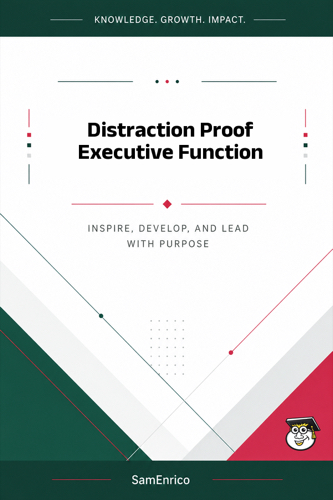
Distraction Proof Executive Function eBook
Strengthens working memory and task switching to r
by Eckert Kesha
Strengthens working memory and task switching to reduce the impact of unavoidable interruptions.
Formats
Free sample
Chapter 1: The Fortress Lie--The most exhausted person in any office is not the one working the hardest. It is the one fighting the most battles against reality. You know this feeling. You have felt it at 2:17 PM on a Tuesday, sitting in front of a screen that contains seventeen open tabs, three unanswered Slacks, an email draft you started four hours ago, and a spreadsheet you cannot remember why you opened. Your jaw is tight.
Your coffee is cold. And you have accomplished exactly nothing that resembles what you set out to do this morning. Here is the truth that no productivity guru has been willing to say out loud: you will never eliminate interruptions. Not tomorrow. Not next year.
Not after you buy that fancy noise-canceling headset or install that app that blocks social media or finally convince your boss to let you work from home. Interruptions are not a bug in the modern workplace. They are a feature. They are structural, systemic, and permanent. The question is not whether you can build a fortress around your attention.
The question is whether you can learn to thrive inside the chaos.This entire chapter is dedicated to dismantling one dangerous fantasy. Call it the Fortress Lie. The Fortress Lie says that productivity is possible only when you have perfect silence, complete control over your environment, and the unquestioning cooperation of every human being within earshot. The Fortress Lie sells noise-canceling headphones. It sells “do not disturb” signs.
It sells co-working memberships in libraries and coffee shops. It sells the dream of a log cabin in the woods where no one can ping you, email you, or tap you on the shoulder. And here is the cruel irony: the people who sell you the Fortress Lie are not lying maliciously. They are selling you what you want to hear. You want to believe that if you could just eliminate the distractions, you would finally be productive.
You want to believe that your failures of focus are environmental, not internal. But the Fortress Lie is still a lie. And until you stop chasing it, you will remain exhausted, frustrated, and convinced that something is wrong with you.Something is not wrong with you. You have simply been fighting the wrong war.The Open Office Paradox Let us start with the most obvious offender. The open office floor plan was designed to increase collaboration.
In practice, it has become the single greatest enemy of focused work. Studies have shown that workers in open offices are interrupted approximately every three minutes. Three minutes. That is barely enough time to read a single email, let alone enter a state of deep concentration. But here is the paradox that the Fortress Lie cannot explain.
When researchers at Harvard asked workers whether they would prefer a private office or an open plan, nearly everyone said private. Yet when those same workers were moved into private offices, their self-reported productivity did not increase. In some cases, it decreased. Why? Because the workers who had private offices felt less accountable.
They checked out more often. They took longer breaks. The open office, for all its chaos, provided a kind of ambient pressure that kept people working. The Fortress Lie promises that isolation is the answer. But isolation comes with its own costs.
You do not need a fortress. You need a system that works whether you are in a silent library or a bustling train station.The open office paradox reveals something deeper about the nature of attention in the modern economy. We have been told that interruptions are accidents—little glitches in an otherwise smooth workflow. They are not accidents. They are the intended architecture of collaborative knowledge work.
When you work in a team, your colleagues need access to you. When you work in an open office, your senses are constantly scanning for relevant information. When you work in a digital environment, the notifications are designed by companies who profit from your immediate attention. None of this is going away. You can complain about it.
You can write angry Linked In posts about how “deep work is dying.” You can install seventeen different focus apps. Or you can accept the reality that interruptions are structural and build a system that works inside that reality.Availability Pressure and the Anxiety of Response There is a second layer to the Fortress Lie that is even more insidious. It is not just that interruptions happen. It is that we have internalized a set of beliefs about what it means to be a good colleague, a good employee, a good person. These beliefs create what researchers call “availability pressure”—the persistent anxiety that if you are not instantly responding to every ping, you are failing.
Consider the last time you saw a Slack message and deliberately waited ten minutes to respond. Did you feel good about that choice? Or did you feel a small spike of guilt, a whisper that said, “You should answer faster”? That whisper is availability pressure. It is not rational.
Most messages do not require an immediate response. But the whisper does not care about rationality. It cares about social belonging. It cares about being seen as reliable, responsive, and “on it.”The Fortress Lie tells you that you can solve availability pressure by turning everything off. Just close Slack, the lie says.
Just put your phone in another room. Just ignore everyone until you finish your deep work. This advice sounds powerful. It also does not work for anyone who has a job that involves other human beings. If you are a manager, you cannot ignore your team for four hours.
If you are a parent, you cannot ignore your child’s school. If you are in sales, you cannot ignore a client’s urgent question. The people who can afford to turn everything off are a tiny fraction of the workforce. For everyone else, the Fortress Lie becomes another source of shame. “I tried to do deep work,” you tell yourself, “but I couldn’t ignore my team.
Something is wrong with me.” Nothing is wrong with you. You were given bad advice.The Real Cost of Chasing the Fortress Chasing the Fortress Lie does not just waste your time. It actively damages your executive function. Here is what happens when you try to build a fortress around your attention. First, you spend energy on environmental control that could have been spent on actual work.
You rearrange your desk. You close your door. You put on your headphones. You open your focus app. You set your timer.
By the time you are ready to work, you have already expended a significant portion of your cognitive fuel. Second, you become brittle. A brittle system is one that fails catastrophically when its conditions are not met. The fortress builder needs silence. When a noise occurs, the fortress builder does not simply notice the noise and return to work.
The fortress builder becomes angry, resentful, and dysregulated. The interruption is not just an interruption. It is a violation of the sacred contract. Third, you train your brain to associate interruptions with threat. Every time you are interrupted while…
This is the end of the free sample. Get the eBook to keep going. Buy now
About this book
Details
- Author
- Eckert Kesha
- Publisher
- SamEnrico
- Language
- English
- Genre
- Non-Fiction, Self-Help, Cognitive Training
- Released
- 2026-06-09
- Pages (approx.)
- 148
- Available as
- eBook, Audiobook

Read better in the ZLOADR app
Your eBooks on your phone or tablet. Sign in with your SamEnrico account and start reading.
More by Eckert Kesha
 Growth Hormone and Estrogen ConnectionEckert Kesha$11.99
 Yahoo Security Team WhistleblowersEckert Kesha$11.99
 The Pre Recording RitualEckert Kesha$11.99
 Procrastination For MenEckert Kesha$11.99
 Naltrexone for AddictionEckert Kesha$11.99
 Goal Distraction ManagementEckert Kesha$11.99
 Parent's Room After DeathEckert Kesha$11.99
 The Skybound Enlightenment: How Thinkers Shaped the Modern WorldEckert Kesha$11.99
 The Iron Ships of the St. Lawrence: Canada's Forgotten Naval PioneersEckert Kesha$11.99
 Joint Employer Legal TrapEckert Kesha$12.99
 Scholarship Alumni Network HandbookEckert Kesha$12.99
 How to Produce Wood PreservativeEckert Kesha$11.99