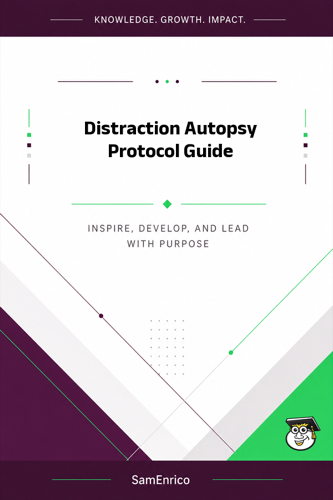
Distraction Autopsy Protocol Guide
After every significant distraction, conduct a fiv
by Edge Lakita
After every significant distraction, conduct a five-question forensic analysis to prevent recurrence.
Formats
About this book
Free sample
Chapter 1: The Crime Scene--–- The first time I realized I had a distraction problem, I was standing in my kitchen holding a cucumber I did not remember picking up.I had walked in to get a glass of water. That much I knew. But somewhere between the refrigerator and the sink, my phone had buzzed, I had checked a notification, scrolled for forty-seven seconds, and then—according to the security camera my wife later showed me—I had opened the crisper drawer, removed a cucumber, and stood staring at it for eleven seconds before looking confused.I was not making a salad. I had no intention of making a salad. My brain had simply gone offline, and my body had continued operating on a kind of autopilot that apparently included produce selection.That cucumber became my first piece of evidence.Why Most People Never Fix Their Distraction Problem Before we conduct our first real autopsy, we need to understand why traditional approaches to distraction fail.
You have likely tried willpower. You have tried to-do lists, phone timers, motivational podcasts, and the solemn promise to “do better tomorrow.” None of it worked for more than a few days because you were treating the symptom, not the cause.Here is what actually happens when you get distracted.You are writing an email. Your phone dings. You look. Someone liked your post.
You spend two minutes scrolling. You close the app. You try to return to the email. But you cannot remember what you were about to write. The thought is gone.
You feel a small sting of shame. You tell yourself to focus. Then you continue writing, but slower now, less confident.That entire sequence—from ding to shame—took perhaps three minutes. But the cost was not three minutes. The cost was the broken mental bridge between the sentence you were composing and the one you attempted to finish.
Researchers call this the context-switch cost, and it can take anywhere from ninety seconds to twenty-three minutes to fully recover from a single interruption, depending on the complexity of the task.Most…
This is the end of the free sample. Get the eBook to keep going. Buy now
Contents
- Chapter 1
- Chapter 2
- Chapter 3
- Chapter 4
- Chapter 5
- Chapter 6
- Chapter 7
- Chapter 8
- Chapter 9
- Chapter 10
- Chapter 11
- Chapter 12
Details
- Author
- Edge Lakita
- Publisher
- SamEnrico
- Language
- English
- Genre
- Non-Fiction, Self-Help, Root Cause Analysis
- Released
- 2026-06-08
- Pages (approx.)
- 138
- Available as
- eBook, Audiobook

Read better in the ZLOADR app
Your eBooks on your phone or tablet. Sign in with your SamEnrico account and start reading.
More by Edge Lakita
 Alcohol Purchase PatternsEdge Lakita$11.99
 Delegation for ExecutivesEdge Lakita$11.99
 Imposter Syndrome For HistoriansEdge Lakita$11.99
 Brain Imaging of PsychopathsEdge Lakita$11.99
 Retirement Income CalculatorEdge Lakita$11.99
 Free Testosterone GuideEdge Lakita$11.99
 Ragnarok’s Last Stand: The Defiance of Surtr the Fire GiantEdge Lakita$11.99
 Understanding Intracranial CystEdge Lakita$11.99
 A Collector's Handbook to the Cadillac Series 10Edge Lakita$11.99
 Plagiarism Avoidance Prompt KitEdge Lakita$12.99
 Bootcamp Technical Interview PrepEdge Lakita$12.99
 How to Produce Furniture PolishEdge Lakita$11.99