
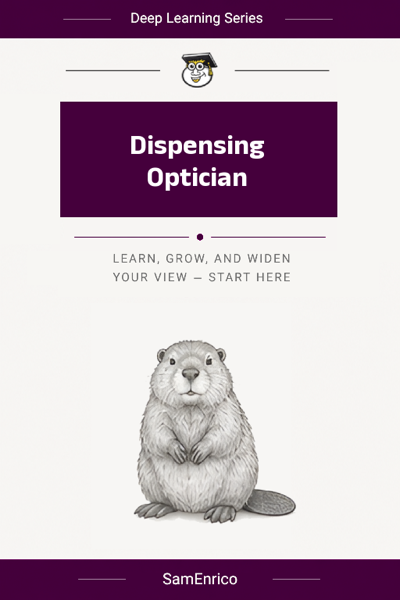
Non-FictionInformativeEducational
Dispensing Optician
A Coursebook on Dispensing Optician
A Coursebook on Dispensing Optician
Formats
About this book
Free sample
Chapter 1: The Living Lens...--The human eye is not a camera. This single sentence, repeated in every first-year opticianry course, rarely lands with the force it deserves. A camera has a fixed lens, a mechanical shutter, and a sensor that records whatever light happens to fall upon it. The eye, by contrast, is alive. It pulses with blood, shifts focus in milliseconds, compensates for its own imperfections, and—most astonishingly—begins to degrade the moment it finishes growing.
For the dispensing optician, understanding this living organ is not an academic exercise. It is the foundation upon which every frame selection, every lens material choice, and every patient interaction rests.When a patient sits across from you and complains that their new glasses feel "wrong," they are not describing a manufacturing defect. They are describing a mismatch between the physics of the lens you dispensed and the biology of their eye. You cannot solve that mismatch without understanding the eye’s optical properties, its anatomical limits, and its neurological quirks. This chapter builds that understanding from the ground up—starting with the structures that bend light, moving through the process of focusing, and ending with the common ocular conditions that transform a routine dispensing into a clinical challenge.1.1 The Gross Anatomy of the Eyeball: A Layered Journey The human eyeball is roughly spherical, averaging 24 millimeters in diameter from cornea to retina.
This measurement—axial length—is not merely an anatomical curiosity. It is the single most important determinant of whether a person is nearsighted, farsighted, or neither. But before we can understand refractive error, we must understand the layers of the eye itself.The Outer Layer: Fibrous Tunic The sclera, the white of the eye, is dense collagenous tissue that maintains the eye's shape and provides attachment points for the extraocular muscles. It is tough, avascular (except at its surface), and surprisingly flexible under intraocular pressure changes. At the front, the sclera transitions into the cornea—the eye’s primary refracting surface.
The cornea is transparent, avascular, and curved more steeply than the sclera. Its refractive power is approximately 43 diopters, accounting…
This is the end of the free sample. Get the eBook to keep going. Buy now
Contents
- Chapter 1
- Chapter 2
- Chapter 3
- Chapter 4
- Chapter 5
- Chapter 6
- Chapter 7
- Chapter 8
- Chapter 9
- Chapter 10
- Chapter 11
- Chapter 12
Details
- Author
- Coffman Natosha
- Publisher
- SamEnrico
- Language
- English
- Genre
- Non-Fiction, Informative, Educational
- Released
- 2026-06-02
- Pages (approx.)
- 143
- Available as
- eBook, Audiobook

Read better in the ZLOADR app
Your eBooks on your phone or tablet. Sign in with your SamEnrico account and start reading.
More by Coffman Natosha
 Indonesian Green Tax Credits GuideCoffman Natosha$11.99
 The Sick Child Sleep GuideCoffman Natosha$11.99
 Stress Management for Recent GraduatesCoffman Natosha$11.99
 Finland Energy Aid Scheme GuideCoffman Natosha$11.99
 Calisthenics Injury PreventionCoffman Natosha$11.99
 The Gilded Runway: Inside the Secret World of Private Jet ConciergeCoffman Natosha$11.99
 Love Letters from the Silk RoadCoffman Natosha$11.99
 EE for PhD GraduatesCoffman Natosha$12.99
 PDP For Parent ProfessionalsCoffman Natosha$12.99
 Understanding Chromosome 20Coffman Natosha$17.99
 How to Start a Hobby in Paper MakingCoffman Natosha$11.99
You may also like
 Hong Kong Handover 1997Dunn Johnnie$11.99
 Zumba For Postnatal Recovery CourseNeal Christian$11.99
 Zumba for BeginnersLadner Nikia$11.99
 YouTube Comment Mining GuideHumes Pandora$12.99
 Worry Box MeditationCarlin Rudy$11.99
 Workplace Stress MeditationNguyen Lynn$11.99
 Workplace Stress and Sleep RepairHawley Ivory$11.99
 Workplace Perfectionism CureDelaney Jeffry$11.99
 Workplace Injustice Anger GuideWallen Isabelle$11.99
 Work Addiction and Burnout LinkGreenwood Ester$11.99
 Women in Yoga and WellnessBeattie Galina$11.99
 Women in Stand Up ComedyChun Evangeline$11.99