
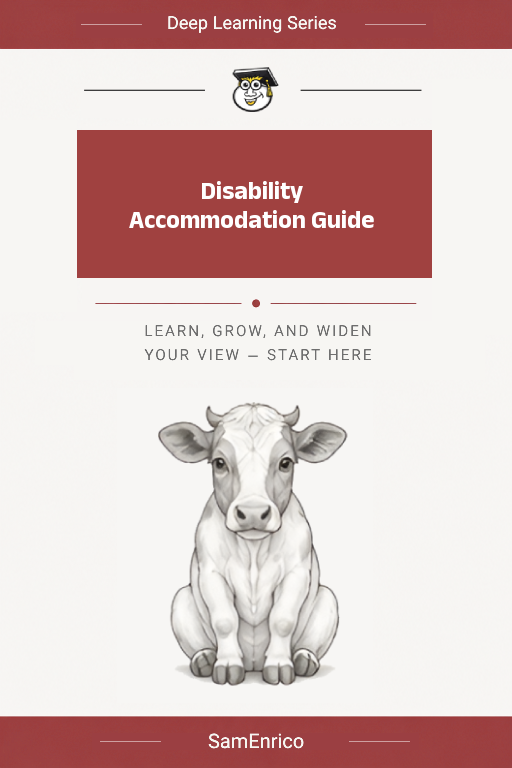
Disability Accommodation Guide eBook
Understand ADA requirements for first employee. Re
Understand ADA requirements for first employee. Reasonable accommodation and interactive process.
Formats
Free sample
Chapter 1: The First domino--–- The email arrived on a Tuesday afternoon. Sarah, who owned a small boutique marketing firm with three employees, had just finished her second cup of coffee when she read the words that would change how she thought about being a boss. "I need to talk to you about something," her senior designer wrote. "I've been struggling with some health issues, and I'm not sure I can keep coming into the office every day. Can we meet?"Sarah's first instinct was kindness.
She liked this employee. She considered herself a good person, a fair boss, the kind of owner who remembered birthdays and bought lunch on Fridays. She typed back immediately: "Of course. Take whatever time you need. We'll figure it out."That was the moment everything changed.
Not because Sarah was cruel or indifferent, but because she was exactly the opposite. She was so eager to be "nice" that she skipped every step of the process she did not know existed. She did not ask what the employee needed. She did not document the conversation. She did not consider whether "take whatever time you need" was sustainable for a three-person firm.
She just responded from the heart.Six months later, Sarah was sitting across from a lawyer, trying to explain why she had fired that same employee after four weeks of unexplained absence. The employee had filed a charge with the Equal Employment Opportunity Commission (EEOC), alleging disability discrimination and failure to accommodate. Sarah kept saying, "But I tried to help. I told her to take whatever time she needed." The lawyer's response was the most painful sentence Sarah had ever heard in business: "Good intentions are not a legal defense."The Hidden Trap That Catches Good Bosses This chapter exists because Sarah's story is not unusual. It happens thousands of times every year across the United States.
Small business owners who genuinely want to do the right thing find themselves on the wrong side of the Americans with Disabilities Act (ADA) not because they intended to discriminate, but because they never learned the basic rules of the road.The ADA was signed into law in 1990, and the ADA Amendments Act (ADAAA) fundamentally expanded it in 2008. Yet most small business owners have never read either law. They have never taken a single hour of training on disability accommodation. They assume, as Sarah did, that being a decent human being is enough. That assumption is wrong, and it is expensive.The EEOC receives approximately 25,000 disability discrimination charges each year.
A significant percentage come from small businesses with fewer than 15 employees—businesses whose owners believed they were "too small" to worry about the ADA. The median monetary recovery for an ADA charge settled by the EEOC is roughly $40,000. That does not include legal fees, which can easily double that amount. For a small business operating on thin margins, a single ADA lawsuit can be financially catastrophic.But here is the truth that most business books will not tell you: the ADA is not your enemy. The ADA is a framework.
It is a set of rules that, when followed, actually make it easier to manage employees with medical limitations. The problem is not the law. The problem is that no one ever taught you the rules.Why "Being Nice" Is Not the Same as "Being Compliant"Let us start with a distinction that will appear throughout this book. Being nice is subjective. It depends on your mood, your relationship with the employee, and your personal definition of fairness.
Compliance is objective. It depends on whether you followed a specific process, documented your decisions, and gave the employee a good-faith opportunity to participate in the interactive process.Sarah was nice. She told the employee to take whatever time she needed. But she was not compliant. She did not initiate a dialogue.
She did not ask for medical documentation tied to essential job functions. She did not explore whether a reduced schedule or temporary remote work might solve the problem. She made a unilateral decision based on her own assumptions, and when that decision became unsustainable, she terminated the employee without ever having engaged in the process the law requires.A court reviewing Sarah's case would not ask, "Was Sarah a nice person?" The court would ask, "Did Sarah engage in the interactive process in good faith?" The answer would be no. The court would not care about her intentions. It would care about her actions.This is the single most important lesson of this entire book: good intentions without structured process are not a defense.
They are not even relevant. The ADA is a process law. It requires specific steps, specific conversations, and specific documentation. You can follow those steps and still end up terminating the employee. The law allows that.
What it does not allow is skipping the steps entirely because you thought you were being kind.The Litmus Test: Your First Accommodation Request The first time an employee says something like "I need help because of a medical issue" is a litmus test for your entire company culture. How you respond will determine whether your employees see you as fair or arbitrary, whether they trust you or hide their limitations from you, and whether your business survives a potential lawsuit or crumbles under the weight of a bad decision.The litmus test has two possible outcomes. The first outcome is favoritism. You respond based on how much you like the employee, how long they have worked for you, or how much you personally sympathize with their condition. You make an exception that you would not make for someone else.
You tell them "take whatever time you need" without any structure. This feels good in the moment. It feels generous. But it is favoritism, not fairness, and favoritism collapses the moment the situation becomes difficult.The second outcome is fairness. You respond with a structured process that you would follow for any employee, regardless of your personal feelings.
You say, "Thank you for telling me. Let us meet tomorrow to understand what you are experiencing and explore what might help you succeed in your role." This feels less emotionally satisfying. It feels almost bureaucratic. But it is fair, it is defensible, and it gives you the information you need to make a good decision.The rest of this book is designed to help you choose fairness. Not because fairness is morally superior (though it is), but because fairness works.
Favoritism leads to inconsistency, resentment, and lawsuits. Fairness leads to predictability, trust, and legal protection.The Four-Step Framework (A Preview)Before we dive into the details of employment, disability definitions, and legal thresholds, you need to understand the destination. This book is built around a four-step framework that will become your default response to any accommodation request. These four steps are the heart of the ADA interactive process, and every chapter in Part 3 of this book is dedicated to explaining them in depth.Step 1: Analyze the Job. You cannot determine what accommodation is reasonable until you know exactly what the job requires.
What are the essential functions? What are the marginal functions? What tasks can be reassigned, and what tasks are the…
This is the end of the free sample. Get the eBook to keep going. Buy now
About this book
Details
- Author
- Hardesty Buena
- Publisher
- SamEnrico
- Language
- English
- Genre
- Non-Fiction, Business Brief, Legal Guide
- Released
- 2026-05-26
- Pages (approx.)
- 141
- Available as
- eBook, Audiobook

Read better in the ZLOADR app
Your eBooks on your phone or tablet. Sign in with your SamEnrico account and start reading.
More by Hardesty Buena
 Selma to Montgomery MarchHardesty Buena$11.99
 Comparison to Exes GuideHardesty Buena$11.99
 Customer Anger Triggers GuideHardesty Buena$11.99
 Cape Town Cleantech FundingHardesty Buena$11.99
 The Calorie Tracking for DiabetesHardesty Buena$11.99
 The Tournament of the Black Prince: The Birth of Sports Spectacle in Medieval EnglandHardesty Buena$11.99
 DocuSign RetentionHardesty Buena$12.99
 Understanding Proximal Tubulopathy Diabetes Mellitus Cerebellar AtaxiaHardesty Buena$17.99
 Director of ComplianceHardesty Buena$11.99
 How to Start a Chicory Growing Business (Beginners Guide)Hardesty Buena$11.99
You may also like
 Whistleblower Protection TrapRipley Maura$12.99
 Wage Theft Prevention GuideGomes Rashida$12.99
 Termination First Employee LawElkins Jannette$12.99
 Stock Options First HireCooks Adrianne$12.99
 Severance Agreement TrapsJenson Eloy$12.99
 Salary History Ban TrapGalindo Donte$12.99
 Remote Employee Legal TrapsBatson Johnson$12.99
 Religious Accommodation TrapMcgill Kandy$12.99
 Overtime Rules First EmployeeMaclean Cinda$12.99
 National Origin Trap GuideLarue Venita$12.99
 Multi State Employment TrapBelt Sean$12.99
 Military Leave Legal GuideLerma Shaquita$12.99