
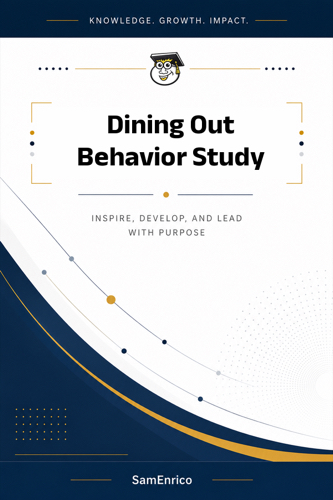
Non-FictionConsumer Mind ReportFood & Beverage
Dining Out Behavior Study eBook
Compare Boomer fine dining frequency against Gen Z
Compare Boomer fine dining frequency against Gen Z fast casual and delivery.
Formats
Free sample
Chapter 1: The Silver Tsunami...--The reservation book at Auguste’s, a venerable French restaurant in Chicago’s Gold Coast, tells a story that the owner wishes he could rewrite. On a recent Tuesday evening in October, twenty-seven of the restaurant’s forty-two tables were occupied. The average age of the diners was sixty-three. The average check was $187 per person before tip. Three tables celebrated anniversaries.
Two tables hosted four-generation family dinners. Not a single table ordered delivery, because Auguste’s does not offer it. Not a single guest scrolled their phone during the appetizer course, because the maître d’ has a quiet policy of asking diners to “be present.” By every traditional metric, the night was a success. Auguste’s has been open for forty-one years. It has survived recessions, the rise of casual dining, the farm-to-table revolution, and the pandemic.
But the owner, who is seventy-two himself, has begun to notice something that keeps him awake at three in the morning. He looks at the reservation book and sees a generation. He looks at his own reflection and sees the problem. His customers are aging. They are wealthy, loyal, and predictable.
They are also, quietly and inexorably, dying.This chapter is not about Auguste’s. It is about the economic and psychological fortress that Baby Boomers have built around the fine-dining industry—and the cracks that are already spreading through its foundation. To understand why Boomers dine differently than their grandchildren, we must first understand not just how much money they have, but how they think about that money in relation to a restaurant table. The story of the Boomer diner is a story of asset wealth, time abundance, and a very specific definition of value that has almost nothing to do with the price of a steak. It is also a story of a paradox: a generation that controls more wealth than any in human history, yet feels, increasingly, that it is being cheated by the very restaurants it has kept alive.
And it is a story of loyalty—but not the kind that points on an app can buy.The Boomer Balance Sheet Let us begin with the numbers, because the numbers are staggering and often misunderstood. According to the Federal Reserve’s 2023 Survey of Consumer Finances, Baby Boomers—Americans born between 1946 and 1964, now aged sixty to seventy-eight—control approximately $70 trillion in net worth. To put that figure in perspective, it is more than the combined GDP of every country on Earth except the United States and China. It represents 51 percent of all household wealth in America, held by just 21 percent of the population. Boomers also command $2.6 trillion in annual purchasing power, a figure that outpaces the entire economy of Canada.
When a Boomer walks into a restaurant, they are not stretching a budget. They are not calculating whether they can afford an appetizer. They are, by and large, the most economically secure generation the restaurant industry has ever seen.But wealth alone does not explain behavior. There are plenty of wealthy Gen Xers and affluent Millennials. What distinguishes Boomers is the composition of their wealth and their stage of life.
Boomer wealth is overwhelmingly illiquid. It is tied up in real estate (they own 38 percent of all homes in America, many mortgage-free) and retirement accounts (401(k)s and IRAs that they are either not touching or are required to draw down slowly). This means that while Boomers have high net worth, they have moderate monthly cash flow. They are not walking around with $1,000 in their pockets every day. They are, however, very comfortable spending $150 to $250 on a single meal when that meal is framed as an occasion.
This is the first key insight: Boomers do not treat restaurant meals as routine expenditures. They treat them as rituals.The Ritual Economy Ask a Boomer to describe their favorite restaurant, and they will not tell you about the price-performance ratio. They will tell you about the anniversary dinner where the chef sent out a complimentary champagne toast. They will tell you about the waiter who remembered their allergy after two years. They will tell you about the table by the window where they proposed, or the corner booth where they take their grandchildren every December.
These are not transactions. They are memories with a bill attached.Data from Touch Bistro’s 2024 Restaurant Industry Report supports this qualitative observation. When Boomers were asked what factors most influence their choice of a full-service restaurant, the top three responses were: quality of food (91 percent), service attentiveness (87 percent), and ambiance (78 percent). Price ranked fourth, at 54 percent—and when price did matter, it was in the context of value, not cost. Boomers are willing to pay $60 for a dry-aged steak if they believe the steak is excellent, the service is warm, and the room is comfortable.
They are not willing to pay $30 for a mediocre steak in a loud room with indifferent staff. Value, for Boomers, is not about getting the lowest price. It is about getting what they pay for—and, ideally, a little more.This brings us to the paradox mentioned at the opening of this chapter. Despite their wealth, nearly one in two Boomers report feeling that they are getting less value from restaurants than they did before the pandemic. The sources of this discontent are specific and, for restaurateurs, deeply concerning.
Shrinkflation—smaller portions for the same price—is the most cited grievance. A Boomer who orders a $48 lamb chop and receives a piece of meat that is visibly smaller than what they remember will notice, and they will remember. Indifferent service is the second grievance. After two years of industry-wide staffing shortages, many full-service restaurants have hired servers who are competent but not warm. For a generation that values the human touch, a server who does not make eye contact or who forgets to ask about dessert feels like a betrayal of the social contract.
The third grievance is more subtle: the disappearance of small amenities. Bread service, complimentary valet, a jacket check, a maitre d’ who knows your name—these are not costs to a Boomer. They are signals of care. When they disappear, the restaurant feels less like a destination and more like a transaction.The Loyalty Paradox Here we must address a point of confusion that has plagued many accounts of Boomer dining behavior. Are Boomers loyal or are they fickle?
The answer depends entirely on what is being asked of them. On matters of quality, service, and ambiance, Boomers are exceptionally loyal. Once a restaurant earns their trust—through consistent food, familiar faces, and a sense of being known—they will return to the same three or four places for years, sometimes decades. They will drive past newer, cheaper, trendier options to sit at the same table and order the same dish. This is not inertia.
It is a form of relationship maintenance. For Boomers, a restaurant is not a utility that can be swapped out for a competitor with a better promotional offer. It is a third place, a member of their personal geography, a landmark in their lives.But on matters of price, Boomer loyalty has sharp limits. When inflation pushes menu…
This is the end of the free sample. Get the eBook to keep going. Buy now
About this book
Details
- Author
- Mcwilliams Aline
- Publisher
- SamEnrico
- Language
- English
- Genre
- Non-Fiction, Consumer Mind Report, Food & Beverage
- Released
- 2026-06-10
- Pages (approx.)
- 111
- Available as
- eBook, Audiobook

Read better in the ZLOADR app
Your eBooks on your phone or tablet. Sign in with your SamEnrico account and start reading.
More by Mcwilliams Aline
 Self Doubt In Learning GuideMcwilliams Aline$11.99
 Team Task Allocation GuideMcwilliams Aline$11.99
 Mega Backdoor RothMcwilliams Aline$11.99
 Managing Notification Overload CourseMcwilliams Aline$11.99
 Anger and Breakup ThreatsMcwilliams Aline$11.99
 Ma Anand Sheela BiographyMcwilliams Aline$11.99
 The Siege of Montluc: France's Bloody Prison Revolt of 1848Mcwilliams Aline$11.99
 DIM Supplement GuideMcwilliams Aline$11.99
 The Black Market of Life: Australia's Organ Harvesting Scandal (1960s-1970s)Mcwilliams Aline$11.99
 How to Start a Endodontic Dentistry Business (Beginners Guide)Mcwilliams Aline$11.99
 How to Produce Furniture AccessoriesMcwilliams Aline$11.99
 How to Produce Skillets and Frying PansMcwilliams Aline$11.99
You may also like
 Hong Kong Handover 1997Dunn Johnnie$11.99
 Zumba For Postnatal Recovery CourseNeal Christian$11.99
 Zumba for BeginnersLadner Nikia$11.99
 YouTube Comment Mining GuideHumes Pandora$12.99
 Worry Box MeditationCarlin Rudy$11.99
 Workplace Stress MeditationNguyen Lynn$11.99
 Workplace Stress and Sleep RepairHawley Ivory$11.99
 Workplace Perfectionism CureDelaney Jeffry$11.99
 Workplace Injustice Anger GuideWallen Isabelle$11.99
 Work Addiction and Burnout LinkGreenwood Ester$11.99
 Women in Yoga and WellnessBeattie Galina$11.99
 Women in Stand Up ComedyChun Evangeline$11.99