
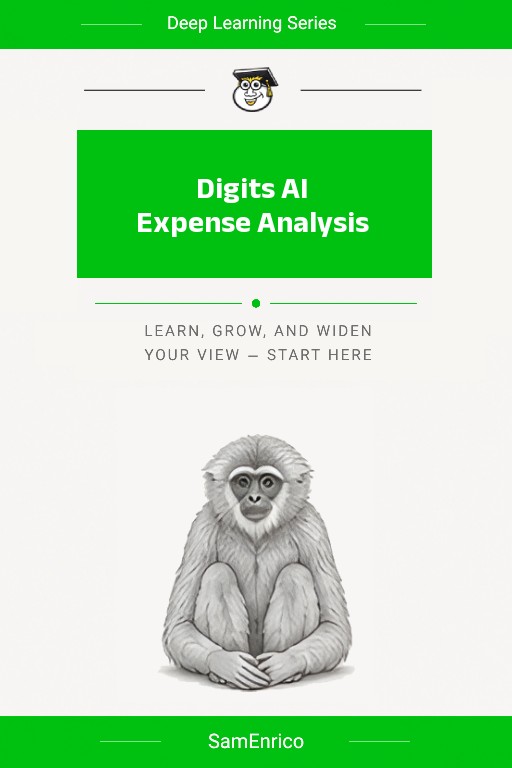
Digits AI Expense Analysis eBook
Upload bank statements to Digits for AI-driven cat
Upload bank statements to Digits for AI-driven categorization and spending insights, designed for startups without dedicated accounting staff.
Formats
Free sample
Chapter 1: The Sunday Night Trap--–- The screen glowed at 11:47 PM, casting blue light across a kitchen table littered with credit card statements, crumpled receipts from three different coffee shops, a half-empty mug of cold coffee, and a laptop with thirty-seven open tabs. Sarah, the founder of a sixteen-person Saa S startup, had been at this since 8 PM. She had promised herself she would finish the books this weekend. She had made the same promise last weekend. And the weekend before.The problem was not her work ethic.
The problem was that her company had grown. Twelve months ago, with just four people, she could track every expense in a simple spreadsheet. She knew every vendor, every subscription, every coffee meeting. But now, with sixteen employees, three corporate credit cards, two bank accounts, and customers in four countries, the spreadsheet had become a monster. Formulas broke when someone inserted a row.
Categorization was inconsistent—sometimes "AWS," sometimes "Amazon Web Services," sometimes "Cloud Services." And receipts? She had given up on receipts three months ago.Sarah was not alone. Across the country, thousands of startup founders were spending their Sunday nights doing exactly what she was doing: manually matching transactions, guessing at categories, and praying that the numbers would somehow balance. They were building products, hiring teams, and raising capital—but they were also acting as part-time, untrained, exhausted accountants. And it was killing their businesses.This book is not for accountants.
It is not for CFOs or finance professionals. It is for founders who hate spreadsheets, who have better things to do than categorize coffee receipts at midnight, and who suspect—correctly—that there has to be a better way. There is. It is called Digits AI Expense Analysis, and by the time you finish this chapter, you will understand why manual bookkeeping is not just tedious but dangerous, and why the startups that survive will be the ones that hand this work over to artificial intelligence.The Hidden Cost of "Doing It Yourself"Let us start with a simple question: How much is your time worth? Not what you pay yourself—what it is actually worth.
If you are a founder, your most valuable asset is not your code, your customers, or your pitch deck. It is your attention. Every hour you spend categorizing expenses is an hour you are not talking to customers, not fixing bugs, not hiring talent, not thinking strategically about your business.But the cost is worse than lost time. It is the cost of being wrong.A study of early-stage startups found that founders who manage their own books without formal training make categorization errors in 20 to 30 percent of transactions. A 10,000laptopbecomesanoperatingexpenseinsteadofacapitalasset,understatingprofitinthecurrentyearandoverstatingitinfutureyears.A10,000 laptop becomes an operating expense instead of a capital asset, understating profit in the current year and overstating it in future years.
A 10,000laptopbecomesanoperatingexpenseinsteadofacapitalasset,understatingprofitinthecurrentyearandoverstatingitinfutureyears.A500 client dinner becomes "Meals" instead of "Client Acquisition," hiding the true cost of sales. A $2,000 flight to meet an investor becomes "Travel" instead of "Fundraising Expense," distorting the picture of where capital is actually going.These errors do not just make your books messy. They make your decisions wrong.If you think your customer acquisition cost is 200whenitisactually200 when it is actually 200whenitisactually250, you will make bad marketing investments. If you think your burn rate is 80,000whenitisactually80,000 when it is actually 80,000whenitisactually95,000, you will run out of money two months earlier than expected. If you present incorrect financials to investors, you will lose credibility—or worse, you will close a round based on numbers that fall apart in due diligence.The Receipt Black Hole Let us talk about receipts.
Sarah had a system: she took photos of every receipt and saved them to a folder called "Expenses 2024." The folder had 847 files. Some were named "IMG_4523.jpg." Some were named "receipt_starbucks." Some were just numbers. When she needed to find a specific receipt—for an audit, for a reimbursement, for a tax deduction—she spent an average of four minutes searching. Multiply that by a hundred receipts, and you have nearly seven hours of pure search time per quarter.But the real problem was not the search time. It was the missing receipts.
Sarah estimated she lost about 15 percent of her receipts entirely. A paper receipt from a parking garage, dropped in her bag and never seen again. An emailed receipt from a software purchase, buried in her inbox and automatically archived after thirty days. A credit card charge for a flight, with no attached receipt because the airline sent confirmation to a different email address.Those missing receipts become disallowed deductions during an audit. For a startup spending 200,000peryear,a15percentlossratemeans200,000 per year, a 15 percent loss rate means 200,000peryear,a15percentlossratemeans30,000 in expenses that cannot be proven.
At a 25 percent tax rate, that is $7,500 in extra taxes. For a bootstrapped company, that is real money.But the audit risk is not the worst part. The worst part is that Sarah knew her books were wrong, but she did not know how wrong. She could not trust her own numbers. And when you cannot trust your numbers, you cannot trust your decisions.The Investor Veto Here is a scene that plays out in venture capital offices every week.
A founder walks in with a promising product, growing revenue, and a passionate team. The founder presents a spreadsheet with financial projections. The investor leans in, asks a few questions, and then says: "Show me your underlying transaction data."The founder freezes. The spreadsheet looks clean, but the source data is a mess. Credit card statements in one folder, bank statements in another, receipts scattered across three different email accounts.
The investor, who has seen this before, asks one more question: "How do you know these numbers are accurate?"The founder cannot answer. Not because they are dishonest, but because they have never audited their own work. They have been too busy building the product to build the financial controls. The investor thanks them for their time, walks them to the door, and writes "pass" in their notes. The reason is not the product or the market.
The reason is financial hygiene. A startup that cannot track its own money cannot be trusted with investor money.This is the investor veto, and it kills more deals than most founders realize. Top venture capital firms now ask for automated financial reporting as a standard due diligence question. If you are still using spreadsheets, you are signaling that you are not ready for scale.The Promise of 93.5 Percent Now let me tell you about a different Sunday night. A founder named Michael had just connected his bank accounts to Digits.
He did it in twelve minutes while drinking his morning coffee. The system pulled twelve months of historical transactions automatically. When he came back to his desk an hour later, Digits had categorized 93.5 percent of them correctly.The 6.5 percent it got wrong were obvious: a Stripe fee labeled as "Software" instead of "Payment Processing," a flight labeled as "Travel" when Michael preferred to call it "Client Meetings." He corrected those few mistakes with a single click each. The next time a similar transaction appeared, Digits remembered his…
This is the end of the free sample. Get the eBook to keep going. Buy now
About this book
Details
- Author
- Sheets Cordell
- Publisher
- SamEnrico
- Language
- English
- Genre
- Non-Fiction, Business Brief
- Released
- 2026-06-01
- Pages (approx.)
- 129
- Available as
- eBook, Audiobook

Read better in the ZLOADR app
Your eBooks on your phone or tablet. Sign in with your SamEnrico account and start reading.
More by Sheets Cordell
 Goal Prioritization MatrixSheets Cordell$11.99
 Initiating A Mediation SessionSheets Cordell$11.99
 Twelve Step Birthday Night PlanningSheets Cordell$11.99
 The Pre Listening StateSheets Cordell$11.99
 James Randi BioSheets Cordell$11.99
 Fiverr International PaymentsSheets Cordell$11.99
 Equifax Breach for Dummies PrimerSheets Cordell$11.99
 Losing a Child to SuicideSheets Cordell$11.99
 The Celestial Traders: How Ancient Egypt's Sky Watchers Built a Cosmic EmpireSheets Cordell$11.99
 Falklands: The Frozen War That Defined a GenerationSheets Cordell$11.99
 How to Produce Workstation and Cubicle AccessoriesSheets Cordell$11.99
 How to Produce Metal StampingsSheets Cordell$11.99
You may also like
 Hong Kong Handover 1997Dunn Johnnie$11.99
 Zumba For Postnatal Recovery CourseNeal Christian$11.99
 Zumba for BeginnersLadner Nikia$11.99
 YouTube Comment Mining GuideHumes Pandora$12.99
 Worry Box MeditationCarlin Rudy$11.99
 Workplace Stress MeditationNguyen Lynn$11.99
 Workplace Stress and Sleep RepairHawley Ivory$11.99
 Workplace Perfectionism CureDelaney Jeffry$11.99
 Workplace Injustice Anger GuideWallen Isabelle$11.99
 Work Addiction and Burnout LinkGreenwood Ester$11.99
 Women in Yoga and WellnessBeattie Galina$11.99
 Women in Stand Up ComedyChun Evangeline$11.99