
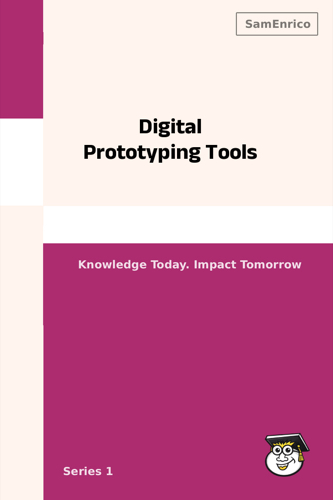
Non-FictionSelf-HelpDigital Prototyping
Digital Prototyping Tools eBook
Use Figma or Miro for interactive mockups.
Use Figma or Miro for interactive mockups.
Formats
Free sample
Chapter 1: The $50,000 Mistake--A few years ago, a product manager named Sarah walked into my office with a problem I had seen a hundred times before. Her team had just spent six weeks building a high-fidelity prototype in Figma. The interactive mockup was beautiful. The animations were smooth. The stakeholder presentation the day before had received enthusiastic nods and approving comments.
Everyone clapped.Then development started. And everything fell apart.The engineers discovered that the login flow Sarah had prototyped assumed users would enter their password correctly on the first try every single time. There was no error state, no "forgot password" path, no account recovery branch. The checkout process required seven screens for a two-click purchase. The "simple" dashboard she had shown actually contained forty-seven unique component variations—none of which matched any existing design system.Three weeks of rework.
Two all-nighters. One very tense meeting where the CTO asked, "Why didn't anyone catch this earlier?" And approximately fifty thousand dollars in wasted engineering time.Sarah had made the same mistake that I see designers make every single week. She started in Figma too early.This book exists because that mistake is not only common—it is completely avoidable. And avoiding it does not require more talent, more experience, or more budget. It requires a different workflow.
A workflow that understands that prototyping is not about opening the right tool. It is about knowing when to use which tool, and in what order.The Tool Trap Let me tell you what the software industry has done to you. Over the past decade, design tool companies have spent millions of dollars convincing you that their application is the only application you will ever need. Figma will tell you that you can design, prototype, and hand off all in one place. Miro will tell you that you can brainstorm, flow, and collaborate without ever leaving their infinite canvas.
Adobe will tell you that XD (or Spark, or whatever they are calling it this quarter) is the complete solution.They are all lying to you.Not maliciously, necessarily. They are selling their product, and their product is designed to keep you inside their ecosystem. But the reality of professional product design is messier than any single tool can handle. The reality is that the best prototypes emerge from a deliberate, intentional dance between two very different kinds of thinking—and therefore two very different kinds of tools.The first kind of thinking is divergent. This is the messy, exploratory, "what if" phase where you are not looking for the right answer because you do not yet know what the questions are.
Divergent thinking generates possibilities. It sketches multiple futures. It welcomes contradiction, ambiguity, and even chaos. Divergent thinking asks: "What are all the ways we might solve this problem?"The second kind of thinking is convergent. This is the focused, precise, "this is the answer" phase where you narrow possibilities down to a single, executable solution.
Convergent thinking makes choices. It commits to specific interactions, specific layouts, specific visual languages. Convergent thinking asks: "Given what we know, what is the best solution to build?"Here is the secret that no tool vendor wants you to understand: You cannot do divergent thinking in a convergent tool, and you cannot do convergent thinking in a divergent tool.If you try to brainstorm in Figma, you will find yourself obsessing over pixel alignment and font weights before you have even decided what problem you are solving. If you try to build high-fidelity interactions in Miro, you will tear your hair out trying to create precise animations inside a tool designed for sticky notes and connector lines.Yet most designers do exactly this. They open Figma on day one because that is what they know, what they are comfortable with, what their manager expects to see.
And then they spend weeks fighting against their own tool, producing prototypes that are either too vague to be useful or too detailed to be flexible.Sarah fell into this trap. She opened Figma the morning after the kickoff meeting. She started placing rectangles and choosing colors before anyone had mapped the user journey. She built a beautiful solution to a problem she had not yet defined.And it cost her team fifty thousand dollars.The Two-Tool Mindset This book introduces a different way of working. I call it the Two-Tool Mindset, and it rests on a very simple premise: Use Miro for the messy middle, and use Figma for the pixel-perfect end.Miro—or any infinite canvas whiteboarding tool—is designed for divergent thinking.
Its infinite zoom means you never feel constrained. Its sticky notes and cards encourage quick, disposable ideas. Its connector lines and flow tools let you map user journeys without worrying about visual polish. Miro is where you ask "what if" without immediately having to answer "what color should that button be?"Figma—or any high-fidelity design tool—is designed for convergent thinking. Its pixel grid, component system, and prototyping engine are built for precision.
Its constraints and auto-layout demand that you make decisions. Figma is where you answer "what color should that button be?" and then document that answer so engineers can build it.Notice what is missing from this framework: overlap. You do not wireframe in Figma. You do not polish in Miro. You move deliberately from one tool to the other, and you do not look back.The Bridge Method™, which you will learn throughout this book, breaks the prototyping process into five distinct phases:SCOPE – Use Miro to understand the problem, map the user journey, and align stakeholders on what success looks like.
(Chapters 3-4)LOGIC – Use Miro to prototype the decision tree before any pixels exist. Map every branch, every error state, every possible path a user might take. (Chapter 4)SKIN – Move to Figma to create visual wireframes and reusable components based on your logic maps. (Chapters 5-6)MOTION – Stay in Figma to add triggers, animations, and conditional logic that make your prototype behave like real software. (Chapters 7-9)SHIP – Validate through user testing (using Miro again for synthesis) and hand off to developers using Figma Dev Mode.
(Chapters 10-11)Five phases. Two tools. One unified workflow.Sarah's team had skipped the first two phases entirely. They had gone straight from kickoff to SKIN, building visual components before anyone understood the logic those components needed to support. The login flow had no error state because no one had ever mapped the "what if the user forgets their password?" branch.
The checkout process had seven screens because no one had ever asked "what is the minimum number of steps to complete this transaction?"The prototype was beautiful. The logic was invisible. And invisible logic always becomes expensive rework.The Cost of Starting in Figma Let me be more precise about what starting in Figma too early actually costs you. I have consulted with more than forty product teams over the past five years, ranging from two-person startups to enterprise organizations with hundreds of designers. I have tracked where their time goes, where their rework happens, and where their budgets bleed.The numbers are remarkably consistent.Teams that open Figma within the first week of a project spend…
This is the end of the free sample. Get the eBook to keep going. Buy now
About this book
Details
- Author
- Gilley Victorina
- Publisher
- SamEnrico
- Language
- English
- Genre
- Non-Fiction, Self-Help, Digital Prototyping
- Released
- 2026-06-10
- Pages (approx.)
- 144
- Available as
- eBook, Audiobook

Read better in the ZLOADR app
Your eBooks on your phone or tablet. Sign in with your SamEnrico account and start reading.
More by Gilley Victorina
 Administrative Job LossGilley Victorina$11.99
 Virtual Presentation SkillsGilley Victorina$11.99
 The Difficult Boss ConversationGilley Victorina$11.99
 Carson Edge Of Sea ConservationGilley Victorina$11.99
 Anger After Childs DiagnosisGilley Victorina$11.99
 Joy in Chronic IllnessGilley Victorina$11.99
 Creative Collaboration GuideGilley Victorina$11.99
 The Suit That Stole the Ring: How Henry Cooper’s Style Defined Boxing’s Golden AgeGilley Victorina$11.99
 The Green Thumb of Timbuktu: The Botanical Wonders of Al-Hassan ibn Muhammad al-WazzanGilley Victorina$11.99
 How to Produce Other Mechanical PartsGilley Victorina$11.99
 How to Produce a Comparison of Net-connected Media PlayersGilley Victorina$11.99
 A Collector's Handbook to the Sunbeam Rapier VGilley Victorina$11.99
You may also like
 Hong Kong Handover 1997Dunn Johnnie$11.99
 Zumba For Postnatal Recovery CourseNeal Christian$11.99
 Zumba for BeginnersLadner Nikia$11.99
 YouTube Comment Mining GuideHumes Pandora$12.99
 Worry Box MeditationCarlin Rudy$11.99
 Workplace Stress MeditationNguyen Lynn$11.99
 Workplace Stress and Sleep RepairHawley Ivory$11.99
 Workplace Perfectionism CureDelaney Jeffry$11.99
 Workplace Injustice Anger GuideWallen Isabelle$11.99
 Work Addiction and Burnout LinkGreenwood Ester$11.99
 Women in Yoga and WellnessBeattie Galina$11.99
 Women in Stand Up ComedyChun Evangeline$11.99