
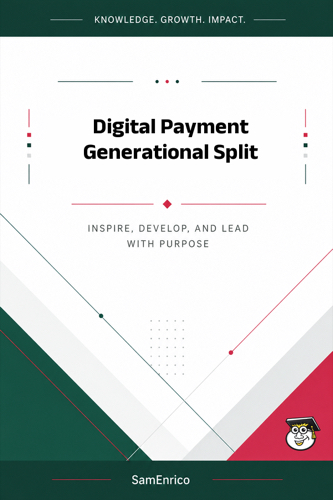
Digital Payment Generational Split eBook
Analyzes Boomer cash and check use versus Gen Z mo
Analyzes Boomer cash and check use versus Gen Z mobile wallet and crypto interest.
Formats
Free sample
Chapter 1: The Envelope System--–- The Sunday ritual begins at 7:00 PM, just after dinner. Margaret, seventy-two years old, spreads her worn leather wallet across the kitchen table. Next to it, she places a stack of white envelopes, each labeled in careful handwriting: Groceries. Utilities. Gas.
Savings. Gifts. Emergency. She counts the cash she withdrew from the bank that morning—exactly four hundred dollars—and begins to divide it. Twenty dollars into Groceries for the midweek milk run.
Forty into Utilities to supplement the automatic payment she still doesn't fully trust. Sixty into Savings, though she knows the interest rate is laughable. Fifteen into Gifts for her grandson's birthday next month. The ritual takes twenty-three minutes. She has performed it every Sunday for forty-two years, since her first apartment in Akron.
She does not consider this old-fashioned. She considers it responsible.Six hundred miles away, in a two-bedroom apartment in Austin shared by three people who met on a roommate matching app, twenty-two-year-old Jordan does not own a wallet. Jordan owns a phone. On that phone are five apps: Venmo, Cash App, Apple Pay, Splitwise, and a cryptocurrency exchange account that currently holds the equivalent of three month's rent in a token their father calls "funny money." Jordan's Sunday ritual takes forty-five seconds. It consists of opening Splitwise, confirming that they owe their roommate Maya $14.67 for the bulk bag of coffee purchased on Thursday, tapping "Pay," and watching the money vanish from one digital balance and appear on another.
There is no cash. There is no envelope. There is no bank teller who knows their name. There is only speed.This book is about the collision of these two worlds—and about the thirty-three million households in the United States where Margaret and Jordan are not strangers but grandmother and grandchild, father and daughter, employer and employee. The collision is not merely inconvenient.
It is reshaping family dynamics, business operations, retail strategy, and the very meaning of financial trust. And until now, no one has explained why both sides are simultaneously right and wrong, or how to bridge the gap without declaring generational war.The Split Nobody Is Talking About The conventional wisdom about generational differences in personal finance tends toward caricature. Boomers, the story goes, are technologically paralyzed Luddites who still balance checkbooks by hand and keep cash stuffed under mattresses. Gen Z, the counter-narrative runs, are reckless crypto-bros who have never held a physical dollar bill and will happily trade their life savings for a JPEG of a cartoon ape. Both caricatures are wrong.
Both are also, in small and specific ways, right. And the gap between them is not a matter of intelligence or stubbornness but of something far more fundamental: the economic weather of their formative years.Consider the data. According to a 2024 survey by the Federal Reserve Bank of San Francisco, 52 percent of Americans still declare "cash is king" when asked about their preferred payment method. But that headline number conceals a dramatic generational split. When the same survey data is disaggregated, a different picture emerges: 78 percent of Boomers affirm cash as their preferred method, compared to only 22 percent of Gen Z.
Conversely, 41 percent of Gen Z report using digital platforms—Venmo, Apple Pay, Cash App, Pay Pal—for the majority of their daily transactions, while only 12 percent of Boomers say the same.These numbers tell us what is happening. They do not tell us why. The why is the subject of this book.But before we dive into the psychology, we must acknowledge the elephant in the room—or rather, the piece of plastic in every wallet. Credit cards remain the single most widely used payment method across all generations. Americans made more than 80 billion credit card transactions in 2024, far surpassing both cash and mobile wallets combined.
Yet credit cards are beloved by no one. Boomers use them for convenience but fear the revolving debt that their generation witnessed destroying friends and neighbors during the 1980s. Gen Z uses them for rewards and credit-building but distrusts the interest structures, the fine print, and the banks behind them. Credit cards are the uneasy ceasefire in the generational payment war—a tool that neither side loves but both use. Understanding why neither generation has made them the center of their financial identity is the first clue to the deeper split.The Trust Spectrum: A New Framework To understand the generational payment split, we need a new language.
This book introduces that language: The Trust Spectrum.The Trust Spectrum is a framework for understanding how different generations answer a single, almost never-asked question: What makes a payment feel real?At one end of the spectrum lies physical tangibility. For individuals anchored here, money feels real only when it can be seen, held, and transferred by hand. Cash is the gold standard because it requires no intermediary, no screen, no battery. A check is acceptable because it leaves a paper trail that can be filed, retrieved, and shown to a skeptical authority. The physical act of signing one's name carries psychological weight that a digital "approve" button does not.
This end of the spectrum is disproportionately—though not exclusively—occupied by Boomers and the Silent Generation before them.At the other end of the spectrum lies algorithmic trust. For individuals anchored here, money feels real precisely because it moves instantly, leaves a digital trail, and can be split to the penny. The algorithm—Venmo's ledger, the blockchain's consensus mechanism, the bank's real-time fraud detection—is more trustworthy than any human handwriting because the algorithm does not tire, does not forget, and cannot be bribed. Speed is not a compromise; speed is a feature. This end of the spectrum is disproportionately—though not exclusively—occupied by Gen Z and the younger Millennials.Between these two poles lies everything else: credit cards (which split the difference with instant approval but delayed payment), debit cards (which feel like plastic but act like digital), and the vast gray zone of "Buy Now, Pay Later" services that attempt to offer the best of both worlds.
The Trust Spectrum is not a judgment. It is a diagnostic tool. Once you understand where someone sits on the spectrum, their payment preferences become predictable, even inevitable.The Scent of Ink and the Sound of the Tap Let us make the Trust Spectrum concrete. Spend five minutes inside the heads of our two opening characters.For Margaret, writing a check is not merely a transaction. It is a ritual with distinct sensory components.
She smells the ink as it flows from the pen. She feels the resistance of the paper as she tears it from the checkbook. She hears the faint scratch of ballpoint against the check surface. She performs the deliberate physical act of signing her name—a signature she has practiced for sixty years, one that represents her identity in a way that a four-digit PIN never could. Then she mails the check, and for two to five business days, the money exists in a pleasing limbo: deducted from her mental ledger but not yet gone from her account.
That limbo is not anxiety. It is control.For Jordan, every step of Margaret's ritual feels like a nightmare. Waiting days…
This is the end of the free sample. Get the eBook to keep going. Buy now
About this book
Details
- Author
- Keaton Tennille
- Publisher
- SamEnrico
- Language
- English
- Genre
- Non-Fiction, Consumer Mind Report, FinTech
- Released
- 2026-06-08
- Pages (approx.)
- 148
- Available as
- eBook, Audiobook

Read better in the ZLOADR app
Your eBooks on your phone or tablet. Sign in with your SamEnrico account and start reading.
More by Keaton Tennille
 Authority Influence HandbookKeaton Tennille$11.99
 Gacy's LGBTQ Victim TargetingKeaton Tennille$11.99Gacy's LGBTQ Victim TargetingKeaton Tennille$11.99
 Palestinian Refugee CampKeaton Tennille$11.99
 Citizen Mob Capture 1985Keaton Tennille$11.99
 Shift Work Meal TimingKeaton Tennille$11.99
 Bipolar Therapy ApproachesKeaton Tennille$11.99
 Bile Acid MalabsorptionKeaton Tennille$11.99
 Marston Moor: The Cavalier's Last StandKeaton Tennille$11.99
 The Silent Heist: The First Digital Bank RobberyKeaton Tennille$11.99
 How to Produce a Society For Information DisplayKeaton Tennille$11.99
 10 Ways to Use Royal Icing (Recipe Book)Keaton Tennille$11.99