
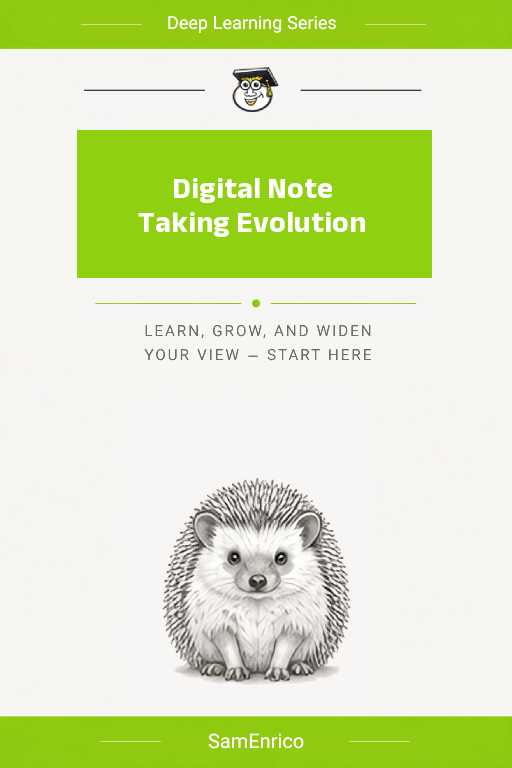
Non-FictionForecast & OutlookNote Tech
Digital Note Taking Evolution eBook
Explore AI-powered notes that auto-summarize lectu
Explore AI-powered notes that auto-summarize lectures, organize highlights, and create flashcards.
Formats
Free sample
Chapter 1: The Perfect Trap...--–- Maria was crying over her notes again. Not because she had failed to capture them—she had 847 pages of beautifully organized, color-coded, timestamped, and meticulously tagged transcripts from the semester. She had every word her professor had uttered. She had highlights in three colors. She had margin notes written in perfect cursive.
And she was going to fail organic chemistry.The study lounge of Benson Hall was empty at 2:17 AM, save for Maria and the ghost of her ambitions. Surrounding her on the table were fourteen printed notebooks, two i Pads, a laptop showing thirty-seven open tabs, and an empty coffee cup that had been refilled four times since noon. She had been reviewing for ten hours. She remembered almost nothing."The worst part," she whispered to no one, "is that I don't know what I don't know."Across the library, two floors up, another student was studying the same material. Jake had attended the same lectures, downloaded the same slides, and taken the same final exam last year—which he had aced.
But Jake's notes fit on three pages. He rarely reviewed them for more than thirty minutes before an exam. And he had never, not once, written down a sentence verbatim.What did Jake know that Maria didn't?The answer is not about intelligence, diligence, or even subject matter. It is about a fundamental misunderstanding of how the human brain learns—and a dangerous myth that has been passed down through generations of students like a hereditary disease. The myth is this: Writing everything down is the same as learning it.This chapter will dismantle that myth.
It will show you why the students who take the fewest notes often remember the most. It will introduce you to a concept called cognitive load theory, which explains why your brain shuts down when you try to transcribe a lecture. And it will reveal the first AI-powered solution that changes everything: Intelligent Noise Cancellation—a tool that doesn't help you write more, but helps you write less.By the end of this chapter, you will understand why Maria was doomed from the first day of class, why Jake succeeded without trying, and how you can become a Jake without sacrificing your work ethic. The answer is not to work harder. It is to stop working against your own brain.The Transcript Delusion Let us begin with an uncomfortable truth: the perfect transcript is worthless.Not just inefficient.
Not just time-consuming. Actually, demonstrably, scientifically worthless as a learning tool. A team of cognitive psychologists at UCLA conducted a landmark study in 2014 that should have ended the debate forever. They divided students into three groups watching the same lecture. Group One took traditional handwritten notes.
Group Two typed notes verbatim on laptops. Group Three was not allowed to take any notes at all but was told they would receive a perfect transcript after the lecture.The results were devastating for anyone who has ever prided themselves on their transcription skills. The laptop group typed an average of 310 words per minute and captured nearly every sentence the professor spoke. Their transcripts were masterpieces of documentation. They scored the lowest on the conceptual exam one week later.The no-notes group, who had received perfect transcripts, scored only marginally higher than the laptop group.
Having the words on paper did not help them understand the ideas behind the words.The handwritten note group, who captured only 65 words per minute and missed roughly 60 percent of what the professor said, scored the highest by a wide margin.Why? Because the act of selecting what to write forced them to process meaning. They could not write everything, so they had to decide what mattered. That decision—that moment of judgment—was the learning event. The transcript group never had to decide anything.
The words arrived pre-packaged, pre-digested, and pre-forgotten.This is what I call the Transcript Delusion: the mistaken belief that capturing information is the same as understanding it. Maria, with her 847 pages, was a victim of this delusion. She believed that if she could just record everything, she would eventually know everything. But the human brain does not work that way. Memory is not a hard drive.
It is a muscle that strengthens through use—specifically, through the use of judgment, selection, and connection.The Transcript Delusion has only gotten worse in the digital age. Before laptops, students were physically limited by how fast they could write. That limitation was actually a blessing. It forced selection. Now, with typing speeds of 80-120 words per minute and AI transcription tools that can capture every syllable in real time, students can record entire lectures without ever engaging their brains.
The technology has made the delusion easier to maintain and harder to escape.Cognitive Load: Why Your Brain Has a Speed Limit To understand why transcription fails as a learning strategy, we need to understand cognitive load theory. Developed by educational psychologist John Sweller in the 1980s and extensively validated since, cognitive load theory describes the limited capacity of working memory—the part of your brain that holds and manipulates information in real time.Here is the crucial fact: your working memory can hold approximately four chunks of information at once. Not forty. Not fourteen. Four.
(The classic "seven plus or minus two" figure has been revised downward by recent research; under cognitive load, four is closer to the truth.)Every mental activity consumes some of that limited capacity. Listening consumes capacity. Deciding what to write consumes capacity. Typing consumes capacity. Checking your formatting consumes capacity.
Trying to remember what the professor said thirty seconds ago while still typing the previous sentence consumes massive capacity.When you attempt to transcribe a lecture verbatim, you are asking your working memory to do the impossible. You must listen to the current sentence, hold it in memory, type it accurately, monitor your typing for errors, while also listening to the next sentence so you don't fall behind. That is five or six simultaneous demands on a system designed for four. Something breaks.What breaks is comprehension. You are so busy transcribing that you never have a free moment to ask: What does this mean?
How does it connect to what we learned last week? Is this a main point or an example? Do I believe this?Those questions are the actual work of learning. Without them, you are not learning. You are just moving your fingers.A study from Princeton University and UCLA in 2014 (the same research mentioned earlier) used eye-tracking technology to observe students during lectures.
The verbatim typists spent 87 percent of their visual attention on their screens—watching their own fingers type. The handwritten note-takers spent 62 percent of their visual attention on the professor or the slides, looking up frequently to process visual information. The typists were not learning the material. They were learning to type faster.Cognitive load theory also explains why reviewing perfect transcripts is so ineffective. When you read a transcript, you are still processing information linearly, word by word.
You have not done the work of selecting, prioritizing, or connecting. The transcript is raw data, not knowledge. Reading raw data does…
This is the end of the free sample. Get the eBook to keep going. Buy now
About this book
Details
- Author
- Hickey Katheryn
- Publisher
- SamEnrico
- Language
- English
- Genre
- Non-Fiction, Forecast & Outlook, Note Tech
- Released
- 2026-06-01
- Pages (approx.)
- 153
- Available as
- eBook, Audiobook

Read better in the ZLOADR app
Your eBooks on your phone or tablet. Sign in with your SamEnrico account and start reading.
More by Hickey Katheryn
 False Self Dream Symbols CourseHickey Katheryn$11.99
 Turkish Yeşil Dönüşüm ProgramHickey Katheryn$11.99
 OKRs for Learning New SkillsHickey Katheryn$11.99
 Meth Weight Restoration GuideHickey Katheryn$11.99
 The Ballad of the Moonlit Runner: Kathrine Switzer and the Boston Marathon RevolutionHickey Katheryn$11.99
 The Shadow Cabinet: How Margaret Thatcher’s Inner Circle Shaped a NationHickey Katheryn$11.99
 Understanding Ichthyosis Mental Retardation Dwarfism Renal ImpairmentHickey Katheryn$17.99
 Ultimate Handbook Guide to Tiruppur : (India) Travel GuideHickey Katheryn$11.99
 Newfoundland Pony Horse BreedingHickey Katheryn$11.99
 Global Talent Mobility ManualHickey Katheryn$12.99
You may also like
 Hong Kong Handover 1997Dunn Johnnie$11.99
 Zumba For Postnatal Recovery CourseNeal Christian$11.99
 Zumba for BeginnersLadner Nikia$11.99
 YouTube Comment Mining GuideHumes Pandora$12.99
 Worry Box MeditationCarlin Rudy$11.99
 Workplace Stress MeditationNguyen Lynn$11.99
 Workplace Stress and Sleep RepairHawley Ivory$11.99
 Workplace Perfectionism CureDelaney Jeffry$11.99
 Workplace Injustice Anger GuideWallen Isabelle$11.99
 Work Addiction and Burnout LinkGreenwood Ester$11.99
 Women in Yoga and WellnessBeattie Galina$11.99
 Women in Stand Up ComedyChun Evangeline$11.99