
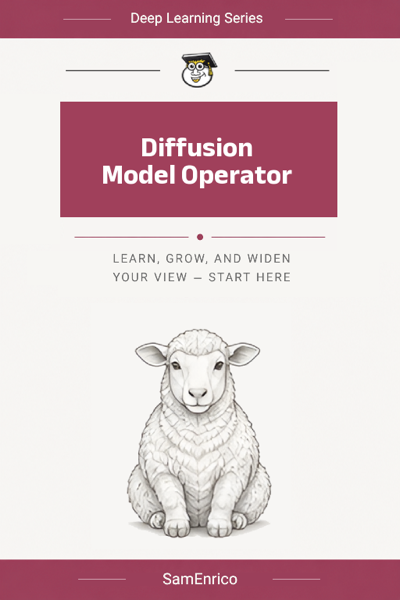
Non-FictionInformativeEducational
Diffusion Model Operator eBook
A Coursebook on Diffusion Model Operator
by Mauldin Geri
A Coursebook on Diffusion Model Operator
Formats
Free sample
Chapter 1: The Generation Gap...--–- The image generator took thirty-seven seconds and eighty-four cents of compute time. It produced a photograph of a cat sitting on a chair. The cat was gray. The chair was wooden. The lighting was plausible.
The result was technically flawless and commercially useless.The designer had asked for something specific: a cat dissolving into the chair, wood grain creeping up the cat’s fur, a visual metaphor for domestic entropy. The model couldn’t do it. Not because it lacked power. Not because the training data was insufficient. But because the model fundamentally does not understand composition, transformation, or reuse.
It only understands sampling.This is the generation gap.In the past five years, diffusion models have revolutionized generative AI. They produce images that fool human observers. They write text that passes graduate exams. They generate music, video, and molecular structures. Yet, for all their power, they remain stubbornly difficult to control, compose, and repurpose.
Every new task—every subtle variation, every compositional request, every operator-like transformation—requires either retraining the model from scratch or stitching together brittle, slow, and often contradictory guidance mechanisms.This book argues that the gap is not a limitation of diffusion models themselves. It is a limitation of how we think about them. We have been treating diffusion models as samplers. We should be treating them as operators.1.1 The Anatomy of Frustration Before we build a better framework, we must understand precisely why current diffusion models frustrate practitioners. The symptoms are well-known, but their root cause is rarely diagnosed correctly.Symptom one: Controllability is an afterthought.Most diffusion models are trained unconditionally.
To make them follow a prompt, we add classifier-free guidance (CFG) as a post-hoc correction. CFG works remarkably well—until it doesn't. When you ask for something outside the training distribution, CFG interpolates between the conditional and unconditional scores in a way that often produces artifacts, oversaturation, or mode collapse. More importantly, CFG offers no mechanism for composing multiple constraints. Want a cat and a dog but not a table?
The standard solution is to linearly combine scores, which has no theoretical guarantee of producing a valid distribution.Symptom two: Reusability is nonexistent.In traditional software engineering, once you write a function that resizes an image, you reuse it millions of times. In diffusion modeling, if you train a model to generate "a red vase," you cannot extract that vase and place it into another scene without retraining or carefully engineered inpainting. The knowledge is entangled across billions of parameters. There is no modularity, no interface, no abstraction boundary. The model is a monolithic black box.Symptom three: Speed is sacrificed for quality.The highest-quality diffusion models require fifty to a thousand sequential denoising steps.
Each step involves passing the entire image through a U-Net with hundreds of millions of parameters. This is computationally expensive and fundamentally sequential. Real-time applications—video games, live video editing, interactive design—remain out of reach for diffusion-based methods.Symptom four: Resolution dependence is baked in.A U-Net trained on 256×256 images cannot directly generate 512×512 images. The architecture assumes a fixed grid. This means you cannot train once and deploy everywhere.
Every resolution requires either retraining, architectural modifications, or expensive fine-tuning.These four symptoms—poor controllability, zero reusability, slow inference, and resolution dependence—are not separate problems. They are different faces of the same underlying issue. The issue is that we have been modeling the distribution rather than the transformation.1.2 The Sampling Paradigm and Its Limits To understand why current diffusion models behave this way, we need to examine their mathematical foundation.A diffusion model, at its core, learns to reverse a noising process. You start with clean data x0x_0x0 drawn from some unknown distribution pdatap_{\text{data}}pdata. You gradually add noise over time t∈[0,T]t \in [0, T]t∈[0,T] according to a stochastic differential equation (SDE):dxt=f(t)xt dt+g(t) d Wtdx_t = f(t)x_t \, dt + g(t) \, d W_tdxt=f(t)xtdt+g(t)d WtThe forward process destroys structure.
The reverse process, if you know the score function ∇xlogpt(x)\nabla_x \log p_t(x)∇xlogpt(x), reconstructs structure from noise:dxt=[f(t)xt−g(t)2∇xlogpt(xt)] dt+g(t) d Wˉtdx_t = [f(t)x_t - g(t)^2 \nabla_x \log p_t(x_t)] \, dt + g(t) \, d\bar{W}_tdxt=[f(t)xt−g(t)2∇xlogpt(xt)]dt+g(t)d WˉtThe insight that made diffusion models practical was that you can train a neural network sθ(xt,t)s_\theta(x_t, t)sθ(xt,t) to approximate the score function using a simple denoising objective:Et,x0,ϵ[∥ϵ−sθ(αˉtx0+1−αˉtϵ,t)∥2]\mathbb{E}_{t, x_0, \epsilon} \left[ \| \epsilon - s_\theta(\sqrt{\bar{\alpha}_t} x_0 + \sqrt{1 - \bar{\alpha}_t} \epsilon, t) \|^2 \right]Et,x0,ϵ[∥ϵ−sθ(αˉtx0+1−αˉtϵ,t)∥2]This works brilliantly. State-of-the-art models achieve FID scores below 2.0 on Image Net. They generate images that are, in many cases, indistinguishable from real photographs.But notice what this formulation assumes. The model learns to map noise to data. That is a single mapping, parameterized by time, from a fixed noise distribution to a fixed data distribution.
There is no notion of transforming one data point into another. There is no notion of composing multiple operations. There is no notion of reusing a learned transformation in a new context.The model is a sampler, not an operator.This distinction matters profoundly. A sampler takes a random seed and returns a sample. An operator takes an input and returns an output, potentially transforming it in a structured, reusable, and composable way.Consider the difference between a random number generator (sampler) and a function that maps a grayscale image to a colorized version (operator).
The random number generator is useful, but it cannot be composed, chained, or parameterized by user input in any meaningful way. The colorization operator, once learned, can be applied to any grayscale image, combined with other operators (e.g., "colorize then upscale"), and parameterized by user preferences.Current diffusion models are samplers. They should be operators.1.3 The Operator Mindset: A First Definition What would it mean to treat diffusion models as operators?Let us propose a provisional definition. A diffusion model operator is a mapping O\mathcal{O}O that satisfies three properties:Domain and codomain. O:X→X\mathcal{O}: \mathcal{X} \to \mathcal{X}O:X→X, where X\mathcal{X}X is some space of data (images, text, audio, etc.).
The operator transforms an input into an output.Learnable from data. O\mathcal{O}O is parameterized by a neural network trained using a denoising objective, similar to standard diffusion models, but with the crucial difference that the forward process may be conditioned on the input.Composable. For any two operators O1\mathcal{O}_1O1 and O2\mathcal{O}_2O2, there exists a composition O2∘O1\mathcal{O}_2 \circ \mathcal{O}_1O2∘O1 that applies one transformation after another, and this composition can be approximated efficiently.This definition deliberately echoes the mathematical concept of an operator from functional analysis—a mapping between function spaces. But we are not yet ready for the full mathematical machinery. For…
This is the end of the free sample. Get the eBook to keep going. Buy now
About this book
Details
- Author
- Mauldin Geri
- Publisher
- SamEnrico
- Language
- English
- Genre
- Non-Fiction, Informative, Educational
- Released
- 2026-06-03
- Pages (approx.)
- 156
- Available as
- eBook, Audiobook

Read better in the ZLOADR app
Your eBooks on your phone or tablet. Sign in with your SamEnrico account and start reading.
More by Mauldin Geri
 Celebrate Recovery Step GuideMauldin Geri$11.99
 Calming Breath FormationsMauldin Geri$11.99
 Franchise Builder's Exit WindfallMauldin Geri$11.99
 Hamstring Stretching For FlexibilityMauldin Geri$11.99
 Ravana's Shadow: The Ten-Headed Tyrant of LankaMauldin Geri$11.99
 Understanding Hypertelorism Hypospadias SyndromeMauldin Geri$17.99
 B Corp Social Enterprise GuideMauldin Geri$12.99
 Insurance Claims AutomationMauldin Geri$12.99
 How to Become a Dining-service InspectorMauldin Geri$11.99
You may also like
 Hong Kong Handover 1997Dunn Johnnie$11.99
 Zumba For Postnatal Recovery CourseNeal Christian$11.99
 Zumba for BeginnersLadner Nikia$11.99
 YouTube Comment Mining GuideHumes Pandora$12.99
 Worry Box MeditationCarlin Rudy$11.99
 Workplace Stress MeditationNguyen Lynn$11.99
 Workplace Stress and Sleep RepairHawley Ivory$11.99
 Workplace Perfectionism CureDelaney Jeffry$11.99
 Workplace Injustice Anger GuideWallen Isabelle$11.99
 Work Addiction and Burnout LinkGreenwood Ester$11.99
 Women in Yoga and WellnessBeattie Galina$11.99
 Women in Stand Up ComedyChun Evangeline$11.99