
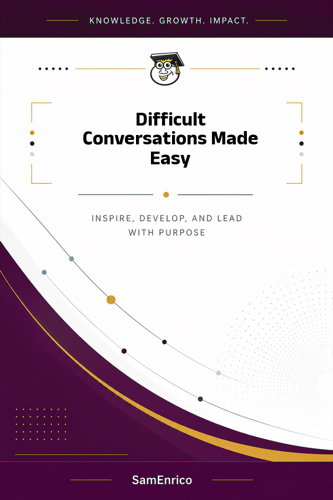
Non-FictionSelf-HelpDifficult Talks
Difficult Conversations Made Easy eBook
Raise sensitive topics with confidence using struc
Raise sensitive topics with confidence using structured assertiveness scripts.
Formats
Free sample
Chapter 1: Your Brain Lies...--Your brain is lying to you. Right now, as you read this sentence, your brain is running ancient software designed for a world where saber-toothed tigers wanted to eat you. That software is excellent at keeping you alive in a physical confrontation. It is terrible at helping you tell a colleague that they missed a deadline, ask a boss for a raise, or explain to a partner that you feel hurt. In fact, the same neural circuitry that once helped you dodge a predator now activates when you simply anticipate a difficult conversation.
Your pulse quickens. Your palms sweat. Your throat tightens. And then, just when you need to be articulate, calm, and strategic, your prefrontal cortex—the part of your brain responsible for reason, language, and self-control—goes offline.This is not a character flaw. It is not a lack of courage.
It is biology.Every person who has ever choked during a hard conversation—and that includes CEOs, therapists, hostage negotiators, and your most confident friend—has experienced the same neural hijack. The difference between people who master difficult conversations and people who avoid them is not that one group lacks anxiety. It is that one group has learned to recognize the hijack and interrupt it before it destroys their ability to speak clearly.This chapter will teach you exactly how to do that. You will learn why your brain treats social rejection like physical pain, how the gap between what you mean and what they hear creates most conversational disasters, and the single most powerful tool for regaining control in the moment: The Regulation Pause.The Amygdala Is Not Your Enemy (But It Is Not Your Friend Either)Let us start with a simple anatomy lesson. Deep inside your brain, tucked near the brainstem, sits two small almond-shaped clusters of neurons called the amygdala.
Your amygdala has one job: to scan the environment for threats. When it detects a threat, it sounds an alarm that floods your body with cortisol and adrenaline, increases your heart rate, shuts down non-essential systems (like digestion and higher reasoning), and prepares you to fight, flee, or freeze.This system evolved over millions of years to handle physical threats. A rustle in the bushes might be a predator. A sudden movement might be an attack. In those moments, you do not need to compose a thoughtful email or remember a five-step negotiation framework.
You need to run or fight. The amygdala is brilliant at this job.Here is the problem. Your amygdala cannot tell the difference between a physical threat and a social threat. To your ancient brain, being criticized in a meeting feels the same as being chased by a lion. Being rejected by a peer feels the same as being exiled from the tribe—which, for early humans, was a death sentence.
Neuroimaging studies have shown that the same regions of the brain (the dorsal anterior cingulate cortex and the anterior insula) activate during social rejection as during physical pain. Tylenol has been shown to reduce the sting of social rejection. Let that sink in. The same medication that treats a headache can, to some degree, treat the pain of being left out.When you prepare to have a difficult conversation, your amygdala anticipates a social threat. It does not know that you are sitting in a well-lit office with a reasonable person who is not going to eat you.
All it knows is that your heart rate is climbing and that something dangerous is about to happen. So it hijacks your prefrontal cortex—the part of your brain you actually need for the conversation—and hands control over to your reactive, impulsive, survival-oriented midbrain.This is why you say things you regret. This is why you go silent. This is why you cry when you are angry, or yell when you are hurt, or agree to something you will resent later. Your amygdala won.The Intention-Impact Gap: Where Conversations Go to Die Here is a statistic that should concern you: the vast majority of conversational failures come from a single source.
That source is the gap between what you intend to communicate and what the other person actually hears.You intend to say, "I want to help us solve this problem together." They hear, "You are the problem."You intend to say, "I need some space to think about this." They hear, "I am leaving because I do not care about you."You intend to say, "Your work on this project has been inconsistent lately." They hear, "You are lazy and incompetent."This gap exists because human beings are not mind readers. The other person does not have access to your intentions. They only have access to your behavior—your words, your tone, your body language, your timing. And they interpret that behavior through the lens of their own history, insecurities, and expectations. If they have been criticized harshly in the past, they will hear criticism even when none is intended.
If they are already feeling insecure about their performance, a neutral observation will land as an accusation.The gap widens precisely when you need it to narrow. When stakes are low, you can clarify your intentions with a simple follow-up sentence. "Oh, I did not mean it like that. What I meant was..." But when stakes are high and emotions are elevated, your amygdala is already sounding the alarm. The other person's amygdala is also sounding its alarm.
Now you have two people whose reasoning brains have been partially hijacked, trying to navigate a gap that requires extraordinary clarity and empathy. This is why difficult conversations go badly even when both people are basically reasonable, basically kind, and basically trying their best.The Regulation Pause is not a tool for closing this gap entirely. No single tool can do that. The Regulation Pause is a tool for creating the conditions under which the gap can be closed. It is a circuit breaker.
It stops the neural fire long enough for your prefrontal cortex to come back online.The Four Silences (And Why You Have Been Confusing Them)Before we go any further, I need to name something that will save you years of confusion. The word "silence" appears throughout this book, but it does not mean the same thing every time. Most books about communication treat silence as a single phenomenon. That is a catastrophic error. There are four distinct types of silence, and each has a different purpose, a different moral valence, and a different set of rules.
Confusing them is one of the most common reasons people fail at difficult conversations.Here is the complete Silence Taxonomy that will guide this entire book. You will see these terms again, so take a moment to learn them.The Regulation Pause (This Chapter): A deliberate, declared silence of approximately 5 seconds that you initiate to interrupt the fight-or-flight response. Its purpose is self-regulation. It is always good, always courageous, and always available to you. You will learn the exact script for the Regulation Pause in this chapter.The Pressure Hollow (Chapter 6): An intentional empty space that you create after delivering feedback.
You say nothing. You wait. The other person feels gentle social pressure to fill the silence, and they almost always…
This is the end of the free sample. Get the eBook to keep going. Buy now
About this book
Details
- Author
- Sturgeon Lulu
- Publisher
- SamEnrico
- Language
- English
- Genre
- Non-Fiction, Self-Help, Difficult Talks
- Released
- 2026-06-07
- Pages (approx.)
- 145
- Available as
- eBook, Audiobook

Read better in the ZLOADR app
Your eBooks on your phone or tablet. Sign in with your SamEnrico account and start reading.
More by Sturgeon Lulu
 Remote Chat ManagementSturgeon Lulu$11.99
 Mindfulness for Job SeekersSturgeon Lulu$11.99
 Lonely Recovery From AddictionSturgeon Lulu$11.99
 The Walking Creativity RitualSturgeon Lulu$11.99
 The Russian Enlightenment: From Catherine the Great to Tolstoy’s WisdomSturgeon Lulu$11.99
 Learn to Play the BandoneónSturgeon Lulu$11.99
 Express Entry Graduate GuideSturgeon Lulu$12.99
 Pre Launch Paid Ads GuideSturgeon Lulu$12.99
 Assistant UnderwriterSturgeon Lulu$11.99
 How to Become a Steam-conditioner OperatorSturgeon Lulu$11.99
You may also like
 Hong Kong Handover 1997Dunn Johnnie$11.99
 Zumba For Postnatal Recovery CourseNeal Christian$11.99
 Zumba for BeginnersLadner Nikia$11.99
 YouTube Comment Mining GuideHumes Pandora$12.99
 Worry Box MeditationCarlin Rudy$11.99
 Workplace Stress MeditationNguyen Lynn$11.99
 Workplace Stress and Sleep RepairHawley Ivory$11.99
 Workplace Perfectionism CureDelaney Jeffry$11.99
 Workplace Injustice Anger GuideWallen Isabelle$11.99
 Work Addiction and Burnout LinkGreenwood Ester$11.99
 Women in Yoga and WellnessBeattie Galina$11.99
 Women in Stand Up ComedyChun Evangeline$11.99