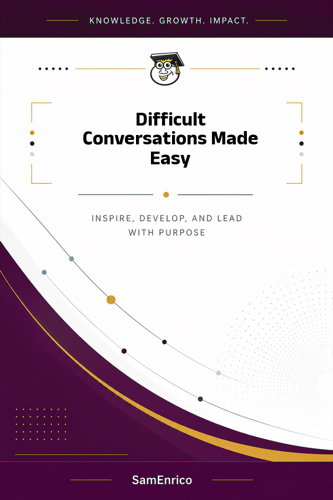
Difficult Conversations Made Easy
Raise sensitive topics with confidence using struc
Raise sensitive topics with confidence using structured assertiveness scripts.
Formats
About this book
Free sample
Chapter 1: Your Brain Lies...--Your brain is lying to you. Right now, as you read this sentence, your brain is running ancient software designed for a world where saber-toothed tigers wanted to eat you. That software is excellent at keeping you alive in a physical confrontation. It is terrible at helping you tell a colleague that they missed a deadline, ask a boss for a raise, or explain to a partner that you feel hurt. In fact, the same neural circuitry that once helped you dodge a predator now activates when you simply anticipate a difficult conversation.
Your pulse quickens. Your palms sweat. Your throat tightens. And then, just when you need to be articulate, calm, and strategic, your prefrontal cortex—the part of your brain responsible for reason, language, and self-control—goes offline.This is not a character flaw. It is not a lack of courage.
It is biology.Every person who has ever choked during a hard conversation—and that includes CEOs, therapists, hostage negotiators, and your most confident friend—has experienced the same neural hijack. The difference between people who master difficult conversations and people who avoid them is not that one group lacks anxiety. It is that one group has learned to recognize the hijack and interrupt it before it destroys their ability to speak clearly.This chapter will teach you exactly how to do that. You will learn why your brain treats social rejection like physical pain, how the gap between what you mean and what they hear creates most conversational disasters, and the single most powerful tool for regaining control in the moment: The Regulation Pause.The Amygdala Is Not Your Enemy (But It Is Not Your Friend Either)Let us start with a simple anatomy lesson. Deep inside your brain, tucked near the brainstem, sits two small almond-shaped clusters of neurons called the amygdala.
Your amygdala has one job: to scan the environment for threats. When it detects a threat, it sounds an alarm that floods your body with cortisol and adrenaline, increases your heart rate, shuts down non-essential systems (like digestion and…
This is the end of the free sample. Get the eBook to keep going. Buy now
Contents
- Chapter 1
- Chapter 2
- Chapter 3
- Chapter 4
- Chapter 5
- Chapter 6
- Chapter 7
- Chapter 8
- Chapter 9
- Chapter 10
- Chapter 11
- Chapter 12
Details
- Author
- Sturgeon Lulu
- Publisher
- SamEnrico
- Language
- English
- Genre
- Non-Fiction, Self-Help, Difficult Talks
- Released
- 2026-06-07
- Pages (approx.)
- 145
- Available as
- eBook, Audiobook

Read better in the ZLOADR app
Your eBooks on your phone or tablet. Sign in with your SamEnrico account and start reading.
More by Sturgeon Lulu
 Remote Chat ManagementSturgeon Lulu$11.99
 Mindfulness for Job SeekersSturgeon Lulu$11.99
 Lonely Recovery From AddictionSturgeon Lulu$11.99
 The Walking Creativity RitualSturgeon Lulu$11.99
 The Russian Enlightenment: From Catherine the Great to Tolstoy’s WisdomSturgeon Lulu$11.99
 Learn to Play the BandoneónSturgeon Lulu$11.99
 Express Entry Graduate GuideSturgeon Lulu$12.99
 Pre Launch Paid Ads GuideSturgeon Lulu$12.99
 Assistant UnderwriterSturgeon Lulu$11.99
 How to Become a Steam-conditioner OperatorSturgeon Lulu$11.99