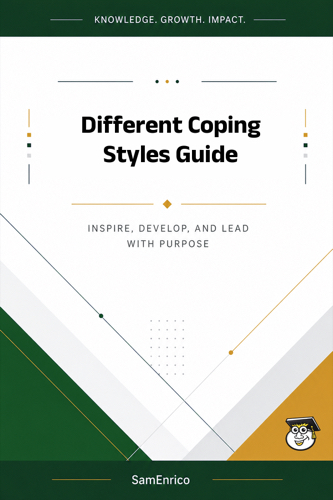
Different Coping Styles Guide eBook
Navigate partnership when one withdraws under stre
by Irby Kimber
Navigate partnership when one withdraws under stress and the other seeks connection.
Formats
Free sample
Chapter 1: The Invisible Dance––Every couple knows the moment. It arrives without warning, often triggered by something small—a late text, a tired sigh, a question asked one too many times. One minute you are sitting on the couch, the air neutral, and the next minute something shifts. You feel it in your chest first: a tightening, a heat, a sudden alertness. Your partner, across the room, seems to feel something too—but in the opposite direction.
You lean in. They lean out. You speak. They go quiet. You ask, “What’s wrong?” They say, “Nothing,” and suddenly you are both trapped in a scene you have lived a hundred times before, each of you convinced the other started it.This is the invisible dance.
It has no choreographer, no music, and no memory of previous performances. Each time it feels brand new, spontaneous, like a fresh betrayal or a sudden rejection. But it is not new. It is ancient. And it is running your relationship on autopilot.Let me describe the dance in slow motion so you can finally see it.When stress enters a relationship—and it will, because stress is not an invader but a permanent resident of human life—two survival instincts activate.
These instincts are not chosen. They are not character flaws. They are not evidence of how much or how little you love your partner. They are biological, neurological, and deeply embedded in your nervous system. One instinct says: Come closer.
Connection is safety. If I can see you, hear you, touch you, I will know we are okay. The other instinct says: Step back. Distance is safety. If I can lower the intensity, quiet the noise, protect my inner world, I will know I am okay.Neither is wrong.
Both are trying to protect you. But when these two instincts occupy the same room, the same relationship, the same argument, they create a machine that runs on pain.The Most Destructive Pattern You Have Never Named Researchers who study couples have identified many patterns that predict divorce, unhappiness, and emotional disconnection. Criticism. Contempt. Defensiveness.
Stonewalling. These are well known. But underneath all of them lies a deeper, more fundamental pattern that acts as the engine for the others. It is called the Demand/Withdraw Cycle, and it is the single most destructive and stable pattern in unhappy relationships.Here is how it works. One partner—usually the one whose nervous system interprets distance as danger—makes a demand.
The demand might sound like “Can we talk?” or “Are you okay?” or “Why didn’t you text me back?” or “You never listen to me.” Underneath the specific words is a single message: I need you to come closer.The other partner—usually the one whose nervous system interprets intensity as danger—responds by withdrawing. Withdrawal might sound like “I need some space” or “Not right now” or silence or leaving the room or picking up their phone. Underneath those specific actions is a single message: I need you to back off.The demand triggers more withdrawal. The withdrawal triggers more demanding. The cycle spins faster and faster.
Both partners feel justified. Both partners feel hurt. Both partners can point to the other’s behavior as the problem. “If she would just stop chasing me, I wouldn’t need to disappear.” “If he would just stop disappearing, I wouldn’t need to chase.”This is the invisible dance. And if you are reading this book, you already know it intimately.
You may not have had a name for it before. But you have felt its gravitational pull.Why Opposites Attract (And Then Attack)Here is a cruel trick of human psychology: the very qualities that draw you to your partner in the beginning are the same qualities that drive you crazy under stress.Think back to when you first met. If you are the partner who tends to pursue under stress, you were probably drawn to someone who seemed calm, steady, self-contained. They didn’t need constant reassurance. They had their own life, their own interests, their own internal thermostat.
That felt safe to you. Finally, someone who wouldn’t abandon you with their own neediness.If you are the partner who tends to withdraw under stress, you were probably drawn to someone who seemed warm, emotionally available, expressive. They wore their heart on their sleeve. They wanted to know how you felt. They asked questions.
That felt safe to you. Finally, someone who wouldn’t leave you alone with your own walls.Those initial attractions are not mistakes. They are your nervous system recognizing a complementary survival strategy. The calm person regulates the anxious person. The warm person thaws the guarded person.
For a while, it works beautifully.But stress changes everything. Under pressure, those same qualities become weapons. The calm person’s steadiness becomes coldness. The warm person’s expressiveness becomes suffocation. The very traits that once made you feel seen now make you feel trapped.
And because you have not named the pattern, you assume the problem is your partner. They have changed. They have stopped trying. They never really loved you.None of that is true. Your partner has not changed.
The context has changed. Stress has activated their survival instinct, and that instinct is the same one that made you fall in love with them. The dance has simply sped up.The One-Time Neurobiology Lesson (Because You Will Need This Later)I promised you that this book would not repeat itself. So I am going to give you the full explanation of the neurobiology behind the cycle right here, in this chapter. After this, I will simply refer back to “the flooded nervous system from Chapter 1” and trust that you remember what it means.
Read this section carefully. It is the foundation for everything that follows.Your nervous system has one job: keep you alive. It does not care if you are happy. It does not care if you have a good relationship. It cares about survival.
And your nervous system learned, long before you met your partner, what survival looks like.For the partner who pursues under stress, the nervous system has learned that distance equals danger. This is not a conscious belief. It is a somatic memory. Somewhere in your childhood, you experienced inconsistency—a caregiver who was sometimes warm and sometimes gone. Your little nervous system learned that if you did not signal loudly enough, you might be left.
So it developed a hair-trigger abandonment alarm. When your partner goes quiet, when they take a step back, when they seem distracted, your nervous system does not think, “They are tired.” It thinks, “We are being left. Sound the alarm. Chase. Cling.
Demand. Do not let them disappear.”This is not neediness. This is not manipulation. This is your amygdala interpreting silence as a predator. Your cortisol spikes.
Your heart rate increases. Your field of vision narrows. You are, biologically speaking, in a state of threat. And the only thing that lowers that alarm is proximity to your partner. That is why you chase.
You are not trying to control them. You are trying to stop the alarm.For the partner who withdraws under stress…
This is the end of the free sample. Get the eBook to keep going. Buy now
About this book
Details
- Author
- Irby Kimber
- Publisher
- SamEnrico
- Language
- English
- Genre
- Non-Fiction, Self-Help, Attachment Styles
- Released
- 2026-06-06
- Pages (approx.)
- 140
- Available as
- eBook, Audiobook

Read better in the ZLOADR app
Your eBooks on your phone or tablet. Sign in with your SamEnrico account and start reading.
More by Irby Kimber
 TM For Low Self EsteemIrby Kimber$11.99
 Travis CI Outage GuideIrby Kimber$11.99
 Salt Craving Addiction GuideIrby Kimber$11.99
 The Memory Palace Study GuideIrby Kimber$11.99
 The Healers of Issus: Medicine in the Shadow of AlexanderIrby Kimber$11.99
 Shopify Advanced Store StrategiesIrby Kimber$11.99
 Madrid Members World MapIrby Kimber$12.99
 Venture Debt Red FlagsIrby Kimber$12.99
 How to Start a Blocks Made of Concrete Business (Beginners Guide)Irby Kimber$11.99
 Understanding Warman–mulliken–hayward SyndromeIrby Kimber$17.99