
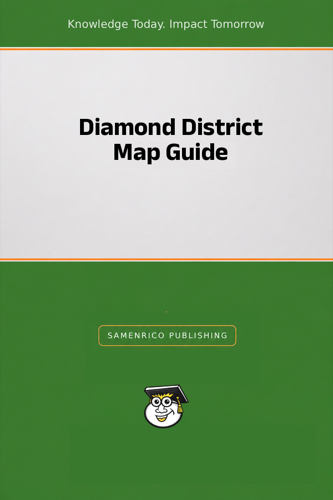
Diamond District Map Guide eBook
Tour the Antwerp diamond district and point out ke
Tour the Antwerp diamond district and point out key heist locations by address.
Formats
Free sample
Chapter 1: The Diamond Mile...--–- The train from Brussels pulls into Antwerp-Centraal, and even before the doors slide open, you feel it. The station itself is a cathedral of travel—marble floors, a massive iron-and-glass dome, clocks ticking in unison—but you are not here for the architecture. You are here for a street so ordinary that most tourists walk past it without a second glance. That street, Hoveniersstraat, runs for barely half a mile. It has no grand monuments, no Michelin-starred restaurants, no famous museums.
What it has is eighty-four percent of the world's rough diamonds.Eighty-four percent.Let that number settle. It means that on any given Tuesday, more diamonds pass through this single street than through any airport, any bank vault, any sovereign treasury on earth. The stones come from mines in Botswana and Russia and Canada, from conflict zones and corporate conglomerates, from diggers working by hand and machines the size of houses. They arrive in padded envelopes carried by couriers who look like middle managers. They are sorted, certified, traded, and shipped again within hours.
All of it happens behind glass doors that say nothing, on desks buried under papers, between men who have known each other for decades and still trust no one completely.This book is not a history. It is a map.Specifically, it is a walking tour of the Antwerp diamond district that follows the path of the most audacious heist ever committed against that street. On February 15, 2003, five Italian thieves entered the vault beneath the Antwerp Diamond Centre and walked out with more than one hundred million dollars in diamonds, gold, silver, and securities. They did not use explosives. They did not take hostages.
They did not fire a single shot. They used hairspray, polystyrene, a ladder, and a hidden camera disguised as a fire extinguisher. And they almost got away with it entirely.They were caught because of a salami sandwich.But we are getting ahead of ourselves. Before you can understand how the thieves succeeded—and why their success turned to ashes forty miles south of the city—you need to understand the ground they walked. You need to stand where they stood, see what they saw, and notice what everyone else missed.
That is the purpose of this chapter and every chapter that follows. We will move address by address, coordinate by coordinate, transforming a casual tourist stroll into a detective's investigation.The tour begins here, at Antwerp Central Station. Not at the diamond district itself, not at the vault entrance, but at the place where every visitor arrives. From this point, you will walk exactly ten minutes to reach Hoveniersstraat. Those ten minutes are important.
They give you time to shift your perspective from traveler to investigator, to notice the transition from the Antwerp of chocolate shops and canals to the Antwerp of armed guards and hidden wealth.So let us begin.The Geography of Invisible Fortune Hoveniersstraat is not the kind of street that announces itself. It runs parallel to the more famous Pelikaanstraat, which is lined with jewelry shops aimed at tourists—displays of engagement rings and gold chains, windows that sparkle invitingly. Pelikaanstraat is where you go if you want to buy a diamond necklace for your anniversary. Hoveniersstraat is where you go if you want to buy ten thousand uncut diamonds in a brown paper envelope.The difference is the difference between retail and wholesale, between theater and reality.The diamond district occupies a rough rectangle bounded by the De Keyserlei to the north, the Pelikaanstraat to the west, the Lange Herentalsestraat to the south, and the statio itself to the east. Within that rectangle, the streets are narrow, the buildings are unremarkable, and the security is invisible until you know what to look for.
Cameras perch on every corner, but they are small, tucked under eaves, painted to blend in. Hydraulic bollards rise from the asphalt at key intersections, capable of lifting a car off its wheels in under two seconds. Private security guards in plain clothes walk the sidewalks, speaking into wrist microphones, their eyes scanning not for pickpockets but for reconnaissance—someone taking too many photos, someone lingering too long, someone whose posture suggests surveillance rather than shopping.These guards are not rent-a-cops. They are former military and police, employed by the Antwerp World Diamond Centre and the various bourses that operate within the district. They carry firearms.
They have the authority to detain. And they know, better than almost anyone, that the greatest threat to the district's security is not a brute-force assault but a patient, intelligent infiltration.They know this because of what happened on February 15, 2003.The Architecture of Trust To understand how the heist was possible, you must first understand the social architecture of the diamond district. The industry runs on trust—a paradox, given that diamonds are the ultimate symbol of permanent value and the ultimate object of theft. But the trust is real, and it is ancient.The Antwerp diamond trade dates back to the fifteenth century, when the city was a major port for the Spanish and Portuguese empires. Jewish merchants fleeing the Inquisition brought diamond-cutting skills to the city, and those skills were passed down through generations.
Today, the district is dominated by two communities: Hasidic Jews, who handle the wholesale and certification end of the business, and Gujarati Indians, who dominate the cutting and polishing trade. The two groups work side by side, often in the same buildings, speaking different languages at home and a common language of business in the office.This is not a nine-to-five industry. Diamond trading follows the rhythms of global markets and religious calendars. The district is largely empty from Friday sunset to Saturday sunset, the Jewish Sabbath. It is also quiet during Indian holidays, though those are fewer and less disruptive to the overall flow.
The thieves who struck in 2003 chose their timing deliberately, hitting the vault over a weekend when the community was absent. They knew that no one would notice anything wrong until Monday morning, giving them nearly forty-eight hours to escape.That timeline—the forty-eight hours of invisibility—is the single most important fact about the heist. The thieves did not need to be fast. They needed to be thorough. And they were.The First Address: Antwerp Central Station Let us stop here, at the station, and establish our first coordinates.Antwerp Central Station Astridplein, 2018 Antwerpen GPS: 51°13'03.4"N 4°25'16.5"EThis is where every tour begins.
From the main entrance, facing the Astridplein, you will walk straight ahead into the De Keyserlei, a broad avenue lined with hotels and office buildings. After two blocks, you will turn right onto Pelikaanstraat. After one more block, you will turn left onto Hoveniersstraat. The entire walk takes ten minutes at a normal pace. Take twelve.
Notice the shift.On the De Keyserlei, you are still in tourist Antwerp. The shops sell chocolates and lace. The restaurants have menus in English and French. The people carry cameras and rolling suitcases. Then you turn onto Pelikaanstraat, and the tone changes.
The jewelry shops appear—display cases full of diamonds, gold chains hanging in windows, security gates visible behind the glass. The…
This is the end of the free sample. Get the eBook to keep going. Buy now
About this book
Details
- Author
- Guthrie Serita
- Publisher
- SamEnrico
- Language
- English
- Genre
- Non-Fiction, True Crime, Location Guide
- Released
- 2026-06-09
- Pages (approx.)
- 131
- Available as
- eBook, Audiobook

Read better in the ZLOADR app
Your eBooks on your phone or tablet. Sign in with your SamEnrico account and start reading.
More by Guthrie Serita
 LBO Clawback Provision GuideGuthrie Serita$11.99
 Debt Refinancing DatabaseGuthrie Serita$11.99
 Bariatric Surgery Pregnancy Nutrition CourseGuthrie Serita$11.99
 Lactose Intolerance Newborn GuideGuthrie Serita$11.99
 The Exiled Empress: How a Fallen Queen Outsmarted EuropeGuthrie Serita$11.99
 Frozen in Time: The Mystery of the Franklin Expedition's Lost ShipsGuthrie Serita$11.99
 Electrical Technical OfficerGuthrie Serita$11.99
 AI Financial Error Correction GuideGuthrie Serita$12.99
 International Research ProposalGuthrie Serita$12.99
 How to Become a Detective IGuthrie Serita$11.99
 Understanding Cca SyndromeGuthrie Serita$17.99