
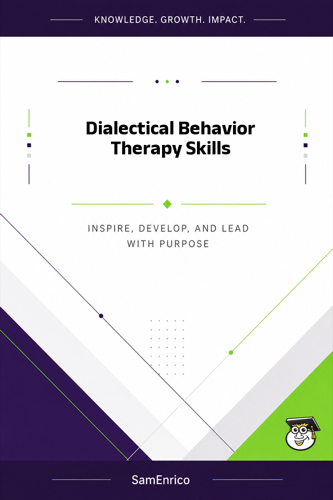
Dialectical Behavior Therapy Skills eBook
Applies DBT skills for long-term emotional regulat
Applies DBT skills for long-term emotional regulation.
Formats
Free sample
Chapter 1: The Cage of Almost...--–- You have stopped the bleeding. You have put out the fires. You have learned to name your emotions instead of being drowned by them. You can, on a good day, ride out a wave of anger without destroying a relationship. You have not self-harmed in months.
You have not called your ex-partner seventeen times in an hour. You have not screamed at your children and then collapsed into a puddle of shame. By every clinical measure, you are better.And yet.You wake up tired. Not the tired of a bad night’s sleep, but the bone-deep exhaustion of someone who has been fighting a war inside their own skull for decades. You go through the motions of a functional life—work, chores, social obligations—but there is a hollow quality to it, like tapping a ceramic mug that looks whole but sounds cracked.
You have moments, sometimes hours, of okayness. But the word “happy” feels like a language you used to speak and have mostly forgotten. You are not in crisis. That is the problem. Crisis, for all its terror, at least gave you a target.
It gave you something to fight, something to survive, something to measure yourself against. Now the alarms have stopped, and you are left in the silence, and the silence is its own kind of scream.This is the cage of almost. Almost stable. Almost functional. Almost free.
You have done the work. You have bought the workbooks, attended the therapy sessions, practiced the skills. You can list the four modules of DBT in your sleep: Mindfulness, Distress Tolerance, Emotion Regulation, Interpersonal Effectiveness. You know what Wise Mind is, even if you cannot always find it. You have a TIPP plan for panic attacks.
You have tried Opposite Action when the depression told you to stay in bed. You have DEAR MAN-ed your way through difficult conversations. And none of it has given you what you actually wanted, which was not just to suffer less, but to live more.This chapter is for the person who is tired of being “better but not well.” It is for the reader who has mastered the art of crisis survival only to discover that survival is not the same as thriving. It is for anyone who has ever thought, I have all these skills, so why do I still feel empty? The answer, which no one tells you in the early stages of DBT, is simple and devastating: most DBT workbooks train you for acute distress.
They do not train you for a life worth living.The Paradox of Skill Mastery Let us name the paradox directly. You have more skills now than you did a year ago. You can regulate your emotions better than ninety percent of the population. You have a toolkit that would make a therapist nod with approval. And yet, your subjective experience of life has not improved in proportion to your skill acquisition.
You might even feel worse in some ways, because now you have no excuse. You know what to do. You just cannot seem to make yourself care enough to do it, or when you do, it feels mechanical, like reciting a poem you have memorized but no longer feel.This is not a failure of character. It is a failure of direction.Imagine you are given a state-of-the-art chainsaw. It is sharp, powerful, well-maintained.
You learn how to start it, how to stop it, how to avoid cutting off your own leg. You become proficient. But no one tells you what you are supposed to cut. So you wander around, chainsaw humming, cutting down whatever happens to be in front of you—a mailbox here, a rosebush there, the leg of your dining room table. You are very good at cutting things.
But your life is a wreck because you had no vision for what you were building.Skills without values are like that chainsaw. They give you power without purpose. They let you stop bad things from happening, but they do not automatically generate good things. And here is the deeper truth that most DBT workbooks are afraid to say: the absence of crisis is not the same as the presence of meaning. You can eliminate every panic attack, every rage episode, every self-harm urge, and still find yourself staring at the ceiling at 2 a.m.
wondering what the point of all this effort was.The bestselling DBT manuals are brilliant at what they do. They teach you how to survive a hurricane. But they assume that once the hurricane passes, you will somehow know how to rebuild your house, plant a garden, and invite friends over for dinner. They assume that survival naturally leads to flourishing. It does not.
Survival leads to more survival. Flourishing requires something else entirely.Introducing the Life Worth Living (LWL) Framework This chapter introduces a concept that will serve as the backbone for everything that follows. It is not a new DBT skill. It is not a worksheet or a protocol. It is a compass.
And you have been trying to navigate without one.The Life Worth Living (LWL) framework comes from the intersection of DBT, positive psychology, and existential therapy. At its core is a simple question that most therapy avoids because it sounds too big, too philosophical, too unmeasurable: What do you want your life to stand for?Not “what do you want to achieve by Friday.” Not “what goals did your therapist suggest.” Not “what would make your parents finally approve of you.” Those are objectives, targets, endpoints. They are useful in the same way that a grocery list is useful. They help you get through the week. But a grocery list is not a life.The LWL framework asks you to identify the values that, if you lived by them consistently, would make your life feel like yours.
Values are not goals. Goals can be checked off. Goals end. You can lose thirty pounds, and then what? You can get the promotion, and then what?
You can find a partner, get married, buy the house—and then the goal is gone, and you are left with the same emptiness, now with nicer furniture.Values are directions. You never arrive at “kindness.” You never finish “creativity.” You never complete “honesty.” Values are infinite horizons. You walk toward them every day, and the walking itself is the point.Consider the difference:Goal Value Lose 20 pounds Nourish my body with respect Get a promotion Contribute meaningfully to my work Find a romantic partner Build relationships based on mutual care Stop having panic attacks Move through the world with courage Be less angry Respond to frustration with integrity The goals on the left are measurable, achievable, and temporary. The values on the right are unfinishable. You cannot “complete” nourishing your body.
You can only do it again and again, in small ways, for the rest of your life. And that is the secret that the cage of almost hides from you: lasting emotional regulation is not about fighting emotions. It is about building a life so aligned with your values that painful emotions have less…
This is the end of the free sample. Get the eBook to keep going. Buy now
About this book
Details
- Author
- Fishman Wiley
- Publisher
- SamEnrico
- Language
- English
- Genre
- Non-Fiction, Self-Help, DBT
- Released
- 2026-06-07
- Pages (approx.)
- 145
- Available as
- eBook, Audiobook

Read better in the ZLOADR app
Your eBooks on your phone or tablet. Sign in with your SamEnrico account and start reading.
More by Fishman Wiley
 Tobacco Cessation Strategies That WorkFishman Wiley$11.99
 Choice Overload FixFishman Wiley$11.99
 Workplace Stress and Toxic CultureFishman Wiley$11.99
 The Blood Covenant: The Madness of the Maji-Maji ProphetsFishman Wiley$11.99
 Advanced Analytics for Marketing StrategyFishman Wiley$11.99
 SaaS Specific Terms WorkbookFishman Wiley$12.99
 How to Produce Art and Collectible ItemsFishman Wiley$11.99
 A Beginners Guide to Knattleikr (Volume 1)Fishman Wiley$11.99
You may also like
 Hong Kong Handover 1997Dunn Johnnie$11.99
 Zumba For Postnatal Recovery CourseNeal Christian$11.99
 Zumba for BeginnersLadner Nikia$11.99
 YouTube Comment Mining GuideHumes Pandora$12.99
 Worry Box MeditationCarlin Rudy$11.99
 Workplace Stress MeditationNguyen Lynn$11.99
 Workplace Stress and Sleep RepairHawley Ivory$11.99
 Workplace Perfectionism CureDelaney Jeffry$11.99
 Workplace Injustice Anger GuideWallen Isabelle$11.99
 Work Addiction and Burnout LinkGreenwood Ester$11.99
 Women in Yoga and WellnessBeattie Galina$11.99
 Women in Stand Up ComedyChun Evangeline$11.99