
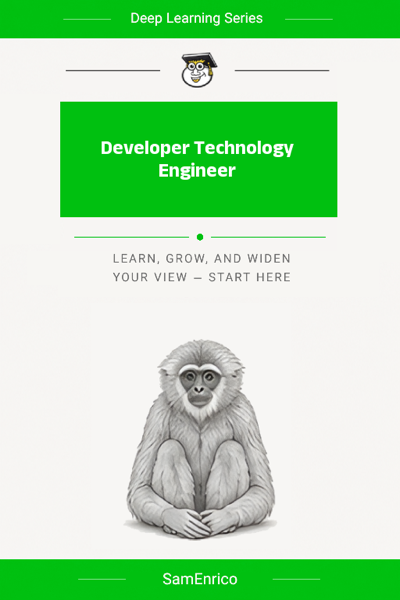
Non-FictionInformativeEducational
Developer Technology Engineer eBook
A Coursebook on Developer Technology Engineer
by Dupree Bambi
A Coursebook on Developer Technology Engineer
Formats
Free sample
Chapter 1: The Broken Welcome Mat--Maya Chin stared at her screen, watching the crash dialog pop up for the seventeenth time. It was 11:47 PM on her first day as a Developer Technology Engineer at Aether Silicon, and the company's flagship “getting started” demo had just failed to run on a clean Windows installation. Again. The error message was characteristically unhelpful: Access violation reading location 0x00000000. A null pointer dereference.
Somewhere. In 47,000 lines of demo code written by an engineer who had left the company two years ago.She leaned back in her chair, the cheap office wheels squeaking against the polished concrete floor. The rest of the Aether Silicon office was dark, the open-plan layout abandoned hours ago. A single floor lamp near the kitchenette cast long shadows across empty desks. Maya had been hired at 10:00 AM that morning, given a laptop, a badge, and a brief handshake from her manager, Tom.
“You'll be working on developer enablement for our new NPU,” he had said. “The SDK ships in six weeks. The demos are mostly done. Just need someone to polish them.”Mostly done. She muttered the words under her breath, tasting the irony.The demo was called “Image Upscale Sample” – a showcase of Aether's neural processing unit performing real-time super-resolution.
According to the marketing brief, it was supposed to demonstrate a 4x performance improvement over the previous generation. According to Maya's screen, it crashed seventeen out of seventeen times on a completely standard driver configuration. That wasn't a fluke. That was a pattern.She opened the call stack for the seventeenth time, scrolling past layers of abstraction. The crash originated in a function named process_tile(), which called dispatch_kernel(), which called enqueue_compute_task(), which eventually led to a null pointer deep inside the NPU runtime.
The variable name was ctx. Not device_context. Not npu_handle. Just ctx. Somewhere above her, buried in 47,000 lines of undocumented, untested, and unloved code, something had failed to initialize properly.And now it was her problem.The 80% Reality Every Developer Technology Engineer learns the same brutal lesson within their first week, and Maya was learning it now: you will spend more time fixing other people's broken code than writing your own.The software engineering industry has a dirty secret that recruiters don't mention during the hiring process.
The myth is that DTEs write beautiful demos, craft elegant SDKs, and ship perfect examples that developers around the world will admire and adopt. The reality is that you inherit a landfill of broken samples, abandoned prototypes, and half-finished experiments, and your job is to turn that landfill into a functioning showcase before the CEO does a live demo at a conference.How broken is the average demo codebase? Maya's experience was not unusual. A study of 500 public SDK repositories across hardware vendors found that 37% failed to build on a clean system without manual intervention. Twenty-two percent crashed when run with default parameters.
And twelve percent contained security vulnerabilities that would have been caught by basic static analysis. These were the samples that companies were proud enough to share publicly. The internal demos were worse.The problem is structural. Hardware companies hire brilliant chip designers who write code as a necessary evil. The demo is finished when it works on the lead engineer's laptop, with its specific driver version, specific compiler flags, and specific environment variables.
The demo is shipped when it builds on one other machine. No one runs it on a clean Windows install. No one tests it with an older driver. No one asks the question that Maya was now asking at midnight on her first day: What happens when a new developer downloads this code, follows the instructions, and presses the build button?That question – that single, painful, costly question – is the entire reason Developer Technology Engineers exist.Pragmatic Parsing: Reading the Tea Leaves of Failure Maya had a background in game engine development before joining Aether. She had spent three years at a mid-sized studio debugging rendering pipelines, and she had learned one skill that proved more valuable than any amount of architectural knowledge: pragmatic parsing – the ability to rapidly read compiler errors, driver logs, and crash dumps to isolate whether a bug lives in the user's code, the SDK, the driver, or the hardware itself.The skill sounds trivial.
It is not. Most engineers see an error message and immediately assume the problem is in the code they just wrote. This is the “localization bias” – the unconscious belief that bugs are found close to where you are working. But DTEs cannot afford this bias. Their job spans the entire stack, from user application down to transistor behavior, and the bug could be anywhere.Maya walked herself through the debugging checklist that had become second nature over years of late-night debugging sessions:Step One: Capture the state.
Before touching a single line of code, document everything. What operating system version? What driver version? What compiler and flags? What were the exact steps to reproduce?
Maya had learned this lesson the hard way after spending three days chasing a bug that only appeared when the system locale was set to Turkish. (The issue: the dotless 'i' in Turkish broke a string comparison deep inside the SDK. She still had nightmares.)Step Two: Make it reproducible. If a bug happens once, it's a fluke. If it happens twice, it's a pattern.
If it happens seventeen times, it's a feature. Maya had a simple rule: she would not move on from a reproduction step until she could trigger the bug on command. This sometimes meant running the same sequence twenty or thirty times, varying parameters, isolating environmental factors. The seventeenth crash was useful because it was identical to the first sixteen. That meant something deterministic was broken.Step Three: Bisect the problem.
Binary search through time or through code. In Maya's case, she couldn't bisect through Git history because the demo repo had no commits before the last six months – the previous engineer had worked in a private branch and then merged everything at once. Instead, she bisected through the initialization sequence. She added log statements at every stage: hardware detection, device context creation, memory allocation, shader compilation, pipeline construction, and finally kernel dispatch. The crash happened exactly after the log line reading Created device context.
But the next log line, Allocated scratch memory, never appeared. So the crash was happening inside Allocated scratch memory – or between the two.Step Four: Isolate the layer. This is the DTE's superpower. Maya asked herself: is this bug in the user code (the demo itself), the SDK (the library Aether provided), the driver (the software layer from the NPU vendor), or the hardware (an actual silicon bug)? She ruled out hardware quickly – the NPU had passed validation on thousands of other workloads.
The driver was a candidate, but the crash signature (null pointer dereference on ctx) looked like an uninitialized pointer in C++, not a driver-level failure. That left user code or SDK.She extracted the offending function into a standalone test: ten lines of code that did nothing but initialize the device context and allocate scratch memory. The standalone test crashed identically. That meant the bug…
This is the end of the free sample. Get the eBook to keep going. Buy now
About this book
Details
- Author
- Dupree Bambi
- Publisher
- SamEnrico
- Language
- English
- Genre
- Non-Fiction, Informative, Educational
- Released
- 2026-05-09
- Pages (approx.)
- 160
- Available as
- eBook, Audiobook

Read better in the ZLOADR app
Your eBooks on your phone or tablet. Sign in with your SamEnrico account and start reading.
More by Dupree Bambi
 Breaking Binge Eating Cycle WorkbookDupree Bambi$11.99
 Personal Ing For Success MarketingDupree Bambi$11.99
 Vitamin B6 for PMS GuideDupree Bambi$11.99
 Investor Pitch Deck GuideDupree Bambi$11.99
 First Year Student Stress GuideDupree Bambi$11.99
 The Lost City of Atlantis: A Deep-Sea Vent MysteryDupree Bambi$11.99
 Echoes of the Moon: The Untold Story of the First Woman in SpaceDupree Bambi$11.99
 Understanding Ectodermal Dysplasia Margarita TypeDupree Bambi$17.99
 Colombian Data Breach GuideDupree Bambi$12.99
 Explainer Script Marking GuideDupree Bambi$12.99
 How to Become a Carpenter IiDupree Bambi$11.99
You may also like
 Hong Kong Handover 1997Dunn Johnnie$11.99
 Zumba For Postnatal Recovery CourseNeal Christian$11.99
 Zumba for BeginnersLadner Nikia$11.99
 YouTube Comment Mining GuideHumes Pandora$12.99
 Worry Box MeditationCarlin Rudy$11.99
 Workplace Stress MeditationNguyen Lynn$11.99
 Workplace Stress and Sleep RepairHawley Ivory$11.99
 Workplace Perfectionism CureDelaney Jeffry$11.99
 Workplace Injustice Anger GuideWallen Isabelle$11.99
 Work Addiction and Burnout LinkGreenwood Ester$11.99
 Women in Yoga and WellnessBeattie Galina$11.99
 Women in Stand Up ComedyChun Evangeline$11.99