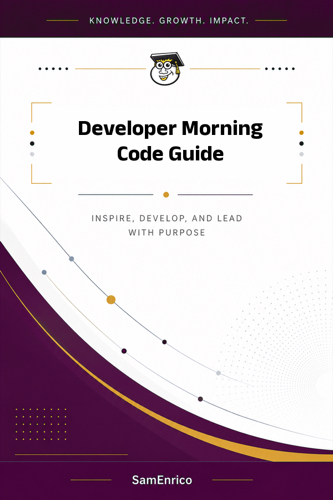
Developer Morning Code Guide eBook
Write your best code before standup using this pra
Write your best code before standup using this practical software engineer routine workbook.
Formats
Free sample
Chapter 1: The Ninety-Minute Heist--You are about to steal back ninety minutes of your life every single day. Not from your employer. Not from your family. From the endless, screaming void of notifications, interruptions, and reactive chaos that has quietly convinced you that feeling busy is the same as being productive.Here is the truth that no one tells you in engineering onboarding: The first ninety minutes of your workday are not like the rest of your day. They are biologically, neurologically, and psychologically distinct.
During this window, your brain is a supercomputer. After this window, it becomes a pocket calculator. And most developers spend their supercomputer hours checking Slack, scrolling email, and clicking through Jira tickets that could have been handled by a well-trained houseplant.This chapter is the heist plan. You are going to learn why the morning window is priceless, how to identify the single task worth stealing time for, and why willpower is a trap that has been failing you your entire career. By the end of this chapter, you will never again open Slack before your editor.
And you will finally understand why the best developers you have ever worked with always seemed to ship impossible things before lunch.The Neurochemistry of Getting Things Done Let us start with biology, because you cannot hack what you do not understand.Your brain does not produce a flat line of cognitive ability from 9 AM to 5 PM. It produces waves. These waves are driven by your circadian rhythm (the roughly twenty-four-hour internal clock) and ultradian rhythms (shorter cycles of ninety to one hundred twenty minutes that govern focus, energy, and rest).During the first ninety to one hundred twenty minutes after you wake—assuming you have slept at least six hours—your brain enters a state that cognitive neuroscientists call peak fluid intelligence availability.Fluid intelligence is your ability to solve novel problems, hold multiple variables in working memory, switch between abstract concepts, and reason without relying on memorized patterns. Fluid intelligence is what you use when you encounter a bug you have never seen before, design a system you have never built before, or refactor code that someone else wrote badly.After this window closes—typically between 10:30 AM and 11:00 AM for someone who wakes at 7:00 AM—your brain shifts toward crystallized intelligence. Crystallized intelligence is your ability to retrieve known patterns, apply learned rules, and perform tasks you have done a hundred times.
It is valuable. But it is not for complex coding.Here is the neurochemical breakdown of why this happens:Cortisol rises naturally upon waking. Despite its reputation as a stress hormone, moderate morning cortisol sharpens alertness, increases glucose metabolism in the brain, and enhances memory retrieval. This is why you remember dreams most vividly right after waking and why morning is the best time for learning new concepts.Dopamine follows a parallel morning curve. Dopamine is not the pleasure molecule pop psychology claims it to be.
It is the motivation molecule. It drives goal-directed behavior, reward-seeking, and—crucially—the willingness to persist through frustration. High dopamine makes a difficult ticket feel like a puzzle. Low dopamine makes it feel like punishment.Norepinephrine peaks in the morning, increasing arousal, attention, and the signal-to-noise ratio of your perception. High norepinephrine allows you to ignore the Slack icon bouncing in your dock.
Low norepinephrine makes every notification feel equally important.Serotonin is still rising but has not yet peaked. Moderate serotonin (rather than high) reduces complacency and keeps you alert to edge cases. Too much serotonin later in the day makes you feel content with "good enough."These four neurotransmitters align in the morning to create what researchers call the peak alertness window. It is not a metaphor. It is measurable, repeatable, and universal across healthy human adults.Now consider what most developers do during this peak alertness window.
They check Slack. They scan email. They review pull requests. They update Jira tickets. They attend a "quick sync" meeting that lasts forty-five minutes.
They are using a Formula One engine to drive to the grocery store.This book is about putting that engine on a racetrack.The Willpower Trap (And Why You Have Fallen Into It)You might be thinking: "I know I should focus in the morning. I just need more discipline."That thought is the Willpower Trap, and it is one of the most expensive lies in productivity.Willpower is not a switch you can flip. It is a finite resource that depletes with use. Psychologists call this ego depletion. Every decision you make—should I open Slack?
Should I answer this DM? Should I respond to this email? Should I start coding?—consumes a small amount of willpower. By the time you have made twenty small decisions, you have nothing left for the big decision: actually doing the hard work of coding.The solution is not more willpower. The solution is fewer decisions.Consider the most productive developers you have worked with.
They do not wake up and wonder what to do. They already know. Their morning ritual is automatic: coffee, environment check, single task selected, code. They do not spend willpower deciding; they spend willpower executing.This chapter (and this entire book) replaces willpower with pre-commitment. Before your morning window begins, you will have already chosen your task.
You will not check Slack first. You will not "just see if anything is urgent." You will open your editor and start typing within three minutes of sitting down. That is not discipline. That is engineering your environment to make discipline unnecessary.The Priority Filter: Choosing Your One Task The most common morning mistake is not distraction. It is mis-selection.
Developers choose the wrong task for their golden window.The wrong task is:Something that takes less than twenty-five minutes (you can do that after standup)Something that does not require deep focus (ditto)Something that no one is waiting for (low leverage)Something that is safe and comfortable (you are avoiding the hard thing)The right task is:Something that requires more than twenty-five minutes of uninterrupted thought Something that, if completed, unblocks a teammate or moves a project forward significantly Something that is the riskiest task on your plate (the one most likely to go wrong)This book gives you a decision tool called The Priority Filter. It is a three-question decision tree. You will complete it every morning before you open Slack. It takes thirty seconds.Question 1: Does this task require more than twenty-five minutes of uninterrupted thought?If no, eliminate it. That task belongs after standup.
Do not waste your golden window on something you could do while half-awake. You are not being efficient by doing a small task first. You are being a coward. Do the hard thing.If yes, move to Question 2.Question 2: Will completing this task before standup unblock a teammate or remove a major risk?Unblocking a teammate is the highest-leverage use of your morning. If you finish a task at 10:00 AM that lets another developer start their work at 10:30 AM instead of 2:00 PM, you have effectively given them back three and a half hours.
That is multiplicative productivity. That is how small actions become big results.If the answer is no—if this task only benefits…
This is the end of the free sample. Get the eBook to keep going. Buy now
About this book
Details
- Author
- Shields Lenora
- Publisher
- SamEnrico
- Language
- English
- Genre
- Non-Fiction, Self-Help, Developer Productivity
- Released
- 2026-06-06
- Pages (approx.)
- 146
- Available as
- eBook, Audiobook

Read better in the ZLOADR app
Your eBooks on your phone or tablet. Sign in with your SamEnrico account and start reading.
More by Shields Lenora
 The Morning Affirmation Ritual GuideShields Lenora$11.99
 Apache Solar Farm DeveloperShields Lenora$11.99
 VRBO Vacation Envy TrapShields Lenora$11.99
 Brenda Lee Little Miss DynamiteShields Lenora$11.99
 The Vanishing Bootlegger: A Witness Protection EnigmaShields Lenora$11.99
 Social Media CopywriterShields Lenora$11.99
 Government Contract FinancingShields Lenora$12.99
 Personal Guarantee Rate ImpactShields Lenora$12.99
 Understanding Short Stature Prognathism Short Femoral NecksShields Lenora$17.99
 How to Become a Police Academy Program CoordinatorShields Lenora$11.99