
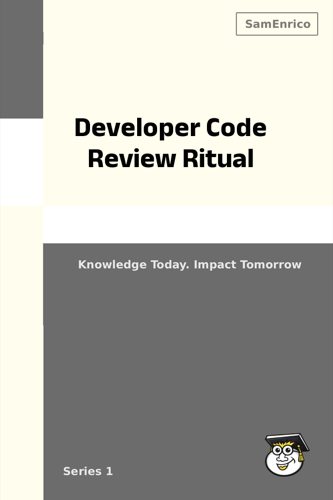
Developer Code Review Ritual eBook
Reviews commits and refactors daily.
Reviews commits and refactors daily.
Formats
Free sample
Chapter 1: The LGTM Lie--–- Every line of code you have ever written will outlive you. Not in a poetic, legacy-of-the-master-artisan sense. In a grim, practical, your-successor-will-be-screaming-at-2AM-while-debugging-your-cleavage sense. Code is not art. Art can be ambiguous.
Art can be interpreted. Code is either true or false, running or crashed, secure or pwned. And somewhere between the moment you type git commit and the moment your teammate types LGTM, the truth of your code gets lost in translation.This chapter dismantles the most expensive habit in software engineering—the thoughtless approval known as "Looks Good to Me." You have used it. You have received it. You have probably felt a small, quiet disappointment when you saw it on your own pull request.
That disappointment is not sensitivity. It is pattern recognition. Your brain knows that LGTM is not a review. It is a social signal that someone wanted to close a browser tab more than they wanted to understand your work.The thesis of this entire book rests on a single uncomfortable truth: Code reviews are not gates. They are handoffs.
A gate stops things. A handoff transfers something valuable. When you approve a pull request without transferring understanding, you have not reviewed code. You have performed a ritual of avoidance dressed in the language of approval.The Anatomy of a Four-Letter Word Let us examine LGTM under a microscope. Four characters.
One acronym. Decades of accumulated damage.The phrase originated in early open-source communities as a shorthand for trusted maintainers reviewing trivial patches. It meant, "I have looked at this, it does not obviously break anything, and I trust you enough to merge it without further discussion." In that narrow context, LGTM was efficient. But like a virus that mutates to infect new hosts, LGTM escaped its origin. It became the default response for every pull request, regardless of size, complexity, or the reviewer's actual understanding.Consider what actually happens when someone types LGTM in 2025.
They have not looked at your code. They have glanced. They have scanned for syntax errors, maybe noticed a missing semicolon, and concluded that nothing is on fire. That is not a review. That is a fire drill where nobody checked for smoke.Worse, LGTM carries a hidden social contract.
When you type it, you are signaling: "I have approved this, and if it breaks, I am not responsible because I said 'Looks Good to Me,' not 'I have verified this thoroughly.'" The phrase is designed to provide the approver with plausible deniability. It is approval without accountability. It is the software engineering equivalent of saying "bless your heart" while meaning the exact opposite.The data backs this up. A study of 2.5 million pull requests across 1,500 organizations found that pull requests approved with LGTM or +1 had a 34 percent higher rate of post-merge defects than those approved with a specific, substantive comment. Not because the substantive comments caught more bugs—but because the act of writing a substantive comment forced the reviewer to actually read the code.Here is the uncomfortable corollary: If you cannot articulate what a pull request does in your own words, you have not reviewed it.
You have scrolled past it. And scrolling is not a quality assurance technique.The Emotional DNA of a Good Review In their research on blockbuster novels, Jodie Archer and Matthew Jockers discovered that successful books share a predictable emotional "DNA"—a sequence of reader feelings that create engagement, tension, and satisfaction. The same principle applies to code reviews. A good review has an emotional arc that both the author and the reviewer can predict. That predictability reduces anxiety.Think about what a developer feels when they open a pull request.
If they are the author, they feel vulnerability. They have exposed their thinking, their naming choices, their architectural decisions. They are asking for judgment. If they are the reviewer, they feel burden. They have to interrupt their own work, parse someone else's logic, and produce feedback that is simultaneously honest and kind.The LGTM response is emotionally cheap.
It costs the reviewer nothing. But it leaves the author with a hollow feeling: "Did they actually read this? Do they care? Am I about to merge something that will embarrass me tomorrow?"A well-structured review, by contrast, follows a predictable emotional pattern:Acknowledgment – The reviewer signals they have seen the work ("I've looked at the three commits in this PR")Curiosity – The reviewer asks clarifying questions that demonstrate engagement ("What happens if the user list is empty here?")Specificity – The reviewer points to exact lines with precise observations ("In handle Auth(), line 47, we're reassigning the session token twice")Resolution – The author and reviewer reach shared understanding, even if that understanding is "this is good enough for now"This pattern takes less than five minutes for a well-sized pull request. But it requires abandoning LGTM as a default response.
It requires replacing a four-character shortcut with a fifteen-second investment in actual communication.The Great Reframe: From Bug Hunting to Context Transfer Here is where most teams get code review fundamentally wrong. They treat it as a quality assurance activity. They believe the goal is to find bugs before they reach production. This is not wrong, but it is incomplete. Bug finding is a side effect, not the purpose.The true purpose of code review is context transfer.
Every time you review code, you are teaching the next person who will touch this file—which might be you in six months—what the code does, why it does it that way, and what assumptions the original author made.When you transfer context successfully, the code becomes self-documenting in a way that comments cannot achieve. Because context is not just information. Context is the set of constraints, trade-offs, and rejected alternatives that shaped the final implementation. A comment can tell you what the code does. A good code review tells you why the code does not do something else.Let me give you a concrete example.
Consider this function:javascript Copy Downloadfunction calculate Discount(user, total) { if (user.tier === 'gold' && total > 100) { return total * 0.2; } return total * 0.1; }A bug-hunting review would ask: "Did you mean to return 0.15 for silver tier?" That is fine. But a context-transfer review would ask: "Why does the gold discount only apply above $100? Was that a product requirement or a performance optimization to avoid hitting the discount API for small carts?"That second question transfers context. It tells the future developer that there is a reason for the total > 100 condition, and that reason is external to the code itself. That knowledge prevents someone from "simplifying" the function later and introducing a business logic error.The difference between a bug hunt and a context transfer is the difference between checking a box and building shared understanding.
One produces compliant code. The other produces a resilient team.Introducing the Code Review Triangle To operationalize context transfer, this book introduces the Code Review Triangle. Every comment you make in a code review should fall into one of three categories. If a comment does not fit, it is probably a nitpick or a preference—and we will deal with those in Chapter 8.Vertex 1: Correctness Does the code do what it…
This is the end of the free sample. Get the eBook to keep going. Buy now
About this book
Details
- Author
- Spivey Suellen
- Publisher
- SamEnrico
- Language
- English
- Genre
- Non-Fiction, Self-Help, Software Development
- Released
- 2026-06-05
- Pages (approx.)
- 125
- Available as
- eBook, Audiobook

Read better in the ZLOADR app
Your eBooks on your phone or tablet. Sign in with your SamEnrico account and start reading.
More by Spivey Suellen
 Stress and Parkinson's ProgressionSpivey Suellen$11.99
 Over justification Effect GuideSpivey Suellen$11.99
 Opioid Dependency Art Therapy Healing GuideSpivey Suellen$11.99
 Brain Cancer Survivor StorySpivey Suellen$11.99
 Toilet Sit to StandSpivey Suellen$11.99
 Spouse Grief JournalSpivey Suellen$11.99
 Russian Mafia in CanadaSpivey Suellen$11.99
 The Asphalt Kings: The Deadly Rivalry That Built American SpeedSpivey Suellen$11.99
 The Werewolves of Pennsylvania: Beastly Killings and Colonial JusticeSpivey Suellen$11.99
 Service Providers Guide to Shopping ServicesSpivey Suellen$11.99
 How to Start a Clothing (commission Agent) Business (Beginners Guide)Spivey Suellen$11.99
 How to Produce Weight Lifting Machines and RacksSpivey Suellen$11.99
You may also like
 Time Blocking For Developers GuideHook Kena$11.99
 Flow in Programming CodingTeeter Rosita$11.99
 Listening In Software Dev GuideEllison Lavona$11.99
 Software Developer Interruption GuideBurton Ricky$11.99
 Distraction Proof Coding WorkflowBallard Ronald$11.99
 Weekly Review for Software DevelopersGoforth Deandra$11.99
 Working Memory For ProgrammersWeller Alec$11.99
 Developer Flow State ProtectionSells Ressie$11.99
 Pomodoro for Coding FocusPatterson Elisa$11.99
 Flow For ProgrammersLemon Jim$11.99
 The Software Engineer CreativityFerry Desmond$11.99
 Pomodoro For ProgrammersBaugh Jung$11.99