
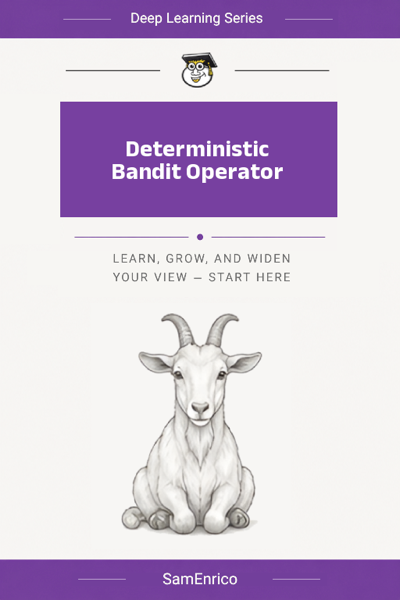
Non-FictionInformativeEducational
Deterministic Bandit Operator eBook
A Coursebook on Deterministic Bandit Operator
A Coursebook on Deterministic Bandit Operator
Formats
Free sample
Chapter 1: The Gambler’s Curse--–- The first lesson of decision-making under uncertainty is that every choice you make changes the world. The second lesson is that no one tells you this.The casino floor hummed with the sound of false promises. Rows of slot machines blinked in hypnotic synchrony, each one a siren singing the same seductive song: pull me, and fortune may favor you. For decades, gamblers, economists, and computer scientists had studied these machines—these "bandits"—as the purest distillation of the explore-exploit trade-off. Should you continue playing the machine that has paid out modestly but reliably, or should you try the untested machine next to it, which might hold a jackpot or might hold nothing?
This is the classic multi-armed bandit problem, and it has been solved, re-solved, optimized, and celebrated as one of the great success stories of sequential decision theory.But there is a lie hidden in the slot machine. The lie is that the world is static.On the other side of the casino floor, far from the rows of independent slot machines, sat a blackjack table. And at that table sat a man named Eddie Thorp, a mathematics professor with a pocketful of index cards and a brain that refused to accept convenient fictions. Thorp had done what no gambler before him had done: he had realized that blackjack is not a static game. Each bet, each hit, each stand changes the state of the deck.
The cards already played are gone. The probability of drawing a ten changes with every hand. The past does not just inform the future—it determines it in ways that are both predictable and hidden.Thorp did not solve a bandit problem. He solved something far more difficult. He learned the operator.This book is about that operator.
It is about what happens when your actions do not simply sample a static reward distribution but instead transition the environment from one state to another, deterministically, irrevocably, and often invisibly. It is about the difference between pulling levers and building the machine. And it begins, as all such journeys must, with the fundamental problem that Thorp glimpsed but never fully formalized: the explore-exploit trade-off in a world that remembers what you did to it.The Illusion of Independence In the classical bandit problem, each arm of each slot machine is assumed to be independent and identically distributed (i.i.d.) across pulls. Pull arm A. Receive a reward drawn from some fixed distribution.
Pull arm A again. Receive a new reward, drawn from the same distribution, independent of the first pull. The machine has no memory. It does not care that you just pulled it. It does not change its internal state.
It is, in the most literal sense, a gambling device designed to be memoryless because memory would make it harder for the house to guarantee its long-term edge.This assumption of independence is not merely a mathematical convenience. It is the bedrock upon which nearly all bandit algorithms are built. The Upper Confidence Bound (UCB) algorithm, which we will explore in Chapter 2, relies on the fact that each pull gives fresh information about the same underlying distribution. The Exp3 algorithm, which handles adversarial rewards in Chapter 3, relies on the fact that the adversary cannot change the underlying structure of the arms—only the rewards they deliver. Even sophisticated extensions like contextual bandits assume that the context changes but the arm-reward relationship remains stable conditional on the context.But consider the world outside the casino.You are a product manager launching a new feature.
You can show version A or version B to users. If you show version A, users may learn how to use it, becoming more efficient over time. Or they may become annoyed and churn. Their behavior changes as a function of what you showed them yesterday. The reward from showing version A today depends on whether you showed version A yesterday.You are a roboticist programming a rover to explore a cave.
The rover can turn left or turn right at each junction. If it turns left, it enters a new chamber. If it turns right, it enters a different chamber. The reward (say, scientific value of images collected) depends not just on the action but on the state the rover is currently in—and that state is the cumulative result of every previous action. A wrong turn ten steps ago cannot be undone by a right turn now, because the rover is already somewhere else.You are a physician choosing treatments for a chronic disease.
The patient has a hidden health state: inflamed, stable, or recovering. Each treatment transitions the patient to a new state. An aggressive treatment might produce high immediate reward (symptom reduction) but transition the patient to a fragile state where future treatments are less effective. A conservative treatment might produce lower immediate reward but keep the patient in a robust state.In all of these examples, the fundamental assumption of independence fails. The past matters not because of statistical correlation but because of causality.
Your actions are operators that map one state to another. The sequence of states is deterministic given the sequence of actions—even if the rewards contain noise. And the learner does not know the transition function. The learner must discover, through trial and error, how the world moves when pushed.This is the Deterministic Bandit Operator (D-BOP) problem. It is the problem of learning a deterministic state transition function under bandit feedback, where each action reveals only the next state and reward, not the full transition matrix.
It is the problem that every intelligent agent faces when it acts in a world that has memory.The Anatomy of a Decision To understand why the D-BOP problem is both harder and more interesting than the classical bandit problem, we must dissect a single decision. Let us define the elements of the problem formally.We have a set of states, denoted S\mathcal{S}S. A state is a complete description of the environment relevant to future rewards. In the blackjack example, the state includes the composition of the remaining deck, the player's current hand, and the dealer's upcard. In the rover example, the state includes the rover's current location, its battery level, and the set of chambers already visited.
In the physician example, the state includes the patient's inflammation level, treatment history, and any side effects.We have a set of actions, denoted A\mathcal{A}A. These are the levers the agent can pull. In blackjack, actions include hit, stand, double down, split. In the rover problem, actions include move left, move right, take a sample, transmit data. In medicine, actions include prescribe drug A, prescribe drug B, or perform a diagnostic test.The deterministic transition function T:S×A→ST: \mathcal{S} \times \mathcal{A} \rightarrow \mathcal{S}T:S×A→S is the operator itself.
It tells us: if you are in state sss and you take action aaa, you will deterministically arrive at state T(s,a)T(s, a)T(s,a). No randomness. No probability. The universe is mechanical.The reward function R:S×A→RR: \mathcal{S} \times \mathcal{A} \rightarrow \mathbb{R}R:S×A→R gives the immediate numerical payoff for taking action…
This is the end of the free sample. Get the eBook to keep going. Buy now
About this book
Details
- Author
- Ritchey Carlene
- Publisher
- SamEnrico
- Language
- English
- Genre
- Non-Fiction, Informative, Educational
- Released
- 2026-06-02
- Pages (approx.)
- 150
- Available as
- eBook, Audiobook

Read better in the ZLOADR app
Your eBooks on your phone or tablet. Sign in with your SamEnrico account and start reading.
More by Ritchey Carlene
 Media Interview Training GuideRitchey Carlene$11.99
 Self Hypnosis For PTSD HyperarousalRitchey Carlene$11.99
 Personal Ing For Success SalesRitchey Carlene$11.99
 Magnesium for PMS ReliefRitchey Carlene$11.99
 Test Taking Calm TechniquesRitchey Carlene$11.99
 The Silk Road Tycoons: How a Desert Caravan Built an EmpireRitchey Carlene$11.99
 The Silent Architect: How a Forgotten Woman Shaped the WorldRitchey Carlene$11.99
 How to Become a Automobile-bumper StraightenerRitchey Carlene$11.99
 Chilean Data Breach GuideRitchey Carlene$12.99
 Voiceover Vocal Health GuideRitchey Carlene$12.99
 Understanding Ectodermal Dysplasia Hypohidrotic Autosomal DominantRitchey Carlene$17.99
You may also like
 Hong Kong Handover 1997Dunn Johnnie$11.99
 Zumba For Postnatal Recovery CourseNeal Christian$11.99
 Zumba for BeginnersLadner Nikia$11.99
 YouTube Comment Mining GuideHumes Pandora$12.99
 Worry Box MeditationCarlin Rudy$11.99
 Workplace Stress MeditationNguyen Lynn$11.99
 Workplace Stress and Sleep RepairHawley Ivory$11.99
 Workplace Perfectionism CureDelaney Jeffry$11.99
 Workplace Injustice Anger GuideWallen Isabelle$11.99
 Work Addiction and Burnout LinkGreenwood Ester$11.99
 Women in Yoga and WellnessBeattie Galina$11.99
 Women in Stand Up ComedyChun Evangeline$11.99