
Non-FictionHealth & WellnessDementia Care
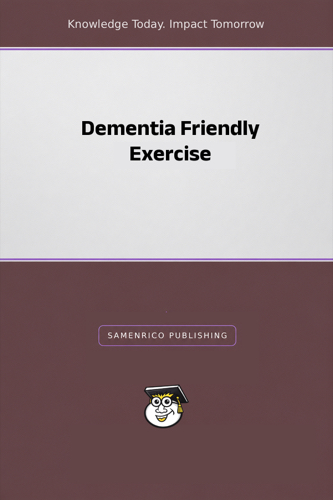
Dementia Friendly Exercise eBook
Teaches simple repetitive movements and music pair
Teaches simple repetitive movements and music paired activities for cognitive decline.
Formats
Free sample
Chapter 1: The Last Connection--–- Eleanor’s daughter hadn’t heard her mother’s voice in eleven months. Not a word, not a whisper, not even a frustrated sigh that made any sense. Eleanor sat in her familiar recliner by the window, the same chair she’d occupied every afternoon for three years since her Alzheimer’s diagnosis. Her hands rested motionless on the armrests. Her eyes followed nothing.
Her daughter, Sarah, had tried everything—photo albums, favorite foods, videos of grandchildren, even the old dog that used to sleep at Eleanor’s feet. Nothing. Eleanor was present in body but unreachable in every other way.Then one Tuesday, out of sheer exhaustion and desperation, Sarah hummed. Not a complex song. Not a request for her mother to remember anything.
Just a simple, tuneless hum of a melody she’d heard a thousand times growing up—the song Eleanor used to sing while folding laundry, while stirring soup, while pushing Sarah on the backyard swing. “You Are My Sunshine.” Sarah didn’t even realize she was doing it. She was just filling the unbearable silence.And then Eleanor’s right foot tapped. Once. Twice.
A pause. Three times. In rhythm. Perfectly in rhythm.Sarah stopped humming, stunned. Her mother’s foot kept tapping for three more beats, as if the music were still playing inside a place that words could no longer reach.
Then Eleanor’s eyes shifted. Not toward Sarah exactly, but toward the sound. Toward the memory that the sound had unlocked. For ninety seconds—the longest ninety seconds of Sarah’s adult life—mother and daughter existed in the same moment again. No names were spoken.
No facts were recalled. No “Do you remember when?” was asked. Just a foot tapping and a melody hanging in the air.That evening, Sarah wrote in a journal she’d started keeping after the diagnosis: “She’s still in there. The disease took her words. It took her face recognition.
It took her ability to tell me she loves me. But the beat is still there. The rhythm is still there. And tonight, for the first time in almost a year, we danced together. Her in her chair.
Me standing beside her. Just a sway. Just a few seconds. But it was a dance.”This book is not about exercise. Not in the way you’ve been taught to think about exercise.
It is not about burning calories, building muscle, lowering cholesterol, or fitting into old clothes. It is about finding the person you love inside a disease that hides them. It is about using the body’s oldest, deepest, most primitive memory system—the one that survives long after names and dates and faces have crumbled—to reconnect. And you can start tonight. In five minutes.
Without leaving the chair they’re sitting in right now.The Wrong Question We’ve Been Asking For decades, the dementia care field has asked a fundamentally flawed question: “How do we get people with dementia to exercise?” This question assumes that exercise is a chore, a prescription, a medicine that must be administered. It assumes resistance is the problem and compliance is the goal. It assumes that the person with dementia doesn’t want to move and must be convinced, bribed, or tricked into doing so.Every single one of those assumptions is wrong.The real question is not how to get them to exercise. The real question is: “How do we use movement to reach them when words no longer work?”This reframing changes everything. When you stop thinking about exercise as a health intervention and start thinking about it as a communication channel, the entire experience transforms.
You are no longer a caregiver trying to force a reluctant patient through a series of pointless calisthenics. You are a dance partner, a rhythm keeper, a bridge builder. You are not asking them to do something for their health. You are inviting them to join you in something that feels, at its core, like play.Consider the difference between these two scenarios:Scenario A (the traditional approach): A caregiver says, “Dad, the doctor says you need to move your arms more. Let’s do ten repetitions.
One, two, three…” The father with dementia feels confused, patronized, and possibly angry. He refuses. The caregiver feels frustrated and incompetent. Everyone ends the interaction worse than they started.Scenario B (the approach in this book): A caregiver sits beside her father, picks up a pair of rhythm sticks, and begins tapping a simple beat on the table—tap, tap, tap-rest, tap, tap, tap-rest. She doesn’t explain.
She doesn’t instruct. She just taps. Her father watches her hands. Then his own hand reaches for the second pair of sticks. He doesn’t know why.
He doesn’t need to know why. His procedural memory—the same system that lets him walk, chew, and scratch an itch without thinking—recognizes the pattern. He picks up the sticks. He taps along. Not perfectly.
Not every beat. But he taps. And for three minutes, they make music together.Which scenario sounds like something you would actually want to do tonight?The Memory That Never Forgets To understand why this works, you need to understand something remarkable about the human brain—something that most exercise books for dementia either get wrong or leave out entirely.Your brain has multiple memory systems. The one we talk about most often is episodic memory—the ability to remember specific events, like what you ate for breakfast or where you parked the car. This is the memory that Alzheimer’s disease attacks first and destroys most completely.
When your loved one can’t remember your name or what happened five minutes ago, episodic memory is failing.But there is another memory system, older and more resilient, called procedural memory. This is the memory for how to do things, not what things happened. Procedural memory is why you can still ride a bicycle even if you haven’t touched one in twenty years. It’s why you can tie your shoes without looking at your hands. It’s why a pianist can play a complex sonata while carrying on a conversation.
The movements have been encoded so deeply into the neural circuits of the basal ganglia and cerebellum that they no longer require conscious thought.Here is the critical fact that changes everything about how we should care for people with dementia: Procedural memory is often preserved well into the moderate and even late stages of the disease.That means the person who cannot remember your name, cannot recall what they ate an hour ago, and cannot tell you what year it is may still be able to clap along to a beat, march in place to a familiar song, or reach out to catch a softly tossed scarf. The body remembers what the mind has lost.This is not a metaphor. This is neuroanatomy. The brain regions that support procedural memory—the basal ganglia, the supplementary motor area, the cerebellum—are different from the regions devastated by Alzheimer’s pathology. While plaques and tangles accumulate in the hippocampus (episodic memory) and the cortex (language, reasoning), the motor circuits…
This is the end of the free sample. Get the eBook to keep going. Buy now
About this book
Details
- Author
- Holcombe Amparo
- Publisher
- SamEnrico
- Language
- English
- Genre
- Non-Fiction, Health & Wellness, Dementia Care
- Released
- 2026-06-05
- Pages (approx.)
- 155
- Available as
- eBook, Audiobook

Read better in the ZLOADR app
Your eBooks on your phone or tablet. Sign in with your SamEnrico account and start reading.
More by Holcombe Amparo
 Francis Stigmata ExperienceHolcombe Amparo$11.99
 Nonverbal Cues TherapyHolcombe Amparo$11.99
 Drug Addiction in VeteransHolcombe Amparo$11.99
 Price Increase Timing Optimization GuideHolcombe Amparo$12.99
 How to Produce CanteensHolcombe Amparo$11.99
 Lead Software Developer and IntegratorHolcombe Amparo$11.99
 How to Become a Meat-cutter ApprenticeHolcombe Amparo$11.99
You may also like
 Hong Kong Handover 1997Dunn Johnnie$11.99
 Zumba For Postnatal Recovery CourseNeal Christian$11.99
 Zumba for BeginnersLadner Nikia$11.99
 YouTube Comment Mining GuideHumes Pandora$12.99
 Worry Box MeditationCarlin Rudy$11.99
 Workplace Stress MeditationNguyen Lynn$11.99
 Workplace Stress and Sleep RepairHawley Ivory$11.99
 Workplace Perfectionism CureDelaney Jeffry$11.99
 Workplace Injustice Anger GuideWallen Isabelle$11.99
 Work Addiction and Burnout LinkGreenwood Ester$11.99
 Women in Yoga and WellnessBeattie Galina$11.99
 Women in Stand Up ComedyChun Evangeline$11.99