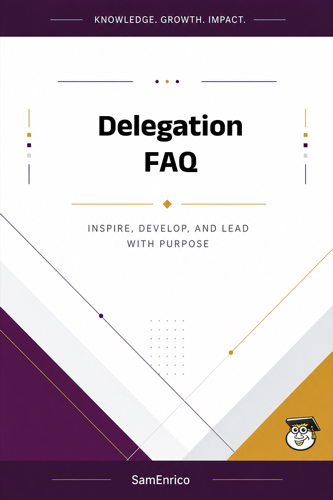
Delegation FAQ eBook
Answers to common questions about task assignment.
by Yu Chastity
Answers to common questions about task assignment.
Formats
Free sample
Chapter 1: The Bottleneck Chair--It was 2:47 on a Tuesday afternoon, and I was staring at a spreadsheet that hadn’t needed my attention in six months. The cursor blinked at me from cell B14, an empty field where a vendor invoice number should have been. I had no idea why I was filling it out. The vendor in question had been paid. The project was closed.
And yet, here I sat, in a $120,000-per-year managerial role, typing numbers into a box that an entry-level coordinator could have handled in their sleep.Behind me, stacked in a precarious tower, were twelve unread emails from my own team. Three of them were simple approval requests. One asked for a signature on a document I had already reviewed twice. Another was a calendar invitation for a meeting about a meeting. And the one at the bottom, sent four days ago, was a polite inquiry: “Can you please send over the login credentials for the analytics dashboard so I can run the report you asked for last week?”I had not sent the login credentials.
Because sending them would mean admitting that I was the only person who had them. And admitting that I was the only person who had them would mean admitting that I had built a system where nothing moved without me.This is the moment most delegation books refuse to name. It is not the heroic moment of strategic insight. It is not the triumphant handoff of a major project to a grateful protégé. It is the 2:47 PM spreadsheet of shame, surrounded by emails you should have delegated, working on tasks you should have abandoned, while your team waits for you to get out of their way.Welcome to the bottleneck.
You are not sitting in your chair. You are the chair.The Question That Launches This Chapter Let me be direct about what brings you here. You are reading a book about delegation, but you did not wake up this morning thinking, “I wonder how I might more effectively distribute workload across my matrixed organization.” You woke up exhausted. You woke up behind. You woke up to a Slack channel with seventeen unread messages, all of them waiting for you to answer a question that someone else could have answered.The question that opens this chapter – the one whispered in performance reviews, muttered in therapy sessions, and screamed into the void of late-night email threads – is this:“Why can’t I just do it myself?”On the surface, this sounds like a plea for efficiency.
But beneath it lies a tangle of fears, habits, and unexamined assumptions. You believe doing it yourself is faster. You believe it is safer. You believe that if you let go, the quality will drop, the deadline will slip, and your boss will wonder why they hired you in the first place.Here is the truth that took me three burned-out years to learn: The belief that you must do everything yourself is not a sign of competence. It is a symptom of a broken system – and you are the one who broke it.The Value Equation: Why Your Hourly Rate Is a Trap Let us start with numbers, because numbers do not argue.
They simply sit there, refusing to be comforted by your good intentions.Imagine you earn $100,000 per year. At fifty hours per week, fifty weeks per year, your hourly rate is approximately $40. Now imagine you spend ten hours per week on tasks that could be done by someone earning $25 per hour. That is $250 per week, or $12,500 per year, that your organization is paying you – a strategic manager – to do administrative work.This is the Value Equation, and it is the first tool I want you to internalize:Your Hourly Value = (Your Annual Compensation / Hours Worked)Task Hourly Value = (Task Performer’s Compensation / Hours Spent)If the Task Hourly Value is lower than Your Hourly Value, you are losing money every minute you touch that task.But this equation is actually too generous. Because it assumes that your only cost is your salary.
In reality, the cost of you doing low-value work is not just financial – it is the foregone value of what you could have been doing instead. Every hour you spend formatting a spreadsheet is an hour you did not spend coaching a direct report, strategizing for the quarter, or building a relationship with a key client.The Harvard Business School Pocket Mentor series calls these “Barriers to Delegating” and lists perfectionism, lack of trust, and fear of losing control as the primary culprits. But I want to reframe those barriers in economic terms. Perfectionism is not a personality trait – it is an expensive luxury your organization cannot afford. Lack of trust is not a relationship problem – it is a training problem you have not solved.
And fear of losing control? That is just the anxiety of realizing you have built a system that collapses without you.The Myth of the Superhero There is a story we tell ourselves about hard work. It goes like this: the leader who does everything, who answers every email, who reviews every document, who stays late and arrives early – that person is dedicated. That person is indispensable. That person is the hero the team needs.This story is a lie, and it is destroying you.The Myth of the Superhero is the belief that your willingness to do everything yourself is a virtue rather than a vulnerability.
In every organization I have consulted with, the person who tries to do everything becomes the single point of failure. When you are the only one who knows the dashboard password, the team cannot run reports without you. When you are the only one who has the client relationship, the account suffers when you are on vacation. When you are the only one who understands the approval process, nothing moves after 5 PM.The superhero is not a hero. The superhero is a bottleneck with a cape.I once worked with a marketing director named Priya.
She was brilliant, fast, and utterly convinced that no one else could write the monthly client newsletter. She had been doing it for three years. The newsletter took her eight hours every month. When I asked why she did not delegate it, she said, “No one knows the voice like I do. It would take longer to explain it than to just write it myself.”We ran an experiment.
For three months, she kept a log of every task she touched. At the end of the first month, she had spent twenty-seven hours on tasks that someone else could have done. At the end of the second month, she identified three tasks to delegate. At the end of the third month, her team was producing the newsletter. It was not identical to hers – and that was the point.
It was 85 percent as good, but it took her team six hours instead of her eight, and she used those eight hours to land a new client worth $200,000.The question is not whether someone else can do it exactly as you would. The question is whether 80 percent quality from someone else is…
This is the end of the free sample. Get the eBook to keep going. Buy now
About this book
Details
- Author
- Yu Chastity
- Publisher
- SamEnrico
- Language
- English
- Genre
- Non-Fiction, Business Brief, Reference
- Released
- 2026-06-09
- Pages (approx.)
- 133
- Available as
- eBook, Audiobook

Read better in the ZLOADR app
Your eBooks on your phone or tablet. Sign in with your SamEnrico account and start reading.
More by Yu Chastity
 FCPA Extradition CasesYu Chastity$11.99
 Insomnia Therapy Without Medication GuideYu Chastity$11.99
 The Sobriety Exercise PlanYu Chastity$11.99
 TM For Diabetes ManagementYu Chastity$11.99
 The Gacy Death CertificateYu Chastity$11.99
 Perfectionism and Imposter CycleYu Chastity$11.99
 Chunking Podcast GuideYu Chastity$11.99
 Hitler Mein KampfYu Chastity$11.99
 Whispers in the Wire: The Secret Love Letters of the Great EscapeYu Chastity$11.99
 The Last Message: The Titanic's Wireless Room SecretsYu Chastity$11.99
 The Quantum Wave: How a Pacific Lab Unlocked the Secrets of the UniverseYu Chastity$11.99
 The Dancer's Guide to Hitch HikeYu Chastity$11.99