
Non-FictionSelf-HelpClear Communication
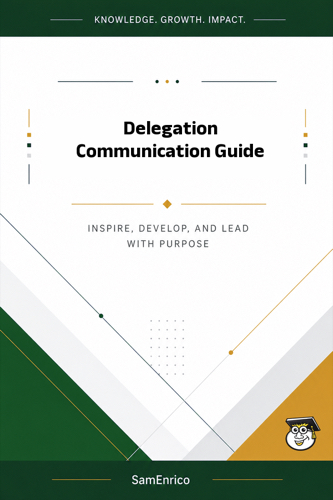
Delegation Communication Guide eBook
Give clear instructions and set expectations.
Give clear instructions and set expectations.
Formats
Free sample
Chapter 1: The $1.2 Trillion Lie--–- Marcus stared at his inbox. Forty-seven unread emails since lunch. His team of eight had missed three deadlines this week. The quarterly report was a disaster—numbers in the wrong columns, conclusions that contradicted his verbal instructions, a client name misspelled twice. He had delegated that report to Sarah, his most reliable senior analyst.
Sarah, who had never missed a deadline in four years. Sarah, who now sat three feet away, silently typing, having not made eye contact since he'd said "great work" through clenched teeth three hours ago.Marcus had said the words he always said: "Sarah, I need the Q3 report by Friday. You know how I like it. Let me know if you have questions." She had nodded. He had checked a box.
And now, on Friday at 4:47 PM, he was rewriting her work while she scrolled through spreadsheets, unaware that he had just lost two hours of his weekend.This book is for Marcus. And for the 47 million other managers who will say "you know how I like it" today—and be disappointed.Here is the truth they do not teach in business school, in leadership seminars, or in the 847 books on "how to delegate" already on the market: Ninety-nine percent of delegation failures are not skill failures. They are communication failures. And the most expensive communication failure in the history of modern management has a name. It is called the Curse of Knowledge.
This chapter will prove to you that you are cursed, show you exactly how the curse destroys your results, and hand you the first tool to break it—before you delegate another task.The Mathematics of Misunderstanding Let us begin with a number: $62.4 million. That is the average annual cost of miscommunication for a large organization, according to a study by the Holmes Report covering 400 corporations with 100,000-plus employees. Extrapolate that across the global economy—every missed deadline, every rewritten report, every "I thought you meant Tuesday," every hour of rework, every lost client, every disengaged employee who stopped asking questions because their manager sighed one time too many—and you arrive at a staggering figure: **$1.2 trillion dollars per year.**One point two trillion dollars. That is not a rounding error. That is the GDP of Australia.
That is the combined market capitalization of Netflix, Mc Donald's, and Boeing. That is the cost of managers saying "let me know if you have questions" and meaning it—while employees hear "figure it out yourself and don't bother me."Let that number land. Every time you delegate a task and the result comes back wrong, you are not unlucky. You are not surrounded by incompetent people. You are not a "micromanager" or a "control freak." You are a participant in a $1.2 trillion annual disaster that has a single, identifiable, fixable cause.The cause is not laziness.
It is not stupidity. It is a elegant, maddening feature of human cognition called the Curse of Knowledge.The Curse of Knowledge: Why Smart Managers Give Terrible Instructions In 1990, a Stanford University graduate student named Elizabeth Newton conducted a simple experiment that would forever change how psychologists understand communication. She divided participants into two roles: "tappers" and "listeners." Tappers were given a list of well-known songs—"Happy Birthday," "The Star-Spangled Banner," "Twinkle, Twinkle, Little Star." Their job was to tap out the rhythm of the song on a table. Listeners had to guess the song based solely on the tapping.Before the experiment began, Newton asked the tappers to predict how often listeners would guess correctly. The tappers estimated 50 percent.The actual result?
2.5 percent.When a tapper taps, they hear the song in their head. The melody, the lyrics, the emotional crescendo—it is all present, vivid, undeniable. But the listener hears only tapping. Random, disconnected, meaningless tapping. The tapper cannot un-hear the song.
They cannot imagine what it is like to hear only the noise.This is the Curse of Knowledge. Once you know something—a process, a deadline, an expected outcome, a client's preference, a report format—you cannot remember what it was like not to know it. You assume the other person hears the song. They hear tapping.Now apply this to Marcus and Sarah. Marcus has written the Q3 report seventeen times.
He knows the preferred font (Calibri, 11pt), the required sections (Executive Summary, Methodology, Findings, Recommendations, Appendix), the pet peeve (never put a comma before "and" in a list), and the unspoken expectation (the recommendations section must be bolded, not underlined). He knows the song.Sarah has written the Q3 report twice. She remembers the last version—the one Marcus stayed late to rewrite because the recommendations were "not quite right." She does not know the song. She hears tapping. When Marcus says "you know how I like it," he means "you have absorbed my seventeen iterations of unspoken preferences." Sarah hears "good luck."The manager assumes clarity.
The employee experiences confusion. Both parties walk away believing the other person is unreasonable. And the $1.2 trillion clock ticks on.The Three Faces of Failure: Introducing the Me-You-We Framework Not all delegation breakdowns are created equal. Some are your fault (the manager's). Some are your employee's fault.
Some belong to the organization. To stop guessing where your failures live, we need a diagnostic framework.Enter the Me-You-We Framework, adapted from communication researcher Molly Tschang. This framework categorizes every delegation failure into one of three buckets. Let us examine each.Me Failures: The Manager's Mirror (60%)The largest bucket. Sixty percent of delegation failures trace directly to the person doing the delegating.
You. Me. The manager.Me failures include:Unclear instructions: "Make it look professional" (what does that mean?).Jargon and acronyms: "Sync the CRM with the ERP before QBR" (the employee has no idea what any of those letters mean).Omitted constraints: "Book the conference room" (but you forgot to mention it needs a projector, must be on the third floor, and cannot conflict with the CEO's standing Tuesday meeting).The "you know" assumption: Any sentence containing the phrase "as usual," "the normal way," or "you know how I like it."Here is the brutal truth about Me failures: they feel like clarity. When you say "make it look professional," you see a specific image in your mind—a clean sans-serif font, generous margins, a subtle color accent. The employee sees a blank page and a prayer.
Because you cannot un-see your image, you do not realize you never described it.The solution to Me failures is not to try harder. It is to externalize your mental image—which we will do in Chapter 4 with the Screen Test Rule.You Failures: The Employee's Gap (25%)One quarter of delegation failures belong to the employee. These are not character flaws; they are competency or safety gaps.You failures include:Skill deficit: The employee genuinely does not know how to do what you asked.Motivation gap: The employee knows how but does not care enough to do it well.Psychological safety deficit: The employee knows they have a question but fears looking stupid, annoying you, or revealing a gap in their knowledge.The third category—psychological safety—deserves special attention. We will return to it in depth in Chapter 10, because it is…
This is the end of the free sample. Get the eBook to keep going. Buy now
About this book
Details
- Author
- Blaylock Kendall
- Publisher
- SamEnrico
- Language
- English
- Genre
- Non-Fiction, Self-Help, Clear Communication
- Released
- 2026-06-06
- Pages (approx.)
- 139
- Available as
- eBook, Audiobook

Read better in the ZLOADR app
Your eBooks on your phone or tablet. Sign in with your SamEnrico account and start reading.
More by Blaylock Kendall
 Sarcopenia Reversal PlanBlaylock Kendall$11.99
 PowerPoint Optimization GuideBlaylock Kendall$11.99
 Nonverbal Interrogation GuideBlaylock Kendall$11.99
 The Maestro's Battle: Music as a Weapon in the Napoleonic WarsBlaylock Kendall$11.99
 How to Start a Luggage Van for Railway Business (Beginners Guide)Blaylock Kendall$11.99
 Agency Pricing Without Fear WorkbookBlaylock Kendall$12.99
 Marketing LeadBlaylock Kendall$11.99
 How to Produce Carpet PadBlaylock Kendall$11.99
You may also like
 Hong Kong Handover 1997Dunn Johnnie$11.99
 Zumba For Postnatal Recovery CourseNeal Christian$11.99
 Zumba for BeginnersLadner Nikia$11.99
 YouTube Comment Mining GuideHumes Pandora$12.99
 Worry Box MeditationCarlin Rudy$11.99
 Workplace Stress MeditationNguyen Lynn$11.99
 Workplace Stress and Sleep RepairHawley Ivory$11.99
 Workplace Perfectionism CureDelaney Jeffry$11.99
 Workplace Injustice Anger GuideWallen Isabelle$11.99
 Work Addiction and Burnout LinkGreenwood Ester$11.99
 Women in Yoga and WellnessBeattie Galina$11.99
 Women in Stand Up ComedyChun Evangeline$11.99