
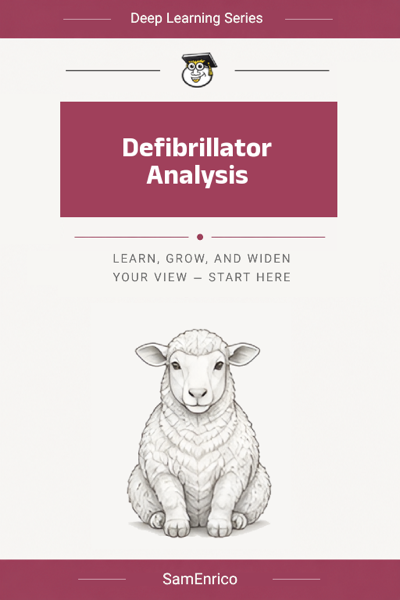
Defibrillator Analysis
A Coursebook on Defibrillator Analysis
A Coursebook on Defibrillator Analysis
Formats
About this book
Free sample
Chapter 1: The Last Three Seconds--–- The paramedic’s hand hovered over the shock button. The monitor displayed a chaotic, undulating line—coarse ventricular fibrillation, the kind that sometimes responded to a single countershock. The automated external defibrillator had finished its analysis and spoken its verdict: “Shock advised.” The team cleared the patient. The paramedic pressed the button. A split-second later, 200 joules of biphasic energy left the defibrillator’s capacitors, traveled through the electrode pads, crossed the patient’s thorax, and passed through his heart.
The fibrillation stopped. After two seconds of asystole, a narrow QRS complex appeared, followed by another, then another. Sinus rhythm had returned. The patient, a 62-year-old man who had collapsed in a grocery store parking lot, would wake up in the hospital three days later and ask why his chest hurt.–- In those last three seconds—from the moment the shock was advised to the moment the heart resumed beating—everything that could have gone right did go right. The defibrillator detected the rhythm correctly.
The charging circuit filled the capacitor to the target voltage. The H-bridge switched polarity at the precise millisecond. The electrode pads conducted the current with minimal impedance. The shock depolarized a critical mass of ventricular myocytes. The post-shock pause ended with a perfusing rhythm.–- But what if any one of those steps had failed?
What if the algorithm had misclassified fine VF as asystole and advised “No shock”? What if the capacitor had aged and could only deliver 120 joules instead of 200? What if the pads had dried out and impedance had risen to 250 ohms, attenuating the waveform? What if the H-bridge had stuck in one polarity, delivering a monophasic shock from a biphasic device? What if the patient’s myocardium, rendered ischemic by three-vessel disease, had a defibrillation threshold of 250 joules instead of 150?–- The difference between life and death in those last three seconds is not luck.
It is the accumulated result of thousands of decisions made long before the emergency: the design choices of engineers, the manufacturing quality of components, the clinical protocols of medical directors…
This is the end of the free sample. Get the eBook to keep going. Buy now
Contents
- Chapter 1
- Chapter 2
- Chapter 3
- Chapter 4
- Chapter 5
- Chapter 6
- Chapter 7
- Chapter 8
- Chapter 9
- Chapter 10
- Chapter 11
- Chapter 12
Details
- Author
- Houghton Rosario
- Publisher
- SamEnrico
- Language
- English
- Genre
- Non-Fiction, Informative, Educational
- Released
- 2026-06-02
- Pages (approx.)
- 160
- Available as
- eBook, Audiobook

Read better in the ZLOADR app
Your eBooks on your phone or tablet. Sign in with your SamEnrico account and start reading.
More by Houghton Rosario
 Nightmare Processing For Insomnia With Nightmares CourseHoughton Rosario$11.99
 Bipolar Medication Side Effect GuideHoughton Rosario$11.99
 Cape Town Silicon Cape AccessHoughton Rosario$11.99
 Holiday Family Anger TriggersHoughton Rosario$11.99
 The Calorie Cycling Diet PlanHoughton Rosario$11.99
 The Great Escape of John 'Red' Kelly: Australia's First Tunnel Prison BreakHoughton Rosario$11.99
 Understanding ProstatitisHoughton Rosario$17.99
 How to Become a Dried Fruit WasherHoughton Rosario$11.99
 Non Compete Trap for StartupsHoughton Rosario$12.99
 Excel Solver Economics OptimizationHoughton Rosario$12.99