
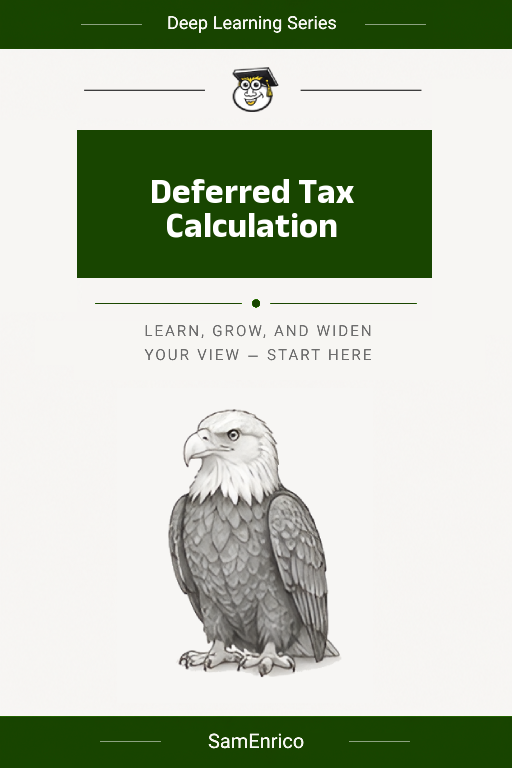
Non-FictionStudent's ShortcutDeferred Tax
Deferred Tax Calculation eBook
Compute deferred tax assets and liabilities using
Compute deferred tax assets and liabilities using temporary differences times tax rate.
Formats
Free sample
Chapter 1: Beyond the Payable...--–- On a quiet Tuesday afternoon in March, a seasoned chief financial officer named Sarah stared at her company’s draft financial statements. Revenue had grown 15%, operating margins were healthy, and the balance sheet showed strong liquidity. Yet the effective tax rate—the one number analysts would scrutinize—was a mystery even to her. The current tax payable from the Form 1120 was clear enough: 4.2millionowedtothe IRS.Buttheincometaxexpenseonthe GAAPincomestatementwas4.2 million owed to the IRS. But the income tax expense on the GAAP income statement was 4.2millionowedtothe IRS.Buttheincometaxexpenseonthe GAAPincomestatementwas5.8 million.
That $1.6 million gap was not a mistake, not a rounding error, and not something she could explain to the audit committee without a deeper understanding of a concept that confounds even experienced accountants: deferred taxes.That gap—between taxes actually payable to the government today and the tax expense reported to shareholders today—is the entire reason this book exists. And at the heart of that gap lies a simple-looking formula: Temporary Difference × Tax Rate. But as Sarah discovered during that long afternoon, the simplicity is deceptive. The real challenge is not multiplication. It is identifying which differences count, determining which future tax rate applies, and judging whether a deferred tax asset will ever deliver real cash savings.This chapter dismantles the common misconception that deferred tax is merely a timing adjustment—a bookkeeping nuisance to be solved by software.
Instead, we will build the conceptual foundation of the asset-liability model, the framework required by ASC 740 (the U.S. GAAP standard for income taxes) and followed by virtually all public companies worldwide under IFRS as well. By the end of this chapter, you will understand why deferred taxes exist, how they differ from current taxes payable, and why the simple formula Cumulative Temporary Difference × Enacted Future Tax Rate is both powerful and perilous.The Two Masters: Why GAAP and Tax Law Do Not See Eye to Eye To understand deferred taxes, you must first understand that corporations serve two masters with two different rulebooks.The first master is financial accounting (GAAP) . Its goal is to present a fair, accurate, and conservative picture of economic performance to investors, creditors, and regulators. Under GAAP, revenue is recognized when earned, and expenses are matched to the revenues they helped generate—regardless of when cash changes hands.
This is the accrual accounting framework.The second master is the Internal Revenue Code (IRC) . Its goal is to collect revenue for the federal government efficiently, enforce tax policy (such as encouraging investment through accelerated depreciation), and minimize disputes between taxpayers and the IRS. Under tax law, income is often recognized when cash is received, and deductions are allowed only when specific statutory requirements are met—not necessarily when GAAP would record an expense.These two masters frequently disagree. What GAAP calls an expense this year, the IRC might defer to next year. What GAAP calls revenue when a product ships, the IRC might tax only when cash is collected from the customer.
These disagreements create temporary differences—items that will eventually reverse, causing the total tax paid over the life of a transaction to match, but the timing of recognition to differ.Consider a simple example: a company sells a product with a one-year warranty. Under GAAP, the company must estimate future warranty claims and record an expense today (matching principle). Under tax law, no deduction is allowed until the company actually pays a warranty claim in cash. The result? Book income is lower than taxable income today.
But next year, when the company pays those warranty claims, book income will be higher than taxable income (because the deduction was taken on the tax return, but no new book expense was recorded). The difference reverses.That reversal is the entire basis of deferred tax accounting.The Old Way: Deferral Method vs. The Modern Way: Asset-Liability Model Before 1992 (under APB Opinion 11), U.S. GAAP used the deferral method. Under that approach, deferred taxes were simply a smoothing mechanism.
If a temporary difference caused book expense to be higher than tax expense this year, you created a "deferred debit" that would amortize into expense in future years. There was no balance sheet focus, no consideration of future tax rates, and no recognition that deferred taxes represented real future cash flows.The deferral method had a fatal flaw: it treated deferred taxes as arbitrary allocations rather than economic assets and liabilities. A deferred tax asset under the deferral method was not a real claim on future tax savings; it was a plug. Auditors and investors rightly criticized this approach for obscuring the true financial position of companies.Enter the asset-liability model (ASC 740, formerly FAS 109). The asset-liability model flipped the logic.
Instead of focusing on the income statement (smoothing tax expense), it focused on the balance sheet. The core question became: For each asset and liability on the balance sheet, what is the difference between its GAAP carrying value and its tax basis? That difference—the temporary difference—represents a future taxable or deductible amount. And that future amount, multiplied by the enacted tax rate, is a real asset (if it will save taxes) or a real liability (if it will require paying taxes).This shift was revolutionary. It meant that deferred taxes were no longer accounting fictions.
They became balance sheet items subject to the same recognition, measurement, and impairment rules as other assets and liabilities.Example of the shift: Under the old deferral method, a 10,000warrantyaccrualwitha10,000 warranty accrual with a 10,000warrantyaccrualwitha0 tax basis would create a "deferred charge" that would be amortized. Under the asset-liability model, it creates a 2,100deferredtaxasset(assuminga212,100 deferred tax asset (assuming a 21% rate) reported on the balance sheet. That DTA represents a real future cash saving: when the company pays the warranty claims, it will reduce its taxable income by 2,100deferredtaxasset(assuminga2110,000 and save $2,100 in cash taxes.Current Tax Expense vs. Deferred Tax Expense: Two Sides of the Same Coin One of the most persistent sources of confusion is the distinction between current tax expense and deferred tax expense. They are not the same thing, but together they make up the total income tax expense reported on the GAAP income statement.Current tax expense is simple: it is the amount of tax owed to the government for the current year, as calculated on the company's tax return (Form 1120 for U.S.
corporations). It is a payable. It will be settled with cash, usually within 90 days of the tax filing deadline. Current tax expense is computed using tax law rules, not GAAP rules.Deferred tax expense is the change in the cumulative temporary differences during the year, multiplied by the enacted future tax rate. It is not a cash flow today.
It represents the increase or decrease in the balance sheet DTLs and DTAs.Total income tax expense (the number on the GAAP income statement) = Current tax expense + Deferred tax expense (or minus deferred tax benefit).Let us return to Sarah's company. She had current tax payable of 4.2million.Thatwasthecheckshewouldwritetothe IRS.Buther GAAPincometaxexpensewas4.2 million. That was the check she would write to the IRS. But her GAAP income tax expense was 4.2million.Thatwasthecheckshewouldwritetothe IRS.Buther GAAPincometaxexpensewas5.8 million. The difference of $1.6 million was her deferred…
This is the end of the free sample. Get the eBook to keep going. Buy now
About this book
Details
- Author
- Gorman Giovanni
- Publisher
- SamEnrico
- Language
- English
- Genre
- Non-Fiction, Student's Shortcut, Deferred Tax
- Released
- 2026-06-01
- Pages (approx.)
- 159
- Available as
- eBook, Audiobook

Read better in the ZLOADR app
Your eBooks on your phone or tablet. Sign in with your SamEnrico account and start reading.
More by Gorman Giovanni
 Eye Fixation Self Trance CourseGorman Giovanni$11.99
 ED and CyclingGorman Giovanni$11.99
 The ED Doppler UltrasoundGorman Giovanni$11.99
 Deck Cards Palace GuideGorman Giovanni$11.99
 Working Parent Self Care PlanGorman Giovanni$11.99
 Pet Loss and Work PerformanceGorman Giovanni$11.99
 Alcohol Reduction SuggestionGorman Giovanni$11.99
 REIT Tax AdvantagesGorman Giovanni$11.99
 The Last Analog: When the Internet Died for 54 MinutesGorman Giovanni$11.99
 Shadows of Tenochtitlan: The Ghosts of Montezuma's RevengeGorman Giovanni$11.99
 How to Produce Faucet AccessoriesGorman Giovanni$11.99
 A Collector's Handbook to the Allard M2xGorman Giovanni$11.99
You may also like
 Hong Kong Handover 1997Dunn Johnnie$11.99
 Zumba For Postnatal Recovery CourseNeal Christian$11.99
 Zumba for BeginnersLadner Nikia$11.99
 YouTube Comment Mining GuideHumes Pandora$12.99
 Worry Box MeditationCarlin Rudy$11.99
 Workplace Stress MeditationNguyen Lynn$11.99
 Workplace Stress and Sleep RepairHawley Ivory$11.99
 Workplace Perfectionism CureDelaney Jeffry$11.99
 Workplace Injustice Anger GuideWallen Isabelle$11.99
 Work Addiction and Burnout LinkGreenwood Ester$11.99
 Women in Yoga and WellnessBeattie Galina$11.99
 Women in Stand Up ComedyChun Evangeline$11.99