
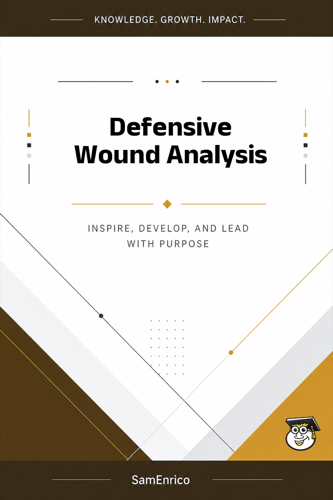
About this book
Free sample
Chapter 1: The Silent Archive...-- The human body tells stories long after the voice falls silent. In the final moments of a violent encounter, when language fails and reason retreats, the body becomes something remarkable: a recording device. It captures angle, force, intent, sequence, and most critically for this inquiry, the desperate geometry of self-preservation. These recordings—what forensic science terms defensive wounds—are not merely injuries. They are the last coherent sentences spoken by a victim before the attack concludes.
They are evidence written in tissue, bone, and blood.This chapter establishes the foundational framework for everything that follows in Defensive Wound Analysis: The Forensic Investigation of Victim Resistance. Before we can interpret the patterns of sharp force defense, reconstruct the dynamics of a struggle, or testify about the meaning of a parry fracture, we must first understand what defensive wounds are, what they are not, and why their proper classification changes the course of criminal investigations. The difference between a correct and incorrect classification of a defensive wound has sent innocent people to prison and allowed guilty ones to walk free. This is not hyperbole. It is the documented record of forensic failure when foundational principles are ignored.The Core Definition: Active Versus Passive Defense Defensive wounds are injuries sustained by an individual while attempting to protect themselves from an imminent threat of physical harm.
This definition seems straightforward, but its application requires careful attention to two distinct categories: active defensive wounds and passive defensive wounds. The distinction matters enormously for reconstruction, for legal argument, and for understanding the victim's state of mind during the assault.Active defensive wounds occur when the victim makes a dynamic, intentional movement to intercept, deflect, or counter an attack. These include blocking a knife with the forearm, grabbing a swinging bat, punching back at an assailant, or grasping the muzzle of a firearm. Active defense requires conscious awareness of the threat, sufficient reaction time, and the physical capacity to move. The wounds resulting from active defense are typically irregular in depth and orientation because they occur while both the victim and the weapon…
This is the end of the free sample. Get the eBook to keep going. Buy now
Contents
- Chapter 1
- Chapter 2
- Chapter 3
- Chapter 4
- Chapter 5
- Chapter 6
- Chapter 7
- Chapter 8
- Chapter 9
- Chapter 10
- Chapter 11
- Chapter 12
Details
- Author
- Granger Leigh
- Publisher
- SamEnrico
- Language
- English
- Genre
- Non-Fiction, True Crime / Wound Pattern
- Released
- 2026-06-09
- Pages (approx.)
- 141
- Available as
- eBook, Audiobook

Read better in the ZLOADR app
Your eBooks on your phone or tablet. Sign in with your SamEnrico account and start reading.
More by Granger Leigh
 LBO Unitranche Debt StructuresGranger Leigh$11.99
 Distant Reiki HealingGranger Leigh$11.99
 The Senior Self Esteem GuideGranger Leigh$11.99
 Anticipatory Grief And PTSDGranger Leigh$11.99
 Empathy for Customer ServiceGranger Leigh$11.99
 SMART For Healthcare GuideGranger Leigh$11.99
 Insomnia Hypnosis WorkbookGranger Leigh$11.99
 The Unstoppable Rise of Hicham El Guerrouj: The Marathon King's Statistical DominanceGranger Leigh$11.99
 The Dragon-Tamer of Wessex: Beowulf’s Forgotten MentorGranger Leigh$11.99
 How to Produce PET Containment SystemsGranger Leigh$11.99
 A Collector's Handbook to the Vespa 400Granger Leigh$11.99
 Biometrics Collection GuideGranger Leigh$12.99
You may also like
 Hong Kong Handover 1997Dunn Johnnie$11.99
 Zumba For Postnatal Recovery CourseNeal Christian$11.99
 Zumba for BeginnersLadner Nikia$11.99
 YouTube Comment Mining GuideHumes Pandora$12.99
 Worry Box MeditationCarlin Rudy$11.99
 Workplace Stress MeditationNguyen Lynn$11.99
 Workplace Stress and Sleep RepairHawley Ivory$11.99
 Workplace Perfectionism CureDelaney Jeffry$11.99
 Workplace Injustice Anger GuideWallen Isabelle$11.99
 Work Addiction and Burnout LinkGreenwood Ester$11.99
 Women in Yoga and WellnessBeattie Galina$11.99
 Women in Stand Up ComedyChun Evangeline$11.99