
Non-FictionSelf-HelpDefaultOpt Out
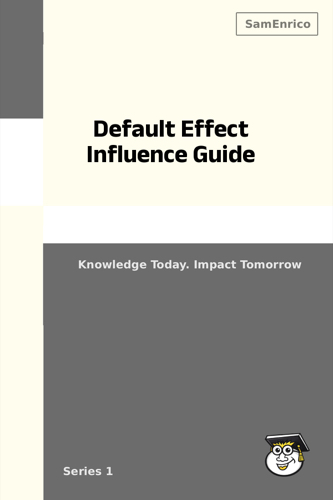
Default Effect Influence Guide eBook
Set beneficial defaults that people are likely to
by Tierney Chi
Set beneficial defaults that people are likely to accept passively.
Formats
Free sample
Chapter 1: The $47,000 Click--I once lost forty-seven thousand dollars by clicking a button I didn't read.The button said "Accept" in friendly blue letters. It was surrounded by three paragraphs of legalese set in eight-point font—the kind of text designed to be invisible. I was tired. It was late. My small business had just processed its first profitable quarter, and I was in a hurry to activate a new payment processing feature that a sales rep had convinced me would save my team ten hours a week.I clicked "Accept."Fourteen months later, a bookkeeper named Maria—who had been with my company for six weeks and barely spoke to me—sent me a Slack message that made my stomach drop.
"Hey," she wrote. "Are you aware we're paying $3,357 per month for something called 'Premium Transaction Shield'?"I had never heard of Premium Transaction Shield.I spent the next four hours digging through vendor contracts, bank statements, and the digital equivalent of a paper trail buried in a landfill. What I found was a masterclass in the dark art of default design. The sales rep had not mentioned Premium Transaction Shield. The checkout page had not highlighted it.
But buried in those three paragraphs of eight-point text—between a clause about arbitration and a clause about data processing—was a single sentence: "By accepting these terms, you agree to enroll in Premium Transaction Shield at the standard rate, which will automatically renew monthly unless cancelled in writing within 14 days of each renewal period."I had not cancelled in writing. I had not even known I was enrolled. And because I had clicked "Accept" while exhausted and distracted, my company had bled forty-seven thousand dollars into a service we never used, never needed, and never wanted.The shame was not the money, though forty-seven thousand dollars is not nothing. The shame was that I teach this stuff. I had spent fifteen years studying behavioral economics, consulting for Fortune 500 companies on choice architecture, and writing academic papers about the ethics of default settings.
And yet, in the wild, on a Tuesday night, with a glass of wine and the false confidence of a profitable quarter, I had been outsmarted by a checkbox and a font size.That was the moment I decided to write this book.The Invisible Architecture of Your Life Before you read another word, I want you to do something. Put down this book—or your phone, or your screen—for exactly sixty seconds. Look around your physical environment. Count the number of decisions you did not actively make today but are currently living with.I will wait.Sixty seconds....Welcome back. What did you find?
Perhaps you noticed that your phone's notification settings are still set to the factory default—meaning every app can interrupt you anytime, even the ones you downloaded once and never opened. Perhaps you noticed that your retirement contribution rate is whatever your HR department set when you were hired, a number you have never reviewed. Perhaps you noticed that your home's thermostat follows a schedule programmed by the previous owner, or that your streaming service renews automatically on the fifth of every month, or that your news feed is curated by an algorithm whose goals are not your goals.Here is the uncomfortable truth that the first four chapters of this book will make unavoidable: you are not the author of most of your choices. You are the passenger. The default settings of your life—the pre-selected options that activate when you do nothing—have been written by someone else.
Sometimes that someone is a well-intentioned product manager who wants to help you save money. Sometimes that someone is a profit-maximizing corporation that wants to extract your attention and your dollars. And sometimes, most insidiously, that someone is your own past self, who made a decision years ago and never revisited it.The default effect is the name behavioral economists give to this phenomenon: the disproportionate likelihood that people will stick with a pre-selected option rather than actively choosing an alternative. It is not a bug in human cognition. It is a feature.
Your brain evolved to conserve energy because for 99 percent of human history, energy conservation was the difference between surviving the winter and starving. Making a decision requires active mental effort. Accepting a pre-set option does not. Your brain is not lazy; it is efficient. But efficiency becomes a trap when the pre-set option is designed to serve someone else's interests.This book is about two things.
First, it is an exposé of the defaults that currently control your behavior without your consent. By the time you finish Part I, you will see them everywhere—in your bank account, your health insurance, your privacy settings, your children's school permission forms, and even your own habits. Second, and more importantly, this book is a toolkit for flipping the script. You will learn how to set defaults that serve your interests and the interests of the people you care about—ethically, transparently, and with respect for autonomy.But before we get to the toolkit, we need to understand the weapon. And the weapon is the default effect.The Statue of Liberty Effect (And Why It Has That Name)Let us start with a case study that will appear in every book ever written about defaults, because it is the cleanest, most dramatic, and most replicable demonstration of the phenomenon.In the 1990s, most American companies used an opt-in system for 401(k) retirement plans.
When you got hired, HR gave you a form. You had to check a box to enroll. You had to choose a contribution rate. You had to pick investment funds. If you did nothing, you were not enrolled.The result was catastrophic.
Despite the fact that most employees said they wanted to save for retirement, participation rates hovered around 40 percent. Younger employees, lower-income employees, and employees who were overwhelmed by choice participated at even lower rates. People were not opting out of retirement savings. They were opting out of the effort of enrolling. They procrastinated.
They got distracted. They told themselves they would do it next week, and next week became never.Then something changed. A handful of companies—influenced by early behavioral economics research—switched to an opt-out system. New employees were automatically enrolled in the 401(k) plan at a default contribution rate of 3 percent, invested in a default target-date fund. If they wanted to change their rate, they could.
If they wanted to opt out entirely, they could. But they had to take action to leave, not to join.The results were staggering. Participation rates jumped from 40 percent to over 85 percent. In some companies, they exceeded 90 percent. The same employees who had failed to enroll under opt-in were now saving for retirement—not because their preferences had changed, but because the default had changed.This phenomenon is known in behavioral economics as the Statue of Liberty effect.
The name comes from the famous Emma Lazarus poem inscribed on the statue: "Give me your tired, your poor, your huddled masses yearning to breathe free." The statue does not require immigrants to knock on the door and request entry. It…
This is the end of the free sample. Get the eBook to keep going. Buy now
About this book
Details
- Author
- Tierney Chi
- Publisher
- SamEnrico
- Language
- English
- Genre
- Non-Fiction, Self-Help, Default, Opt Out
- Released
- 2026-06-10
- Pages (approx.)
- 150
- Available as
- eBook, Audiobook

Read better in the ZLOADR app
Your eBooks on your phone or tablet. Sign in with your SamEnrico account and start reading.
More by Tierney Chi
 LinkedIn Success Comparison TrapTierney Chi$12.99
 The Menopause Libido Recovery WorkbookTierney Chi$11.99
 Discord Server Status GamesTierney Chi$11.99
 Influencer Disclosure For CryptoTierney Chi$11.99
 Affirmations for AthletesTierney Chi$11.99
 The Forge of Hephaestus: Fire and Forged in OlympusTierney Chi$11.99
 Understanding Jones–hersh–yusk SyndromeTierney Chi$17.99
 MarblesTierney Chi$11.99LinkedIn Success Comparison TrapTierney Chi$12.99
 Renewable Energy Investment GuideTierney Chi$12.99
 How to Become a Lacquer MakerTierney Chi$11.99
You may also like
 Hong Kong Handover 1997Dunn Johnnie$11.99
 Zumba For Postnatal Recovery CourseNeal Christian$11.99
 Zumba for BeginnersLadner Nikia$11.99
 YouTube Comment Mining GuideHumes Pandora$12.99
 Worry Box MeditationCarlin Rudy$11.99
 Workplace Stress MeditationNguyen Lynn$11.99
 Workplace Stress and Sleep RepairHawley Ivory$11.99
 Workplace Perfectionism CureDelaney Jeffry$11.99
 Workplace Injustice Anger GuideWallen Isabelle$11.99
 Work Addiction and Burnout LinkGreenwood Ester$11.99
 Women in Yoga and WellnessBeattie Galina$11.99
 Women in Stand Up ComedyChun Evangeline$11.99