
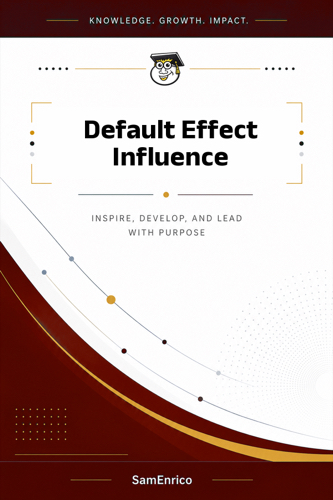
Non-FictionSelf-HelpBehavioral Design
Default Effect Influence eBook
Set desired option as default to increase selectio
by Smoot Theola
Set desired option as default to increase selection rates.
Formats
Free sample
Chapter 1: The Invisible Inheritance--–- In 2012, a country increased its rate of organ donation from 4.5 percent to nearly 100 percent overnight. It did not run a single public service announcement. It did not pass a law requiring donation. It did not offer tax incentives or celebrity endorsements. It simply changed the default on a form.Austria had long operated under a system of presumed consent: every citizen was automatically considered an organ donor unless they actively opted out.
Germany, its neighbor with nearly identical cultural attitudes toward medicine and mortality, used an opt-in system: citizens had to actively register as donors. The result was not a modest difference. It was a chasm. Austria achieved consent rates of approximately 99 percent. Germany struggled at around 12 percent.The same citizens, the same hospitals, the same medical needs.
Only one thing differed: what happened if you did nothing.This is the default effect in its purest form. And it is, quite possibly, the most powerful and least understood force shaping human behavior today.Consider your own life. How many of your current choices are actually choices you actively made, rather than paths you simply never bothered to change? Your retirement savings contribution rate. Your smartphone's notification settings.
Your web browser's search engine. The renewal status of your streaming subscriptions. The privacy preferences on every app you have ever installed. For most people, most of these settings remain exactly as they were preset on day one.This is not laziness. It is not stupidity.
It is the predictable, systematic, and deeply human response to a world that demands more decisions than any person could sanely make. The default effect is a cognitive shortcut—a mental efficiency tool that allows us to conserve energy for the choices that truly matter. But like any shortcut, it can lead us exactly where someone else has chosen to point us.This book is about that someone else. It is about you.Whether you realize it or not, you are already a choice architect. Every time you design a form, structure a menu, set up a software workflow, or craft a policy, you are deciding what happens when the user does nothing.
You are inheriting—and passing along—an invisible inheritance of defaults that shape behavior more powerfully than incentives, education, or even mandates.The question is not whether you will influence choices. The question is whether you will do so with intention, transparency, and respect for human autonomy.The Core Engine: Two Biases That Drive Inertia To understand the default effect, we must first understand why doing nothing feels so much safer than doing something. The answer lies in two interlocking psychological forces that form what this book will call the core engine of inertia.The first is loss aversion. Discovered by psychologists Daniel Kahneman and Amos Tversky in their prospect theory research, loss aversion is the finding that losses hurt approximately twice as much as equivalent gains feel good. Losing one hundred dollars produces a negative emotional response roughly twice as intense as the positive response to finding one hundred dollars.
Evolutionarily, this makes sense: an organism that fails to avoid losses is an organism that does not survive. The asymmetry is baked into our nervous systems.The second is status quo bias. First named by researchers William Samuelson and Richard Zeckhauser, this is the tendency to stick with the current state of affairs simply because it is familiar. When presented with a choice between a new option and an existing one, people systematically prefer the existing one—even when the new option is objectively superior. The status quo requires no mental effort, no risk assessment, no anticipation of regret.When a default option is preset, these two biases combine explosively.
Changing the default requires overcoming loss aversion (I might lose something by switching) and status quo bias (the current setting is familiar). Doing nothing requires overcoming nothing at all. The path of least resistance leads straight to the preset choice.This is why the Austrian organ donation system works so effectively. Citizens who receive their driver's license or voter registration form see a default of "donor" already checked. To opt out, they must actively take action—finding the form, checking the box, submitting the change.
The hundred thousand citizens who never get around to it are not making a deliberate choice against organ donation. They are simply doing nothing. And doing nothing is, in this context, the most powerful choice of all.The Retirement Revolution The most famous demonstration of the default effect comes not from medicine but from money. In the early 2000s, behavioral economists Richard Thaler and Cass Sunstein began advising companies on their retirement savings plans. The traditional approach was opt-in enrollment: employees received paperwork and had to actively choose to join the 401(k) plan, select contribution levels, and allocate investments.
Participation rates hovered around 40 percent.Thaler and Sunstein proposed a simple change: switch to auto-enrollment. New employees would be automatically enrolled in the retirement plan at a default contribution rate (say, 3 percent of salary) and a default investment fund (say, a target-date fund). Employees could opt out or change their settings at any time. Nothing else changed. The same employees, the same matching contributions, the same investment options.The result was staggering.
Participation rates jumped from approximately 40 percent to over 85 percent—and in many companies, to over 90 percent. Doing nothing now meant saving for retirement rather than remaining unenrolled. Employees who had ignored opt-in paperwork for years suddenly became retirement savers overnight.Critically, subsequent research found that the vast majority of auto-enrolled employees stayed with the default settings. They did not opt out. They did not adjust contribution rates upward.
They simply accepted whatever was preselected. The default did not just increase participation; it shaped the entire savings trajectory of millions of workers.This finding has been replicated across dozens of countries, hundreds of companies, and millions of employees. It holds for large and small organizations, for high-income and low-income workers, for financial professionals and novices. The default effect is not a subtle nudge. It is a bulldozer.Why Defaults Outperform Incentives and Education One might reasonably ask: why not just offer a financial incentive for enrolling?
Or launch an education campaign about the importance of retirement savings? The answer is that defaults consistently outperform both approaches—often by an order of magnitude.Financial incentives face a fundamental problem: the incentive must be large enough to overcome inertia. In one study, researchers offered employees a one-hundred-dollar bonus simply for completing retirement enrollment paperwork. The result was a modest increase in participation—far smaller than the effect of auto-enrollment. People were willing to leave one hundred dollars on the table rather than fill out a form.
The hassle of action outweighed the reward.Education campaigns face an even steeper challenge. Information alone rarely changes behavior. Smokers know that smoking causes lung cancer. Drivers know that speeding causes accidents. Diners know that vegetables are healthier than dessert.
Knowledge is not the bottleneck; inertia is. The default effect works by removing the need for knowledge in the first place. You do not need to understand the benefits of organ donation to be a donor. You simply need…
This is the end of the free sample. Get the eBook to keep going. Buy now
About this book
Details
- Author
- Smoot Theola
- Publisher
- SamEnrico
- Language
- English
- Genre
- Non-Fiction, Self-Help, Behavioral Design
- Released
- 2026-06-06
- Pages (approx.)
- 148
- Available as
- eBook, Audiobook

Read better in the ZLOADR app
Your eBooks on your phone or tablet. Sign in with your SamEnrico account and start reading.
More by Smoot Theola
 Change Resistance Anger WorkbookSmoot Theola$11.99
 The Disenfranchised Grief GuideSmoot Theola$11.99
 Business Innovation WorkbookSmoot Theola$11.99
 Breaking the Cycle of Compulsive BehaviorSmoot Theola$11.99
 The Southern Cross and the Stars: New Zealand's Scientific OdysseySmoot Theola$11.99
 Understanding TrimethylaminuriaSmoot Theola$17.99
 International Franchise InsuranceSmoot Theola$12.99
 CeramicsSmoot Theola$11.99
 How to Become a Plant OperatorSmoot Theola$11.99
You may also like
 Hong Kong Handover 1997Dunn Johnnie$11.99
 Zumba For Postnatal Recovery CourseNeal Christian$11.99
 Zumba for BeginnersLadner Nikia$11.99
 YouTube Comment Mining GuideHumes Pandora$12.99
 Worry Box MeditationCarlin Rudy$11.99
 Workplace Stress MeditationNguyen Lynn$11.99
 Workplace Stress and Sleep RepairHawley Ivory$11.99
 Workplace Perfectionism CureDelaney Jeffry$11.99
 Workplace Injustice Anger GuideWallen Isabelle$11.99
 Work Addiction and Burnout LinkGreenwood Ester$11.99
 Women in Yoga and WellnessBeattie Galina$11.99
 Women in Stand Up ComedyChun Evangeline$11.99