
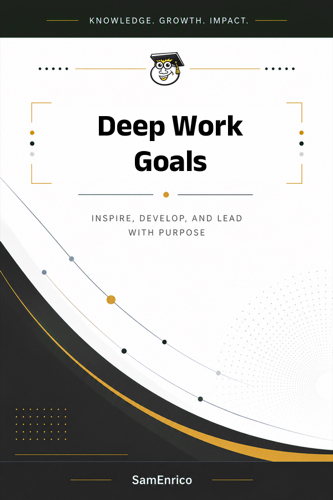
Deep Work Goals eBook
Schedule uninterrupted focus for important goals.
by Casas Jada
Schedule uninterrupted focus for important goals.
Formats
Free sample
Chapter 1: The Pseudo-Productivity Trap--–- Sarah had just finished her third cup of coffee, and it wasn't yet 10:00 AM. Her inbox showed forty-seven unread messages. Slack notifications blinked in orange and red from six different channels. Her calendar indicated back-to-back meetings starting in eleven minutes, followed by another meeting, then another, until 4:30 PM. And somewhere beneath this avalanche of activity, buried like a fossil under sedimentary layers of urgency, was her actual job: launching the new customer retention program that her bonus, her reputation, and her team's morale depended upon.She had not touched it in nine days.Not because she was lazy.
Not because she didn't care. But because the machinery of modern work had consumed her entirely. Every time she opened the document to write the strategic framework, a Slack message arrived. Every time she found a fifteen-minute gap between meetings, she spent it "clearing the deck" by replying to emails that only generated more emails. She was working fifty-five hours per week, sleeping poorly, and somehow falling further behind each morning.Sarah is fictional, but her condition is not.
She suffers from what this book calls pseudo-productivity: the exhausting sensation of feeling perpetually busy while making zero measurable progress on what actually matters. And if you are reading this chapter, there is a strong chance you suffer from it too.The goal of this chapter is not to make you feel guilty. Guilt is useless fuel. The goal is to help you see the machinery of distraction for what it is—a trillion-dollar system designed to capture your attention, fragment your focus, and convince you that answering email is the same as doing your job. Once you see it clearly, you cannot unsee it.
And once you cannot unsee it, you can begin to fight back.The Great Paradox of the Knowledge Worker Let us begin with a paradox that defines modern professional life. Since 1980, the average American workweek has remained relatively stable at approximately forty hours. Yet the volume of information, communication, and administrative overhead has exploded exponentially. Email alone consumes an estimated twenty-eight percent of the average knowledge worker's week. Slack and similar tools add another fifteen percent.
Meetings consume anywhere from twenty to forty percent, depending on industry and seniority.If you add these numbers together, something alarming emerges: before a single moment of deep, focused, valuable work has occurred, the typical professional has already exceeded their available hours. This is not a time management problem. This is a structural problem. The system is designed to consume all available time with shallow activity while disguising that activity as productivity.Here is the paradox stated plainly: The tools and practices designed to make us more productive have instead made meaningful work nearly impossible. Email promised instant communication; it delivered an open-ended obligation to respond.
Slack promised team alignment; it delivered a firehose of context-switching interruptions. Meetings promised collaboration; they delivered performative busyness where the loudest voice wins and the deepest thinking never happens.The result is what Cal Newport, in his foundational work Deep Work, identified as the central crisis of the knowledge economy: The ability to focus without distraction is becoming simultaneously increasingly rare and increasingly valuable. When everyone is fragmented, the person who can integrate becomes a superhuman. When everyone is shallow, the person who can go deep becomes irreplaceable.But before you can go deep, you must understand what is keeping you shallow. And the most important mechanism driving that shallowness is something called attention residue.Understanding Attention Residue: The Hidden Tax on Your Brain In 2009, researcher Sophie Leroy published a study that should be required reading in every business school.
She gave subjects a series of tasks to complete, then interrupted some of them before they could finish. When she measured their performance on subsequent tasks, a clear pattern emerged: People who switched between tasks before completing the first one performed significantly worse on everything that followed.Leroy called this phenomenon attention residue. Here is how it works: When you are working on Task A and you switch to Task B—whether because of an interruption, a notification, or your own restless impulse—a portion of your cognitive capacity remains lodged in Task A. Your brain is still thinking about the previous activity. It is still processing incomplete information.
It is still, in a very real sense, there, even as your physical body has moved here.The cost of attention residue is staggering. Leroy found that it takes approximately twenty minutes of focused work on a new task to reach peak cognitive performance after a single interruption. Not five minutes. Not ten. Twenty minutes.Now consider the average knowledge worker's experience.
If you check email every thirty minutes—a common habit—you are never more than ten minutes into a new task before the next interruption arrives. You never reach the twenty-minute threshold. You never achieve depth. You spend your entire day swimming in the shallow end of the cognitive pool, feeling busy but producing nothing of lasting value.This is not a personal failing. It is a structural feature of the modern workplace.
Open office plans, push notifications, instant messaging, and a culture that valorizes "responsiveness" over results have conspired to create an environment where attention residue is the default state. You are not lazy. You are being robbed.Consider an experiment conducted by Gloria Mark at the University of California, Irvine. Mark placed observers in actual workplace environments and tracked how long employees spent on any single task before switching. The average was three minutes and five seconds.
After a switch, it took an average of twenty-three minutes to return to the original task. And during those twenty-three minutes, the employee was performing other tasks with diminished cognitive capacity due to attention residue from the original interruption.The math here is devastating. Three minutes of work. Twenty-three minutes of recovery. Repeat twelve times per day.
This is not work. This is cognitive chaos disguised as productivity.The Deep Work Hypothesis: Why Focus Is the New Superpower If attention residue is the disease, deep work is the cure. Deep work is defined as professional activities performed in a state of distraction-free concentration that push your cognitive capabilities to their limit. These efforts create new value, improve your skills, and are difficult to replicate. Examples include writing a strategic plan, learning a new technical skill, analyzing complex data to find a novel pattern, or creating original intellectual property.Deep work stands in opposition to shallow work: logistical, low-value tasks that can be performed while distracted.
Shallow work feels urgent because it involves other people—emails, messages, meeting requests—but it rarely moves the needle on your most important goals.The Deep Work Hypothesis is simple but profound: The ability to perform deep work is becoming increasingly rare and increasingly valuable in our economy. Therefore, the individuals and organizations that cultivate this ability will thrive, while those that do not will fall into pseudo-productive mediocrity.Consider the evidence. In a study of over 10,000 workers, those who reported being able to focus without interruption were 43 percent more likely to report high job satisfaction and 37 percent more likely to report high productivity. They did not…
This is the end of the free sample. Get the eBook to keep going. Buy now
About this book
Details
- Author
- Casas Jada
- Publisher
- SamEnrico
- Language
- English
- Genre
- Non-Fiction, Self-Help, Deep Work
- Released
- 2026-06-08
- Pages (approx.)
- 132
- Available as
- eBook, Audiobook

Read better in the ZLOADR app
Your eBooks on your phone or tablet. Sign in with your SamEnrico account and start reading.
More by Casas Jada
 Burnout And Occupational HazardsCasas Jada$11.99
 Growth Hormone and Eye HealthCasas Jada$11.99
 Exam Performance AffirmationsCasas Jada$11.99
 Uber Boost Zones StrategyCasas Jada$11.99
 Opioid Respiratory DepressionCasas Jada$11.99
 Grief and EMDR After Child LossCasas Jada$11.99
 The Skykeepers of Axum: Astronomy and the Stars of Ancient EthiopiaCasas Jada$11.99
 Enki's Riddle: The God Who Shaped the WorldCasas Jada$11.99
 A Collector's Handbook to the Opel Ascona (1970-75)Casas Jada$11.99
 How to Produce Wok AccessoriesCasas Jada$11.99
 Growing AgathisCasas Jada$11.99
 Disability Insurance Legal HandbookCasas Jada$12.99
You may also like
 Deep Work Scheduling HandbookRuby Ngoc$11.99
 Long Pomodoro for Deep WorkMetzler Man$11.99
 Deep Work Scheduling StrategiesSoares Raisa$11.99
 The Four-Hour Focus Block CourseLong Ray$11.99
 The 90 Minute Deep MorningMcnabb Apolonia$11.99
 Protect Deep Work BlocksGatlin Vannesa$11.99
 The Deep Work Schedule BlueprintHewitt Eddie$11.99
 Deep Work Block SchedulingSams Willian$11.99
 Individual Contributor FocusLadner Kourtney$11.99
 Deep Work Interruption Protection CourseTorrence Steffanie$11.99
 Deep Concentration GuideDanielson Terese$11.99
 Quadrant Two Deep Work FocusMontero Racheal$11.99