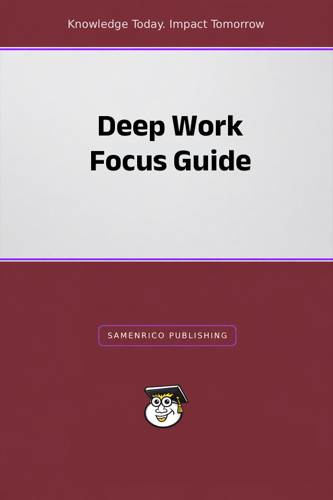
Deep Work Focus Guide eBook
undefined
by Boucher Rory
undefined
Formats
Free sample
Chapter 1: The Fragile Mind--–- The email arrived at 9:17 AM. You probably don’t remember it, but you answered it within ninety seconds. Then came a Slack message. Then a news notification. Then a calendar reminder.
By 9:24 AM, you had switched tasks seven times. By noon, you had lost count. And by 5:00 PM, you had worked ten hours but accomplished nothing you will remember six months from now.This is not a failure of character. It is not laziness, lack of discipline, or a weak work ethic. It is the natural state of the human brain when dropped into the modern workplace—a brain that evolved to notice rustling grass (potential predator) and ripened fruit (potential meal), not to write quarterly reports while ignoring a vibrating rectangle in your pocket.
The mismatch between your ancient neural hardware and your digital environment is the single greatest obstacle to meaningful work in the twenty-first century. And until you understand why your mind fragments so easily, no productivity system, time management app, or inspirational morning routine will save you.This chapter is a diagnosis. Before we build the deep work rituals that will transform your professional life, you must understand the enemy. That enemy is not your phone, your boss, or your colleagues. The enemy is a set of cognitive vulnerabilities that the modern economy has learned to exploit with surgical precision.
You are not broken. You are being hacked.Let us begin by examining the most dangerous myth of the knowledge work era: the belief that more hours equals more output.The $10,000 Hour Imagine two software engineers. We will call them Priya and Marcus. Both earn salaries that place them comfortably in the upper middle class. Both work for the same technology company.
Both have identical job descriptions. But their days could not look more different.Priya arrives at 8:30 AM. She checks email immediately—forty-seven messages, she answers the twenty-three that seem urgent. Then she joins a stand-up meeting (thirty minutes). Then she reviews a document her colleague shared (fifteen minutes, interrupted by three Slack pings).
Then she opens her code editor, but a notification announces a bug report. She investigates for twenty minutes. Then a product manager asks for a status update. Then it is lunch. The afternoon is a blur of more email, more meetings, and more context switching.
At 6:30 PM, Priya leaves tired. She answered 114 messages, attended four meetings, and wrote thirty-seven lines of code. She feels productive. She was busy.Marcus arrives at 9:00 AM. He does not check email.
He has not installed Slack on his phone. He closes his office door, puts on noise-canceling headphones, and works uninterrupted until 11:00 AM. In those two hours, he writes 240 lines of code—clean, documented, tested. Then he checks email for thirty minutes, answers only the messages that actually matter, and ignores the rest. After lunch, he attends two necessary meetings (both with agendas) and spends the afternoon reviewing Priya’s code.
At 4:30 PM, he leaves. He wrote 240 lines of code. He attended two meetings. He answered twelve emails.Who is more productive? By any reasonable measure, Marcus.
He produced more than six times the code in one quarter of the shallow work. But here is the uncomfortable truth: In most companies, Priya would be promoted first. She appears busy. She responds instantly. She signals availability and conscientiousness through visible activity.
Marcus, by contrast, looks like he is doing nothing—staring at a screen, ignoring messages, leaving early. Deep work is invisible. Shallow work is a performance.This is the first and most important distinction you must internalize: Shallow work is non-cognitively demanding, logistical, interruptible tasks often performed while distracted. Email, scheduling, status meetings, data entry, expense reports—these are shallow. Deep work is cognitively demanding, focused, uninterrupted activity that pushes your abilities to their limit.
Writing a strategy document, analyzing a dataset, learning a new skill, solving a novel problem—these are deep.The economic value of these two types of work is diverging faster than at any time in history. Here is why.The Great Divergence In 1970, a factory worker who spent her day tightening bolts on an assembly line performed shallow work by our definition. It was repetitive, required little cognitive effort, and could be done while chatting with a coworker. But she earned a middle-class wage because the world had not yet figured out how to automate her job or outsource it to a cheaper labor market.By 2025, that bolt-tightening job is gone—done by a robot that costs fifty cents per hour to operate. The same fate awaits routine cognitive work.
Data entry, basic customer service, appointment scheduling, even some legal document review: all are being automated by artificial intelligence or outsourced to workers in countries where wages are a fraction of Western levels.What remains? What cannot be automated or outsourced? Three categories, according to economist David Autor:Complex problem-solving that requires intuition and adaptability Creative innovation that generates novel ideas Human connection that requires empathy and trust Every single one of these categories requires deep work. You cannot solve a complex problem in two-minute increments. You cannot innovate while checking Instagram.
You cannot build trust with a client while your attention is split between them and your email inbox.The math is brutal and undeniable. The hourly value of shallow work is plummeting toward zero as AI becomes more capable. The hourly value of deep work is rising as it becomes rarer. This is the Great Divergence, and it is the economic reality that will determine whether you thrive or merely survive in the coming decade.Let us put numbers on it. A 2023 study by Mc Kinsey estimated that 30% of tasks in 60% of occupations could be automated by existing AI technology—and that percentage is rising monthly.
The tasks most vulnerable are precisely the shallow ones: information retrieval, basic analysis, scheduling, routine communication. The tasks least vulnerable are deep ones: strategic thinking, creative problem-solving, relationship management, complex decision-making.Here is a thought experiment that should terrify you: Imagine your job description. Now imagine an AI that can do 80% of your tasks. Will your employer keep you for the remaining 20%? Only if that 20% is extraordinarily valuable.
And you can only make it valuable if you perform it deeply.This is not a hypothetical future. It is happening now. And most knowledge workers are responding by working longer hours at shallow tasks, thereby training themselves to be more easily replaced by automation. They are digging their own graves with their inboxes.The Fragmentation Epidemic Even if you accept the value of deep work, you face a more immediate obstacle: your brain has been trained to fragment.Let us revisit Sophie Leroy’s research on attention residue, which we introduced briefly. In her 2009 study, Leroy asked participants to work on Task A, then switch to Task B.
She measured how much of their cognitive capacity remained stuck on Task A after the switch. The answer was staggering: even when participants believed they had fully transitioned, a significant portion of their attention lingered on the previous task, reducing performance on Task B by as much as 40%.This means that every time you switch tasks, you carry a cognitive…
This is the end of the free sample. Get the eBook to keep going. Buy now
About this book
Details
- Author
- Boucher Rory
- Publisher
- SamEnrico
- Language
- English
- Genre
- Non-Fiction, Self-Help / Deep Work
- Released
- 2026-06-06
- Pages (approx.)
- 137
- Available as
- eBook, Audiobook

Read better in the ZLOADR app
Your eBooks on your phone or tablet. Sign in with your SamEnrico account and start reading.
More by Boucher Rory
 Voice Actor First Generation StoryBoucher Rory$11.99
 Methamphetamine Skin Sores GuideBoucher Rory$11.99
 Networking at WeddingsBoucher Rory$11.99
 In Law Anger ManagementBoucher Rory$11.99
 Teen Dream Building GuideBoucher Rory$11.99
 Chiropractor Practice StressBoucher Rory$11.99
 Neonatal Death SupportBoucher Rory$11.99
 The Healing Hands of the Nile: The Royal Physicians of Pharaonic EgyptBoucher Rory$11.99
 The Siege of Azov: The Ottomans' Naval Gambit (1696)Boucher Rory$11.99
 How to Start a Conveyer Belts Made of Plastic Business (Beginners Guide)Boucher Rory$11.99
 How to Produce Moisturizing ProductsBoucher Rory$11.99
 How to Produce Cap Making Machinery PartsBoucher Rory$11.99