
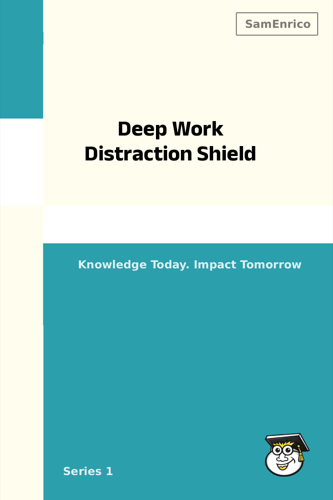
Deep Work Distraction Shield eBook
Creates uninterrupted focus blocks daily.
Creates uninterrupted focus blocks daily.
Formats
Free sample
Chapter 1: The Three-Headed Enemy--–- Consider the last time you tried to read a novel. Perhaps it was a gift, a book you had been meaning to read for months. You poured a cup of coffee, found a comfortable chair, and opened to page one. You read the first sentence. Then the second.
By the bottom of the first page, your hand twitched toward your phone. Just a quick check. Nothing important. You scrolled for thirty seconds, put the phone down, and returned to the book. You read two more paragraphs.
Another twitch. Another scroll. Twenty minutes later, you had read seven pages and checked your phone eleven times. You closed the book, convinced you were lazy, undisciplined, or broken.You are none of those things. You are neurologically trapped.This book is not about willpower.
It is not about morning routines, productivity hacks, or inspirational quotes pinned to your monitor. It is about building a Distraction Shield—a literal, engineered system of defense against the forces that have been deliberately designed to capture your attention. The shield has four layers: Internal Mindset, Environmental Design, Daily Scheduling, and Recovery. But before you can build the shield, you must understand the enemy. And the enemy is not your phone.
The enemy is not your lack of discipline. The enemy is not social media, your boss, or your children.The enemy is three-headed.This chapter presents the Unified Theory of Distraction, synthesizing research from neuroscience, cognitive psychology, and behavioral economics. You will learn why your brain has been rewired for skimming, why every notification costs you precious cognitive resources, and why you reach for your phone precisely when the work becomes difficult. More importantly, you will learn that distraction is not a moral failure—it is a predictable, multi-layered response to a world that has been optimized against your focus. And what has been learned can be unlearned.The First Head: Neuroplasticity and the Foraging Brain Let us begin with a history of the human mind.
For most of human existence, the dominant intellectual technology was the book. Not the e-book or the audiobook—the physical, linear, page-by-page book. The book taught the brain to think in straight lines. You started at the beginning, proceeded through the middle, and arrived at the end. Along the way, you held a single thread of argument or narrative in your working memory.
There were no hyperlinks. No notifications. No infinite scroll. Just you and the text.The book shaped the brain. This is not a metaphor.
Neuroplasticity—the brain's ability to rewire itself based on what you practice—means that the physical structure of your cortex changes depending on your habits of attention. If you spend hours each day reading long-form texts, your brain strengthens the neural pathways associated with sustained focus, deep comprehension, and linear thought. If you spend hours each day skimming, clicking, and switching between tabs, your brain strengthens the pathways associated with rapid scanning, task-switching, and shallow processing.Enter the internet.The internet is not a book. It is a foraging environment. Consider how you use the web: you land on a page, scan the headline, click a link, scan that page, check your email, return to the first page, click another link, check your phone, open a new tab, read two sentences, close the tab, check your phone again.
This is not a failure of attention. This is the design. Every link, every notification, every autoplay video is an invitation to forage. The business model of the attention economy depends on you foraging rather than reading. Every click is a micro-transaction of attention, and attention is the currency that fuels advertising.Nicholas Carr, in his seminal book The Shallows, documented what happens to the brain under these conditions.
He showed that the more time you spend foraging online, the harder it becomes to read long-form texts. Your brain literally loses the ability to hold a single thread of thought for extended periods. You are not imagining that you used to read novels more easily. You were reading them more easily—because your brain was trained differently. The internet has retrained it.The concept of cognitive load helps explain why.
Working memory—the part of your consciousness that holds and manipulates information in real time—has a finite capacity. The classic study by George Miller put that capacity at roughly seven items, plus or minus two. More recent research suggests the number is closer to four. Regardless of the exact number, the principle holds: you can only hold so much information in your mind at once.The internet is designed to exceed that capacity. A typical web page contains not just the article you intended to read, but also a sidebar of recommended articles, a header with navigation links, a footer with social media icons, a pop-up asking for your email address, a video that starts playing automatically in the corner, and three advertisements that shift and change as you scroll.
Your brain cannot ignore all of that. Every element competes for a slice of your cognitive load. The result is continuous partial attention—a state in which you are paying attention to everything and nothing at the same time.Here is the trap: you believe distraction is a moral failure. You tell yourself that if you just had more discipline, you could ignore the phone and focus on the book. But the problem is not your character.
The problem is that you have practiced distraction so many thousands of times that your neural pathways for focus have atrophied like an unused muscle. You are not weak. You are trained. And what has been trained can be retrained.The Second Head: Switch Cost and the Myth of the Multitasker The first head of the enemy is neurological: your brain has been rewired for foraging. The second head is cognitive: every time you switch tasks, you pay a tax.There is a persistent myth in modern culture that multitasking is efficient.
You see it in job descriptions that demand "excellent multitasking abilities." You hear it from colleagues who boast about answering emails during meetings while writing reports while eating lunch. You may even believe it yourself—that you are one of the rare people who can do two things at once without losing effectiveness.You cannot.The neuroscience of task-switching is unequivocal. When you shift from one task to another, your brain cannot snap instantly from A to B. It must go through a three-step process. First, disengagement: you must disengage your attention from Task A.
This sounds simple, but the brain does not release attention instantly. There is a lag, a lingering residue of the previous task. Second, goal shifting: you must activate the rules and context for Task B. This requires retrieving the relevant mental frameworks from long-term memory and loading them into working memory. Third, reorientation: you must reorient your attention to the specific next action within Task B.Each of these steps takes milliseconds.
The problem is that milliseconds add up. Research by Gloria Mark and her colleagues at the University of California, Irvine, found that it takes an average of twenty-three minutes to fully return to a…
This is the end of the free sample. Get the eBook to keep going. Buy now
About this book
Details
- Author
- Cloutier Emory
- Publisher
- SamEnrico
- Language
- English
- Genre
- Non-Fiction, Self-Help, Deep Work
- Released
- 2026-06-06
- Pages (approx.)
- 151
- Available as
- eBook, Audiobook

Read better in the ZLOADR app
Your eBooks on your phone or tablet. Sign in with your SamEnrico account and start reading.
More by Cloutier Emory
 Zumba Party In Motion GuideCloutier Emory$11.99
 Mindfulness for MenopauseCloutier Emory$11.99
 Anki For GeographyCloutier Emory$11.99
 Kalahari Bushman LifeCloutier Emory$11.99
 The OKR Accountability PartnerCloutier Emory$11.99
 Self Esteem for Return ParentsCloutier Emory$11.99
 Mind Mapping for BusinessCloutier Emory$11.99
 The Navigator of the Cosmos: Abd al-Rahman ibn Battuta's Epic Journey Across ContinentsCloutier Emory$11.99
 The Eagle and the Lion: Murat's Charge at Eylau (1807)Cloutier Emory$11.99
 How to Produce Racquetball and Squash GlovesCloutier Emory$11.99
 How to Produce Energy and Mineral EquipmentCloutier Emory$11.99
 DIY Event Decor Cheat SheetCloutier Emory$12.99
You may also like
 Hong Kong Handover 1997Dunn Johnnie$11.99
 Zumba For Postnatal Recovery CourseNeal Christian$11.99
 Zumba for BeginnersLadner Nikia$11.99
 YouTube Comment Mining GuideHumes Pandora$12.99
 Worry Box MeditationCarlin Rudy$11.99
 Workplace Stress MeditationNguyen Lynn$11.99
 Workplace Stress and Sleep RepairHawley Ivory$11.99
 Workplace Perfectionism CureDelaney Jeffry$11.99
 Workplace Injustice Anger GuideWallen Isabelle$11.99
 Work Addiction and Burnout LinkGreenwood Ester$11.99
 Women in Yoga and WellnessBeattie Galina$11.99
 Women in Stand Up ComedyChun Evangeline$11.99