
Non-FictionSelf-HelpHypnosis Scripts
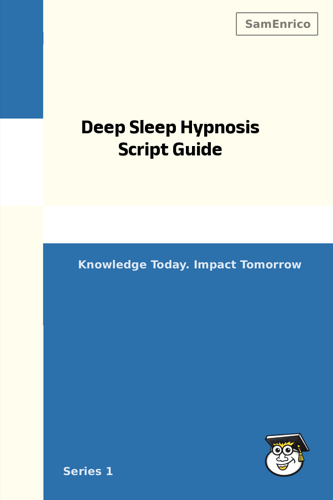
Deep Sleep Hypnosis Script Guide eBook
Provides read aloud scripts for self guided trance
Provides read aloud scripts for self guided trance.
Formats
Free sample
Chapter 1: The Voice in the Dark...--–- You are reading this because something has gone wrong with your sleep. Not the ordinary "I had a late night" kind of wrong. The kind where the bed becomes a battlefield. Where the hours between midnight and dawn stretch into something that feels like punishment. Where you have tried the things people suggest—melatonin, warm milk, no screens, earlier bedtimes—and none of them have worked the way you needed them to work.
You may have even tried medication. It worked for a while. Then it stopped working. Or it worked but left you feeling like a hollow version of yourself the next morning. Or you read the long-term studies and decided you did not want to trade sleep for dependency.This chapter is not another sleep hygiene lecture.
You will not be told to buy blackout curtains or a weighted blanket or a fifteen-hundred-dollar mattress. You will not be told to "just relax" as if that were a switch you could flip. What you will receive is something different: a explanation of why your own voice—spoken aloud, in the dark, with no audience except yourself—can do what pills and silence and white noise cannot. And at the end of this chapter, you will speak your first script. It will take two minutes.
You will not need to believe it will work. You will only need to say the words.The Problem That Sleep Hygiene Cannot Solve Let us begin with an uncomfortable truth: sleep hygiene is useful but incomplete. It tells you to keep your bedroom cool, dark, and quiet. It tells you to wake up at the same time every day. It tells you to avoid caffeine after 2 PM.
These are good instructions. They are not, however, sufficient for the person whose mind refuses to cooperate. You can have the perfect bedroom—blackout curtains, white noise machine, temperature precisely calibrated—and still lie awake because your brain is doing something that no curtain can block.The thing your brain is doing is called rumination. It is not simply thinking. Rumination is thinking that loops.
It is the replay of a conversation you had three days ago, the rehearsal of a conversation you will have tomorrow, the calculation of how many hours remain before your alarm goes off, and the judgment that you are failing at sleep because you are still awake to do that calculation. Rumination is the mind eating its own tail.Here is what happens neurologically. When you are awake and alert, your brain produces beta waves—fast, low-amplitude oscillations associated with focused attention and problem-solving. This is useful during the day. At night, beta waves are the enemy of sleep.
They keep your sympathetic nervous system engaged, which means your heart rate stays elevated, your muscles remain ready for action, and your cortisol levels do not fall the way they should. You are, in effect, lying perfectly still inside a body that is preparing for a threat.The standard solution offered by meditation and mindfulness is to observe your thoughts without engaging with them. This is excellent advice for someone who has already developed a meditation practice. For the insomniac, it often fails because observing thoughts requires a level of metacognitive distance that sleep deprivation actively destroys. The more tired you are, the harder it is to watch your thoughts without being pulled into them.
Telling a sleep-deprived person to "just observe" is like telling someone who is drowning to "just notice the water."There is another way. It does not require years of meditation. It does not require belief in anything mystical or supernatural. It requires only that you use a tool you already possess: your voice.Why Your Voice Works When Silence Fails The human brain has a finite amount of attentional bandwidth. You cannot fully focus on two demanding cognitive tasks at the same time.
This is why you cannot read a book and hold a conversation simultaneously. This is also why talking on the phone while driving is dangerous—your brain is dividing attention between language processing and road monitoring, and it does both less effectively than it would do either alone.This limitation is the foundation of self-hypnosis for sleep. When you speak aloud—or listen to a recording of your own voice speaking—you occupy the brain's language processing centers. You give them a task. That task consumes bandwidth.
And because your brain has limited bandwidth, it has less capacity left over for rumination. You are not fighting your thoughts. You are simply crowding them out, the way you might clear a crowded table by putting something larger on top of the pile.This is different from silent meditation in a critical way. In silent meditation, the instruction is to return your attention to your breath whenever you notice your mind wandering. This requires you to notice the wandering, which requires metacognitive awareness, which is precisely what exhausted people lack.
The voice-based method does not require you to notice anything. You simply speak the words. If your mind wanders while you are speaking, you continue speaking anyway. The voice continues to occupy the language centers regardless of whether your attention is wandering. The mechanism does not depend on your skill as a meditator.
It depends only on your willingness to make sound.You do not need a pleasant voice. You do not need a calm voice. You do not need to sound like a professional hypnotherapist. In fact, trying to sound calm often backfires because it adds performance pressure. The voice that works best is your ordinary voice—slightly tired, slightly flat, entirely unpolished.
That voice is already familiar to your brain. It does not trigger alertness or evaluation. It is simply the sound of you.The Hypnotic Crease: Where the Magic Happens There is a specific neurological state that sleep researchers call the hypnagogic state. It is the transition between wakefulness and sleep, the boundary region where thoughts become dreamlike, where you might experience sudden jerks (hypnic jerks), where time begins to behave strangely. In this state, your brain is producing theta waves—slower than beta, faster than the delta waves of deep sleep.
Theta is the frequency of hypnosis, of daydreaming, of the kind of absorbed attention where you lose track of your surroundings.The hypnagogic state is also where suggestions land most effectively. Your critical factor—the logical, analytical part of your mind that evaluates whether something is true or false—is partially offline. Not fully offline, because you are not yet asleep, but sufficiently relaxed that it stops arguing with everything it hears. When you speak a suggestion in the hypnagogic state, your brain absorbs it more like a memory than like an instruction. It does not ask "Is this true?" It simply files it away.Most people enter the hypnagogic state without realizing it.
It is the feeling of lying in bed, half-aware that you are still awake, but no longer caring. It is the moment when you lose track of whether you have been thinking for two minutes or twenty. The scripts in this book are designed to guide you into that state…
This is the end of the free sample. Get the eBook to keep going. Buy now
About this book
Details
- Author
- Lavigne Dotty
- Publisher
- SamEnrico
- Language
- English
- Genre
- Non-Fiction, Self-Help, Hypnosis Scripts
- Released
- 2026-06-09
- Pages (approx.)
- 138
- Available as
- eBook, Audiobook

Read better in the ZLOADR app
Your eBooks on your phone or tablet. Sign in with your SamEnrico account and start reading.
More by Lavigne Dotty
 Binge Eating Self Compassion CourseLavigne Dotty$11.99
 Personal Ing For Success Remote WorkersLavigne Dotty$11.99
 Morning Routine Distraction ShieldLavigne Dotty$11.99
 Cortisol and Brain Fog RecoveryLavigne Dotty$11.99
 The Last Oracle of Delphi: A Demand for TruthLavigne Dotty$11.99
 The Tides of Calculus: How a Forgotten Mathematician Charted the South China SeaLavigne Dotty$11.99
 How to Start a Fats (edible) Business (Beginners Guide)Lavigne Dotty$11.99
 Electric Linear Dichroism TechnicianLavigne Dotty$11.99
 SaaS Data Breach GuideLavigne Dotty$12.99
 Understanding Ectrodactyly PolydactylyLavigne Dotty$17.99
You may also like
 Hong Kong Handover 1997Dunn Johnnie$11.99
 Zumba For Postnatal Recovery CourseNeal Christian$11.99
 Zumba for BeginnersLadner Nikia$11.99
 YouTube Comment Mining GuideHumes Pandora$12.99
 Worry Box MeditationCarlin Rudy$11.99
 Workplace Stress MeditationNguyen Lynn$11.99
 Workplace Stress and Sleep RepairHawley Ivory$11.99
 Workplace Perfectionism CureDelaney Jeffry$11.99
 Workplace Injustice Anger GuideWallen Isabelle$11.99
 Work Addiction and Burnout LinkGreenwood Ester$11.99
 Women in Yoga and WellnessBeattie Galina$11.99
 Women in Stand Up ComedyChun Evangeline$11.99