
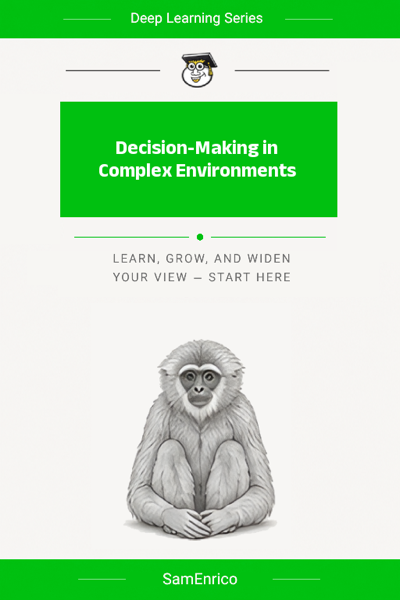
Decision-Making in Complex Environments
A Coursebook on Decision-Making in Complex Environ
A Coursebook on Decision-Making in Complex Environments
Formats
About this book
Free sample
Chapter 1: The Poker Paradigm--–- The conference room was silent. Twelve executives sat around a mahogany table, each holding a forty-page analysis prepared by a team of data scientists. The question before them was simple in form but monstrous in consequence: should the company acquire a smaller competitor for $400 million? The spreadsheets showed 18% projected returns. The consultants had run ten thousand Monte Carlo simulations.
The decision seemed clear.The CEO, a former chess champion in his youth, stood up. "The numbers don't lie," he said. "We have perfect information. We've modeled every variable. This is a chess move, and we're going to win."Eighteen months later, the acquisition had destroyed $1.2 billion in shareholder value.
The competitor's key technology was obsolete. A regulatory change no one had predicted made the business model illegal in three countries. And the CEO's career was over.He wasn't wrong because he made a bad decision. He was wrong because he was playing the wrong game.The Most Dangerous Mistake in Decision-Making Every day, in boardrooms, government agencies, hospitals, and living rooms, intelligent people make catastrophic decisions. They do not make these decisions because they are stupid, lazy, or uninformed.
They make them because they have been trained to play chess in a world that is actually poker.This distinction – between chess and poker – is the single most important concept in this entire book. If you understand nothing else, understand this: the tools and strategies that work brilliantly in complicated, predictable environments will destroy you in complex, uncertain ones. And most of the decisions that actually matter – the ones that shape your career, your company, your family's future – happen in the second type of environment.Let me prove this to you.Chess: The Beautiful Illusion Chess is a closed system. Every piece is visible to both players. Every rule is fixed and known.
There is no hidden information, no random chance, no unpredictable behavior from the pieces themselves. A pawn does not wake up one morning and decide to move diagonally three spaces because it "feels right." The board does not change size mid-game.In chess, if…
This is the end of the free sample. Get the eBook to keep going. Buy now
Contents
- Chapter 1
- Chapter 2
- Chapter 3
- Chapter 4
- Chapter 5
- Chapter 6
- Chapter 7
- Chapter 8
- Chapter 9
- Chapter 10
- Chapter 11
- Chapter 12
Details
- Author
- Pederson Kirstie
- Publisher
- SamEnrico
- Language
- English
- Genre
- Non-Fiction, Informative, Educational
- Released
- 2026-06-03
- Pages (approx.)
- 158
- Available as
- eBook, Audiobook

Read better in the ZLOADR app
Your eBooks on your phone or tablet. Sign in with your SamEnrico account and start reading.
More by Pederson Kirstie
 Imposter Syndrome For TherapistsPederson Kirstie$11.99
 Vacation Comparison SyndromePederson Kirstie$11.99
 Compulsive Gaming And ADHD GuidePederson Kirstie$11.99
 Cancel Culture Fear WorkbookPederson Kirstie$11.99
 The Rotavirus Vaccine GuidePederson Kirstie$11.99
 The Poverty Childhood WoundPederson Kirstie$11.99
 Postpartum Depression After LossPederson Kirstie$11.99
 Self Talk for Parenting PatiencePederson Kirstie$11.99
 Resilience JournalPederson Kirstie$11.99
 Rommel's Gambit: The Price of Sand and Steel in North AfricaPederson Kirstie$11.99
 Ravana's Last Gambit: The Asura King's Final StandPederson Kirstie$11.99
 Growing SmilacinaPederson Kirstie$11.99