
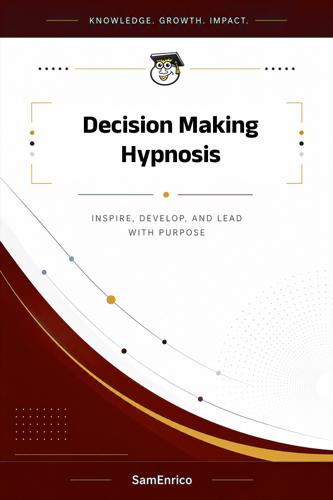
Decision Making Hypnosis eBook
Teaches scripting to clarify values and access inn
Teaches scripting to clarify values and access inner wisdom for choices.
Formats
Free sample
Chapter 1: The Straw Poll Fallacy...--–- Sarah had made fourteen pro/con lists. She had asked eleven friends, her mother, her therapist, and a stranger on an airplane. She had color-coded her options, assigned weighted scores, and even flipped a coin. The coin told her to take the job in Seattle. She flipped again.
The second coin told her to stay in Austin. She had been staring at both coins for twenty minutes, hoping they would fight to the death and spare her the trouble.The decision was not trivial. A promotion, a cross-country move, a relationship that would either deepen or dissolve, and a version of herself she had been chasing for five years. Every logical input suggested she should go. Better salary, better title, better weather.
And yet, every time she imagined saying yes, her stomach produced a sensation she could only describe as a quiet, insistent “no.” Not the dramatic no of panic. Not the fearful no of cowardice. A small, dense, heavy no that lived just below her sternum and refused to leave.She had been trying to think her way out of it for three weeks. And she was exhausted.If you have ever found yourself in Sarah’s chair – surrounded by data, opinions, and conflicting internal signals – this book is for you. But before we offer you a single technique or script, we must first tell you something that will sound like a paradox: the reason you cannot decide is not that you lack information.
It is that you have been asking the wrong part of your brain to make the call.The Myth of the Rational Decider We live in a culture that worships logic. From business schools to self-help blogs, the message is consistent: gather data, analyze objectively, list pros and cons, and the correct choice will emerge like a mathematical proof. This is called the rational decision-making model. It is taught in universities, practiced in boardrooms, and repeated in marriage counseling. It is also, for most of life’s important decisions, deeply flawed.Not wrong, necessarily.
But incomplete to the point of uselessness.The rational mind – what we will call throughout this book the Conscious Witness – is a remarkable evolutionary achievement. It can calculate, compare, and plan. It can delay gratification and override impulses. But it has a critical limitation that most self-help literature conveniently ignores: the Conscious Witness holds only a tiny fraction of the data required for a wise decision.How tiny? Neuroscientific estimates vary, but the consensus is striking.
The conscious mind processes approximately 40 to 60 bits of information per second. The subconscious mind, by contrast, processes approximately 11 million bits per second. This is not a metaphor. This is the current understanding of sensory and internal processing bandwidth. Your Conscious Witness is a bicycle.
Your subconscious is a space shuttle. And we have been asking the bicycle to navigate interstellar travel.The Straw Poll Fallacy Let us name this error. Call it the Straw Poll Fallacy.Imagine you are the mayor of a city of fifty thousand people. You need to make a decision that will affect every resident. You have the resources to ask exactly two people for their opinion.
Those two people are well-meaning, reasonably intelligent, and completely unrepresentative of the broader population. They are also exhausted, biased by their own recent experiences, and prone to forgetting what they ate for breakfast.If you based your decision solely on those two people, your constituents would rightly call you incompetent. And yet this is exactly what we do every time we rely on the Conscious Witness alone to make a significant choice. The Conscious Witness is not wrong. It is simply too small.
It holds your most recent thoughts, your loudest fears, your social conditioning, and maybe a few half-remembered facts from a podcast you listened to last week. It does not hold your body’s accumulated wisdom, your childhood learnings, your past successes and failures encoded as somatic memory, or the deep values that your subconscious has been tracking for decades.When you make a pro/con list, you are not gathering all the data. You are gathering the data that happens to be floating on the surface of your awareness at 10:47 on a Tuesday morning. That is not strategy. That is convenience masquerading as rigor.The Anatomy of Indecision Let us go deeper.
Why does indecision feel so terrible?The popular answer is that indecision is a lack of information. If you just knew more – more facts, more scenarios, more opinions – the answer would become clear. This is why people who are stuck often obsessively research. They read reviews, watch documentaries, interview friends, and scroll through Reddit threads until their eyes burn. And then, after all that research, they are still stuck.
Sometimes more stuck than before.This is because indecision is not an information problem. It is an agreement problem.Inside your nervous system, there are multiple systems that evaluate choices. The logical system (centered in the prefrontal cortex) evaluates based on abstract rules, future consequences, and social norms. The emotional system (centered in the limbic system) evaluates based on past experiences, somatic markers, and learned fears. The intuitive system (distributed throughout the body and brain) evaluates based on pattern recognition and values alignment.
These systems do not always agree.When they agree, you experience what we will call throughout this book Subcertainty: the profound peace of knowing a choice is right not because you can prove it logically, but because your entire neurology – mind, body, and subconscious – has voted yes. You feel it as a full-body alignment, a quiet settling, a sense of “oh, of course.”When they disagree, you experience indecision. And indecision is not a neutral state. It is an active conflict. Your logical system is pulling one direction while your emotional system is pulling another.
Your body is sending signals that your conscious mind cannot interpret. Your subconscious is shouting in a language you have never learned to speak. The result is not confusion. The result is a low-grade civil war.The Hypnotic Constant (Refined)At this point, some readers may be expecting us to say: “And that is why you need hypnosis. Hypnosis will fix everything.”Not exactly.Let us be precise about what we mean by hypnosis in this book, because the word has been stretched until it means almost nothing.
In popular culture, hypnosis is mind control, stage shows, and swinging pocket watches. In clinical practice, hypnosis is a state of focused attention, reduced peripheral awareness, and enhanced suggestibility. Both definitions are useful in their contexts. But for our purposes, we need a more specific framework.Throughout this book, we will use the term trance to refer only to a formal hypnotic state: eyes typically closed, an induction script, a deliberate invitation to the subconscious to step forward. Trance is a tool.
It is not something that happens to you. It is something you enter intentionally, like a quiet room.The rest of the time – when you are doom-scrolling, catastrophizing, ruminating, or making impulsive purchases at 2 AM – you are not in a trance. You are in what we will call a loop or a rut.…
This is the end of the free sample. Get the eBook to keep going. Buy now
About this book
Details
- Author
- Donahue Regena
- Publisher
- SamEnrico
- Language
- English
- Genre
- Non-Fiction, Self-Help, Decision
- Released
- 2026-06-08
- Pages (approx.)
- 145
- Available as
- eBook, Audiobook

Read better in the ZLOADR app
Your eBooks on your phone or tablet. Sign in with your SamEnrico account and start reading.
More by Donahue Regena
 Micronutrients For PMS Relief GuideDonahue Regena$11.99
 Secondary Sale TermsDonahue Regena$11.99
 Nap Timing Chronobiology GuideDonahue Regena$11.99
 MBSR for Political StressDonahue Regena$11.99
 Move Out Process GuideDonahue Regena$11.99
 Fibromyalgia WorkbookDonahue Regena$11.99
 Improv to SitcomDonahue Regena$11.99
 Caregiver for Stroke SurvivorsDonahue Regena$11.99
 The Phantom of the Paris Catacombs: The Unearthed Secrets of the City of the DeadDonahue Regena$11.99
 Excalibur’s Forgotten Guardian: The Enigma of Sir BalinDonahue Regena$11.99
 The Silent Conspiracy: Rome's Forgotten Plot Against CleopatraDonahue Regena$11.99
 Growing ZephyranthesDonahue Regena$11.99
You may also like
 Hong Kong Handover 1997Dunn Johnnie$11.99
 Zumba For Postnatal Recovery CourseNeal Christian$11.99
 Zumba for BeginnersLadner Nikia$11.99
 YouTube Comment Mining GuideHumes Pandora$12.99
 Worry Box MeditationCarlin Rudy$11.99
 Workplace Stress MeditationNguyen Lynn$11.99
 Workplace Stress and Sleep RepairHawley Ivory$11.99
 Workplace Perfectionism CureDelaney Jeffry$11.99
 Workplace Injustice Anger GuideWallen Isabelle$11.99
 Work Addiction and Burnout LinkGreenwood Ester$11.99
 Women in Yoga and WellnessBeattie Galina$11.99
 Women in Stand Up ComedyChun Evangeline$11.99