
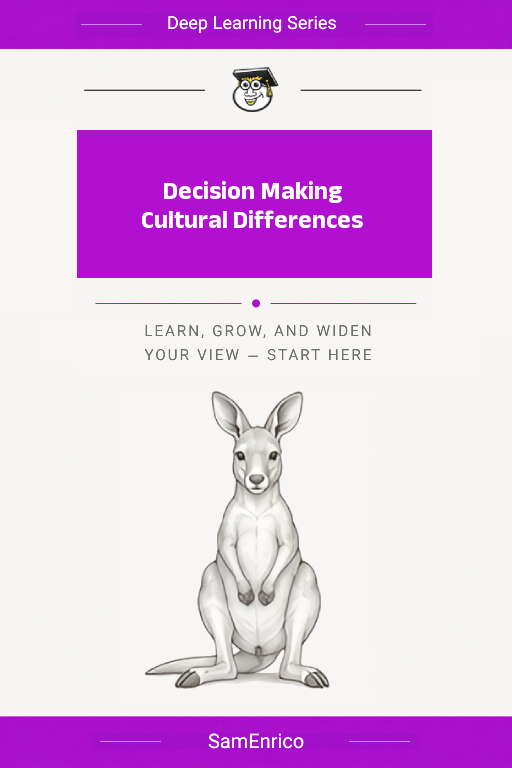
Non-FictionProfessional's Cheat Sheet
Decision Making Cultural Differences eBook
Expect top-down decisions in hierarchical cultures
by Cook Gilbert
Expect top-down decisions in hierarchical cultures, consensual in Japanese and Swedish cultures, and rapid individual decisions in American culture.
Formats
Free sample
Chapter 1: The Three Engines--The email arrived at 11:47 on a Tuesday morning. Maria Vasconcelos, the São Paulo–based head of Latin American operations for a Swedish-American medical devices firm, read it three times before the words stopped blurring.“The Fujimoto launch is delayed indefinitely. Please explain to your team why we missed the Q3 window.”She had not known the launch was in trouble. Twenty-four hours earlier, she had received a green light from her American counterpart in Chicago. Forty-eight hours before that, her Swedish supply chain lead had confirmed “all alignment completed.” And three weeks earlier, her Japanese manufacturing partners had stamped every document in the ringi process without a single objection.Everyone had agreed.
No one had decided.The delay cost $47 million in projected revenue. But the real loss was invisible: six months of trust between four offices that would never look at each other the same way again.Maria’s story is not unusual. It is not even remarkable by the standards of global business. What happened to her happens every day, in every industry, on every continent where humans try to make decisions across cultural lines. The only thing unusual about Maria’s case is that she eventually figured out why the system failed—and fixed it.This book is for everyone else who is still wondering why good people, working hard, with good intentions, cannot seem to decide anything together.The Hidden Structure Beneath Every Meeting Most leaders believe that decision-making is about logic.
Gather data, weigh options, choose the best path, execute. This belief is comforting, because it suggests that if we just get smarter people in the room, or better analytics, or more time, we will make better decisions.This belief is also wrong.Decisions are not primarily about logic. They are about process legitimacy—the often-invisible set of rules that determine whether a group accepts a decision as real, binding, and worth executing. And that process legitimacy is almost entirely cultural.Before a single piece of data is shared, before any option is weighed, before anyone says “I think we should…”—every person in every meeting has already answered four questions based on their cultural software:Who has the right to propose a decision?Who has the authority to finalize it?Who can block it, openly or silently?Who needs to be informed, and when?These four questions are never answered explicitly. They are assumed.
And when people from different cultures sit at the same table, their assumptions clash not with loud arguments but with silent, accumulating friction. The Swede waits for consensus that never comes. The American decides alone and never understands why no one follows. The Japanese executive nods politely, meaning “I hear you,” while the French manager hears “I agree.” The German prepares a decision memo assuming sign-off, while the Chinese team continues consulting higher authority.Nobody is wrong. Nobody is stupid.
Nobody is trying to fail.But the system fails anyway.The Three Engines: A New Way to See Decisions After studying decision-making across thirty-seven countries and analyzing more than two thousand cross-cultural team failures (and four hundred unexpected successes), a clear pattern emerged. Despite the infinite complexity of human culture, the way groups decide things falls into just three fundamental patterns. Call them engines.Every culture, every organization, every team runs on one dominant decision engine. Some run on a hybrid of two. But none run on all three equally.
And the single biggest predictor of cross-cultural decision failure is when people from different engine types assume everyone else is running on theirs.Here are the three engines.Engine One: The Top-Down Engine In hierarchical cultures—including China, Russia, France, Germany, the Middle East, and much of Latin America—decisions flow from the top down. A single leader or a small executive group holds legitimate authority. Subordinates do not expect to decide. They expect to receive orders, execute them, and be held accountable for execution, not for the wisdom of the decision itself.The Top-Down Engine is not authoritarian in the pathological sense. It is a culturally logical system optimized for three conditions that are common in high-power-distance societies: risk aversion, clear accountability, and respect for expertise as a function of rank.When failure is punished severely—as it is in many Asian and Middle Eastern business contexts—subordinates want clear authority above them.
Making a decision without explicit approval is not initiative; it is suicidal. The boss exists to absorb risk. The subordinate exists to execute. This division of labor is efficient, predictable, and deeply trusted by those who grew up inside it.The signature strength of the Top-Down Engine is vertical speed. Once the boss decides, implementation happens immediately, without debate, second-guessing, or passive resistance.
The signature weakness is bottleneck risk. If the boss is absent, uninformed, or indecisive, nothing moves.Engine Two: The Consensual Engine In consensus cultures—most famously Japan and Sweden, but also South Korea, Indonesia, and to varying degrees Germany and the Netherlands—decisions are treated as group property. No single person owns a decision. Instead, the group builds alignment over time, often through elaborate pre-decision processes, until everyone genuinely agrees.The Consensual Engine is often misunderstood by outsiders as slow, inefficient, or懦弱 (a Japanese word meaning “weak-willed”). This misunderstanding is costly.
Consensus cultures are not slow; they are pre-decision fast. They invest significant time upfront to achieve alignment so that execution can happen at lightning speed with zero backtracking, no passive resistance, and minimal need for coordination meetings.Japan’s Ringi system is the most formalized example. A proposal document (ringisho) circulates vertically and horizontally, collecting stamps (hanko) from every department and every level that might be affected. Behind the scenes, Nemawashi (“root-binding”) involves months of informal one-on-one conversations to build agreement before the formal process even begins. By the time a Japanese team holds a “decision meeting,” the decision has already been made.
The meeting is not for debate; it is for ratification.Sweden’s diskuterar culture is less formal but equally powerful. Meetings begin with open discussion where every voice is expected to speak. No one dominates. No one votes. The group talks until alignment emerges naturally.
A Swedish manager who ends a meeting without consensus has failed—not because the decision was wrong, but because the process was incomplete.The signature strength of the Consensual Engine is horizontal reliability. Once consensus is achieved, execution is unanimous, enthusiastic, and self-correcting. The signature weakness is entry friction. Outsiders who do not understand the pre-decision phase will mistake silence for indecision and try to force premature commitments.Engine Three: The Individualistic Engine In individualist cultures—the United States above all, but also Australia, Canada, and the United Kingdom—decisions are owned by individuals. A single person decides, often quickly, with limited consultation, and then announces the decision to others.
Accountability is personal and unmistakable. Praise and blame land on one person’s shoulders.The Individualistic Engine emerged from a specific cultural history: frontier expansion (where lone pioneers made life-or-death calls without committees), low uncertainty avoidance (a tolerance for being wrong and correcting quickly), and meritocratic ideology (rewarding those who act decisively, regardless of rank). In the American business context, this engine has…
This is the end of the free sample. Get the eBook to keep going. Buy now
About this book
Details
- Author
- Cook Gilbert
- Publisher
- SamEnrico
- Language
- English
- Genre
- Non-Fiction, Professional's Cheat Sheet
- Released
- 2026-05-30
- Pages (approx.)
- 142
- Available as
- eBook, Audiobook

Read better in the ZLOADR app
Your eBooks on your phone or tablet. Sign in with your SamEnrico account and start reading.
More by Cook Gilbert
 Les Misérables Original CastCook Gilbert$11.99
 Injury Pain Management HypnosisCook Gilbert$11.99
 Workplace Accommodations GuideCook Gilbert$11.99
 Tape Trace Evidence GuideCook Gilbert$11.99
 Pregnancy Loss And WorkCook Gilbert$11.99
 Holden Roberto FNLA AngolaCook Gilbert$11.99
 SRS For ProfessionalsCook Gilbert$11.99
 Child Loss And Sleep DisturbanceCook Gilbert$11.99
 Da Vinci’s Flying Machines: The Renaissance DreamerCook Gilbert$11.99
 The Clockwork Genius of Benjamin Banneker: Sundials, Almanacs, and the Birth of American PrecisionCook Gilbert$11.99
 How to Start a Commercial Bakeries BusinessCook Gilbert$11.99
 How to Produce Scratch RepairCook Gilbert$11.99
You may also like
 Hong Kong Handover 1997Dunn Johnnie$11.99
 Zumba For Postnatal Recovery CourseNeal Christian$11.99
 Zumba for BeginnersLadner Nikia$11.99
 YouTube Comment Mining GuideHumes Pandora$12.99
 Worry Box MeditationCarlin Rudy$11.99
 Workplace Stress MeditationNguyen Lynn$11.99
 Workplace Stress and Sleep RepairHawley Ivory$11.99
 Workplace Perfectionism CureDelaney Jeffry$11.99
 Workplace Injustice Anger GuideWallen Isabelle$11.99
 Work Addiction and Burnout LinkGreenwood Ester$11.99
 Women in Yoga and WellnessBeattie Galina$11.99
 Women in Stand Up ComedyChun Evangeline$11.99