
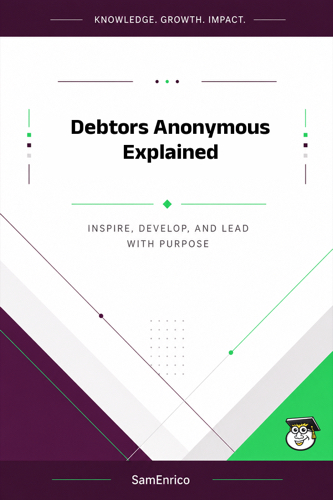
Non-FictionSelf-HelpDebt Recovery
Debtors Anonymous Explained eBook
Use twelve steps to stop compulsive debting, spend
Use twelve steps to stop compulsive debting, spending, and underearning behaviors.
Formats
Free sample
Chapter 1: The Unseen Illness...–- Most people believe that if you cannot manage your money, you simply need better information. They think you need a spreadsheet, a budgeting app, or a stern talking-to from a financial advisor. This book exists because that belief is catastrophically wrong.You are reading this for one of three reasons. Either you have tried every financial system and failed. Or you are watching someone you love destroy their life with debt while insisting they are fine.
Or you have a secret suspicion that something deeper than poor math skills is driving your financial chaos. Whatever brought you here, the truth is the same: your problem is not your bank account. Your problem is an illness that masquerades as irresponsibility.Debtors Anonymous is not a budgeting club. It is not a credit counseling service. It is not a get-out-of-debt-quick scheme.
It is a Twelve Step recovery program modeled on Alcoholics Anonymous, adapted specifically for people who cannot stop incurring unsecured debt, who cannot stop spending money they do not have, or who cannot stop earning far less than they need. The fellowship has existed since the 1970s, has helped hundreds of thousands of people worldwide, and operates on a simple but radical premise: compulsive debting is a progressive, potentially fatal illness that can be arrested through spiritual means—not mathematical ones.Before you close this book because you heard the word “spiritual,” hear this. You do not need to believe in God. You do not need to join a religion. You do not need to speak in tongues or sit in a pew.
The word “spiritual” in this context simply means something beyond your own willpower. Because your willpower has already failed. If it had worked, you would not be holding this book.The Threefold Illness Every compulsive debtor lives with a three-part condition that affects their body, their emotions, and their spirit. Until you understand all three layers, you will keep trying to fix the wrong problem.The physical component is the simplest to describe and the hardest to explain to someone who does not share it. It is an irresistible urge to incur debt.
Not to spend money you have. Not to invest wisely. To incur debt. There is a specific physiological experience associated with signing for a loan, swiping a credit card, or clicking “buy now, pay later.” Some debtors describe it as a rush of warmth. Others call it relief.
Many say it feels like taking a deep breath after holding it for hours. Whatever the sensation, it is real, it is physical, and it is followed by a predictable crash.The emotional component is the roller coaster. First comes the temporary relief from whatever pain you were feeling before the purchase—boredom, loneliness, anger, exhaustion, or even celebration. Then, days or weeks later, comes the arrival of the bill. And with that bill comes crushing remorse, shame, panic, and self-loathing.
You promise yourself you will never do it again. You mean it. You absolutely mean it. And then something triggers the urge, and you do it again. The emotional whiplash between the high of acquisition and the low of the bill is exhausting.
It is also addictive.The spiritual component is the most overlooked and the most important. Beneath the debt and the spending and the underearning lies a fundamental feeling of emptiness. It is a void that no purchase can fill, no possession can satisfy, and no achievement can permanently seal. Compulsive debters try to fill this void with things. They buy clothes, electronics, cars, houses, dinners, vacations, gifts, and garbage.
And every time, the void grows larger. The spiritual component is the belief that you are not enough—not rich enough, not worthy enough, not lovable enough—and that the next purchase will finally prove otherwise. It never does.This threefold illness is why financial literacy fails. You can teach a compulsive debtor how to budget. You can hand them a spreadsheet.
You can explain compound interest until you are blue in the face. They already know. Most compulsive debtors are intelligent, educated, and fully aware that credit card interest is destroying them. Knowledge is not the missing ingredient. The missing ingredient is the power to stop when the urge arrives.The Myth of the Normal Spender Here is the central analogy that drives all Twelve Step recovery.
Imagine two people at a wedding. The first person has a glass of champagne, toasts the couple, and puts the glass down. They do not think about alcohol again for weeks. The second person has a glass of champagne, and their entire nervous system lights up. They need another.
They start scanning the room for the bar. They calculate how many drinks they can have before someone notices. These two people are not having the same experience. The first person is a normal drinker. The second person is an alcoholic.Now apply that same logic to money.
A normal person can carry a credit card, use it for groceries, pay it off at the end of the month, and feel nothing more than convenience. A compulsive debtor cannot do that. The moment they have access to unsecured credit, something shifts. They start justifying small purchases. Then larger ones.
They tell themselves they will pay it off next month. Next month becomes next year. The balance grows. They take out a second card to pay the first. They consolidate.
They borrow from friends. They lie. They hide bills. They are not having the same experience as the normal person.This is not a moral failing. It is not laziness.
It is not a character flaw. It is an illness. And like any illness, it requires treatment, not shame.The most dangerous lie in our culture is that everyone uses credit the same way. They do not. For the normal person, credit is a tool.
For the compulsive debtor, credit is a drug. Unsecured debt—credit cards, payday loans, borrowing from family, unpaid medical bills, any debt not backed by a tangible asset—is the substance to which the debtor is allergic. One is too many, and a thousand is never enough.The Failure of Willpower If you are reading this, you have likely tried to stop. You have made resolutions. You have cut up credit cards.
You have frozen them in blocks of ice. You have unsubscribed from shopping emails. You have installed budgeting apps. You have promised your spouse, your parents, your children, and your God that you would change. And then, in a moment you cannot fully explain, you did it again.This is not because you are weak.
It is because you are trying to fight an illness with willpower. Willpower is a finite resource. It runs out when you are tired, hungry, lonely, or angry. The urge to incur debt does not run out. It waits.
It watches. And the moment your guard drops, it strikes.Alcoholics Anonymous understood this a century ago. They realized that alcoholics could not simply decide to stop drinking. Their willpower had been defeated too many times. What they needed was a complete psychic change—a spiritual awakening—that would remove the obsession to drink.…
This is the end of the free sample. Get the eBook to keep going. Buy now
About this book
Details
- Author
- Goldsmith Dung
- Publisher
- SamEnrico
- Language
- English
- Genre
- Non-Fiction, Self-Help, Debt Recovery
- Released
- 2026-06-06
- Pages (approx.)
- 133
- Available as
- eBook, Audiobook

Read better in the ZLOADR app
Your eBooks on your phone or tablet. Sign in with your SamEnrico account and start reading.
More by Goldsmith Dung
 Design Thinking for Campus PlanningGoldsmith Dung$11.99
 Virtual Whiteboard ToolsGoldsmith Dung$11.99
 Legacy Through MentoringGoldsmith Dung$11.99
 Mining Shift Sleep GuideGoldsmith Dung$11.99
 NVC for Difficult FamilyGoldsmith Dung$11.99
 Financial Savings From QuittingGoldsmith Dung$11.99
 Parent Energy ManagementGoldsmith Dung$11.99
 Hakeem the Conqueror: The Rise of a Nigerian NBA LegendGoldsmith Dung$11.99
 Florence's Golden Light: The Inventors Who Lit Up the RenaissanceGoldsmith Dung$11.99
 Service Providers Guide to NephrologyGoldsmith Dung$11.99
 How to Produce Toy InstrumentsGoldsmith Dung$11.99
 A Collector's Handbook to the Hrg 1500 (1946-56)Goldsmith Dung$11.99
You may also like
 Hong Kong Handover 1997Dunn Johnnie$11.99
 Zumba For Postnatal Recovery CourseNeal Christian$11.99
 Zumba for BeginnersLadner Nikia$11.99
 YouTube Comment Mining GuideHumes Pandora$12.99
 Worry Box MeditationCarlin Rudy$11.99
 Workplace Stress MeditationNguyen Lynn$11.99
 Workplace Stress and Sleep RepairHawley Ivory$11.99
 Workplace Perfectionism CureDelaney Jeffry$11.99
 Workplace Injustice Anger GuideWallen Isabelle$11.99
 Work Addiction and Burnout LinkGreenwood Ester$11.99
 Women in Yoga and WellnessBeattie Galina$11.99
 Women in Stand Up ComedyChun Evangeline$11.99