
Non-FictionCapital & Valuation RegisterLegal Finance
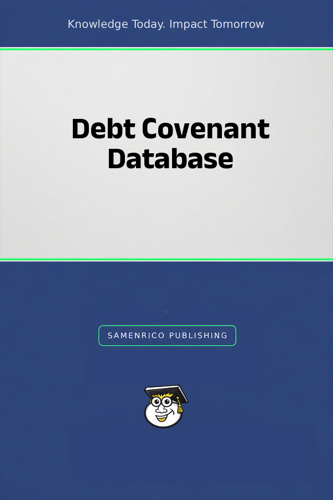
Debt Covenant Database
Compiles common maintenance and incurrence covenan
Compiles common maintenance and incurrence covenants across industries.
Formats
About this book
Free sample
Chapter 1: The 2 AM Phone Call--The phone rang at 2:14 AM on a Tuesday. Sarah Chen, CFO of a $400 million manufacturing company, knew before she picked up that something had gone terribly wrong. Her company had missed a debt covenant. Not because they were insolvent. Not because they had missed an interest payment.
They had missed it because an auditor had reclassified $12 million of short-term debt as long-term debt – a change that improved their accounting but violated a technical definition in their credit agreement. The lender was demanding full repayment within 30 days. Sarah had never heard of the covenant that killed her company. That was the problem.This book exists because Sarah's story happens thousands of times each year. And in almost every case, the covenant that triggered the crisis was not mysterious, hidden, or unusually aggressive.
It was sitting in plain sight, in a credit agreement that someone had signed, reviewed by lawyers, and filed with the SEC. But no one had built a database to track it. No one had coded the trigger. No one had asked the simple question: What happens if this number moves by 10 percent?The Birth of the Covenant: From a Handshake to a Hundred Pages Before we build a database, we must understand what we are codifying. The debt covenant – a promise made by a borrower to a lender – has existed in some form for as long as lending itself.
Ancient Mesopotamian clay tablets record pledges of collateral. Medieval Italian bankers demanded personal guarantees. But the modern covenant, the kind that fills 150-page credit agreements and triggers multi-billion-dollar restructurings, is a creature of the late twentieth century.The Negative Pledge Era (1960–1980)In 1965, a typical corporate bond indenture was fewer than twenty pages. The primary covenant, if any existed at all, was the negative pledge. This was a simple promise: "The borrower will not pledge its assets to another lender without equally securing this debt." That was it.
No financial ratios. No maintenance tests. No sweeps of excess cash flow. The logic was straightforward: if the company stayed solvent and paid its interest, lenders had little…
This is the end of the free sample. Get the eBook to keep going. Buy now
Contents
- Chapter 1
- Chapter 2
- Chapter 3
- Chapter 4
- Chapter 5
- Chapter 6
- Chapter 7
- Chapter 8
- Chapter 9
- Chapter 10
- Chapter 11
- Chapter 12
Details
- Author
- Justus Shelby
- Publisher
- SamEnrico
- Language
- English
- Genre
- Non-Fiction, Capital & Valuation Register, Legal Finance
- Released
- 2026-06-09
- Pages (approx.)
- 155
- Available as
- eBook, Audiobook

Read better in the ZLOADR app
Your eBooks on your phone or tablet. Sign in with your SamEnrico account and start reading.
More by Justus Shelby
 Gluten Sensitivity Self Diagnosis GuideJustus Shelby$11.99
 TikTok Teen Addiction Recovery HandbookJustus Shelby$11.99
 Vision Loss Household ChoresJustus Shelby$11.99
 Parental Addiction and ReunificationJustus Shelby$11.99
 The LEGO Brick That Changed the World: A Tiny Invention's Big StoryJustus Shelby$11.99
 The Last Supper Club: How a Secret Dining Society Shaped Modern CuisineJustus Shelby$11.99
 Multiple Choice Navigation TipsJustus Shelby$12.99
 Business Credit vs Revenue GuideJustus Shelby$12.99
 How to Start a Potted Meat. Business (Beginners Guide)Justus Shelby$11.99
 Cornhole Board MakerJustus Shelby$11.99
You may also like
 Hong Kong Handover 1997Dunn Johnnie$11.99
 Zumba For Postnatal Recovery CourseNeal Christian$11.99
 Zumba for BeginnersLadner Nikia$11.99
 YouTube Comment Mining GuideHumes Pandora$12.99
 Worry Box MeditationCarlin Rudy$11.99
 Workplace Stress MeditationNguyen Lynn$11.99
 Workplace Stress and Sleep RepairHawley Ivory$11.99
 Workplace Perfectionism CureDelaney Jeffry$11.99
 Workplace Injustice Anger GuideWallen Isabelle$11.99
 Work Addiction and Burnout LinkGreenwood Ester$11.99
 Women in Yoga and WellnessBeattie Galina$11.99
 Women in Stand Up ComedyChun Evangeline$11.99