
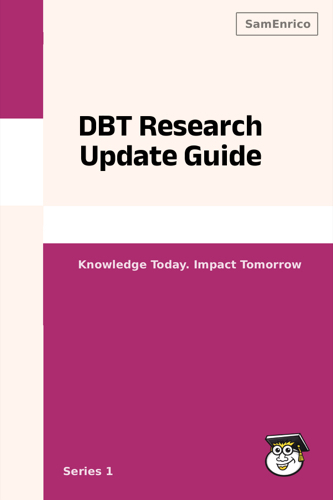
DBT Research Update Guide
Review latest studies on emotion regulation effect
by Levy Joel
Review latest studies on emotion regulation effectiveness.
Formats
About this book
Free sample
Chapter 1: The BPD Prison Break...--For nearly three decades, if a clinician said "dialectical behavior therapy," the immediate follow‑up question was almost always the same: "For which borderline patient?" The assumption was so deeply embedded in clinical training that DBT and borderline personality disorder became nearly synonymous. Referral forms specified "DBT – BPD only." Insurance authorizations required a BPD diagnosis. Training programs taught DBT as a specialized treatment for a specific population. And for years, that made sense. Marsha Linehan developed DBT for chronically suicidal women with BPD, and the early efficacy trials were rightly focused on that group.But the research of the last five years—particularly the systematic review and meta‑synthesis by Hall and colleagues (2025)—has fundamentally overturned that assumption.
The evidence now shows that emotion dysregulation, not BPD diagnosis, is the true target of DBT. And emotion dysregulation cuts across diagnostic boundaries in ways that the field is only beginning to appreciate. This chapter dismantles the historical link between DBT and BPD, introduces the transdiagnostic revolution, and provides a practical framework for determining when DBT is indicated regardless of what is written on the patient's intake form.The Historical Accident: How DBT Got Linked to BPDIt is worth understanding, briefly, how the field arrived at this narrow view. When Linehan published her first randomized controlled trial of DBT for BPD in 1991, the choice of population was not arbitrary. BPD is characterized by profound emotion dysregulation, impulsive self‑harm, and chronic suicidality—precisely the problems that DBT's skill‑based approach was designed to address.
The trial showed striking effects: DBT reduced suicide attempts, self‑harm episodes, and psychiatric hospitalizations compared to treatment as usual. Over the following decade, replications accumulated. By 2010, DBT was the gold‑standard psychosocial treatment for BPD, recognized by the American Psychological Association and the National Institute for Health and Care Excellence.But here is the crucial point that the field missed: the success of DBT for BPD did not mean that DBT was exclusively for BPD. It meant that DBT worked for a disorder defined by emotion dysregulation. The natural next question—"Does DBT work for…
This is the end of the free sample. Get the eBook to keep going. Buy now
Contents
- Chapter 1
- Chapter 2
- Chapter 3
- Chapter 4
- Chapter 5
- Chapter 6
- Chapter 7
- Chapter 8
- Chapter 9
- Chapter 10
- Chapter 11
- Chapter 12
Details

Read better in the ZLOADR app
Your eBooks on your phone or tablet. Sign in with your SamEnrico account and start reading.
More by Levy Joel
 Anger-Free Parenting of Neurodivergent KidsLevy Joel$11.99
 The IBS Food Intolerance GuideLevy Joel$11.99
 Jealousy Workbook GuideLevy Joel$11.99
 The Values And Mission Alignment StrategyLevy Joel$11.99
 Baba Yaga's Apprentice: The Witch Who Tamed the ForestLevy Joel$11.99
 No Money Idea Validation GuideLevy Joel$12.99
 Agricultural Export Payment GuideLevy Joel$12.99
 Understanding Thoracopelvic DysostosisLevy Joel$17.99
 Receiving CoordinatorLevy Joel$11.99
You may also like
 Scientific Research On TM GuideMartens Nathanial$11.99
 Research Proposal Methodology Section MasteryPauley Debroah$11.99
 Research Proposal Appendix CompilationRaines Tyisha$11.99
 Academic Researcher Distraction GuideFord Virgil$11.99
 TM Research and ScienceCovert Nicki$11.99
 Social Anxiety Research ReviewRoberge Cole$11.99
 Research Proposal Significance Section GuideBock Tory$12.99
 Research Proposal Reviewer PsychologyLugo Tawanda$11.99
 Research Proposal Research Questions DesignLara Robbi$11.99
 Research Proposal References and CitationsPatten Shanice$11.99
 Research Proposal Mixed Methods DesignCameron Omega$11.99
 Research Proposal Data Management PlanAnderson Roberto$12.99